. 2017 May 19:8:14998.
doi: 10.1038/ncomms14998.

Dual-stimuli responsive and reversibly activatable theranostic nanoprobe for precision tumor-targeting and fluorescence-guided photothermal therapy

Affiliations

Dual-stimuli responsive and reversibly activatable theranostic nanoprobe for precision tumor-targeting and fluorescence-guided photothermal therapy

Xu Zhao et al. Nat Commun. .

Abstract

The integrated functions of diagnostics and therapeutics make theranostics great potential for personalized medicine. Stimulus-responsive therapy allows spatial control of therapeutic effect only in the site of interest, and offers promising opportunities for imaging-guided precision therapy. However, the imaging strategies in previous stimulus-responsive therapies are 'always on' or irreversible 'turn on' modality, resulting in poor signal-to-noise ratios or even 'false positive' results. Here we show the design of dual-stimuli-responsive and reversibly activatable nanoprobe for precision tumour-targeting and fluorescence-guided photothermal therapy. We fabricate the nanoprobe from asymmetric cyanine and glycosyl-functionalized gold nanorods (AuNRs) with matrix metalloproteinases (MMPs)-specific peptide as a linker to achieve MMPs/pH synergistic and pH reversible activation. The unique activation and glycosyl targetibility makes the nanoprobe bright only in tumour sites with negligible background, while AuNRs and asymmetric cyanine give synergistic photothermal effect. This work paves the way to designing efficient nanoprobes for precision theranostics.


Conflict of interest statement

The authors declare no competing financial interests.

Figures
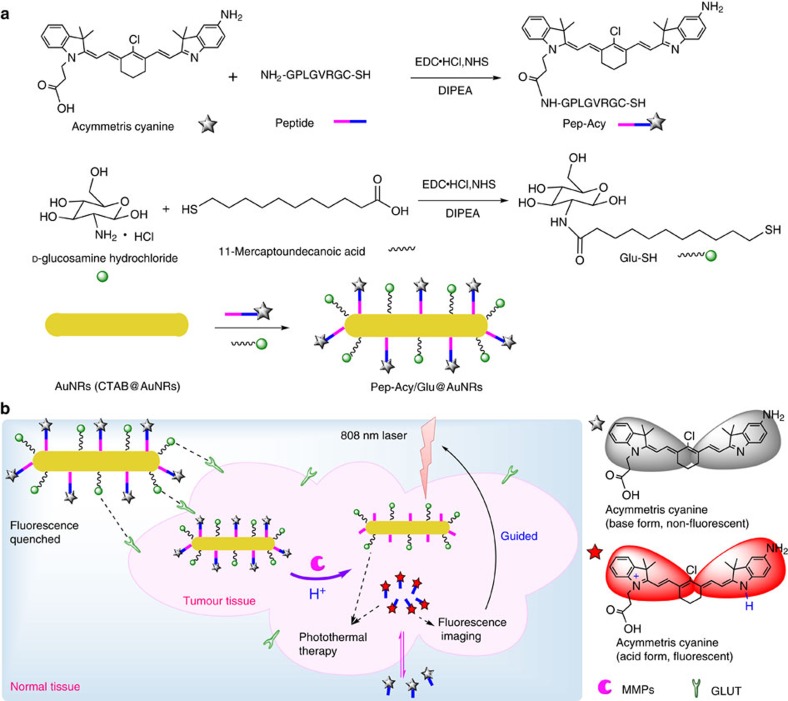
Figure 1
Figure 1. Synthesis and functionalization of the theranostic nanoprobe.
(a) Schematic representation of the design strategy and synthesis route. (b) Illustration of the nanoprobe as a MMPs/pH dual-stimuli synergistically and pH reversibly activated theranostic platform for in vivo tumour-targeted precision imaging-guided photothermal therapy.
Figure 2
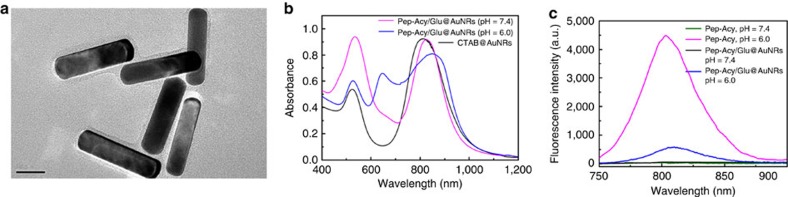
Figure 2. Characterization of the functionalized AuNRs.
(a) TEM images of Pep-Acy/Glu@AuNRs (Scale bar, 20 nm). (b) UV-vis-NIR spectra of Pep-Acy/Glu@AuNRs and CTAB@AuNRs. (c) Fluorescence spectra of Pep-Acy and Pep-Acy/Glu@AuNRs.
Figure 3
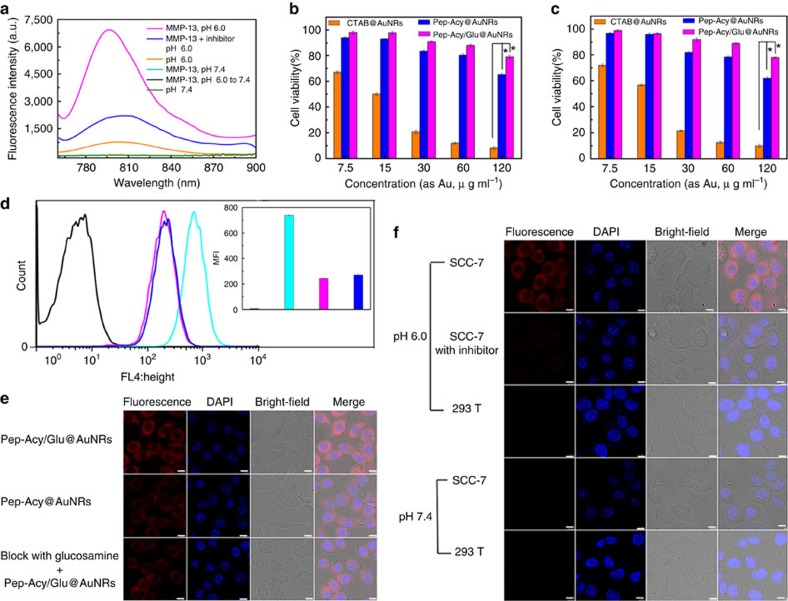
Figure 3. In vitro evaluation of Pep-Acy/Glu@AuNRs.
(a) Responses of the fluorescence spectra of Pep-Acy/Glu@AuNRs to MMP-13 and pH with or without inhibitor. (b,c) Cells cytotoxicity of CTAB@AuNRs, Pep-Acy@AuNRs and Pep-Acy/Glu@AuNRs against SCC-7 and 293T cells, respectively (n=5, *P<0.05). (d) Flow cytometry analysis. Inset: Corresponding mean fluorescent intensity (MFI). Cyan and magenta: SCC-7 cells treated with Pep-Acy/Glu@AuNRs (cyan) and Pep-Acy@AuNRs (magenta), respectively. Blue: Glucosamine per-blocked SCC-7 cells treated with Pep-Acy/Glu@AuNRs. Black: SCC-7 cells without treatment. (e) Cell internalization of Pep-Acy/Glu@AuNRs towards SCC-7 (Scale bar, 10 μm). (f) Cell imaging of Pep-Acy/Glu@AuNRs towards SCC-7, 293T and inhibitor pretreated SCC-7 cells (Scale bar, 10 μm). Center values and error bars are defined as mean and s.d., respectively. Statistical significance is assessed by a two-factor analysis of variance (two-way ANOVA).
Figure 4
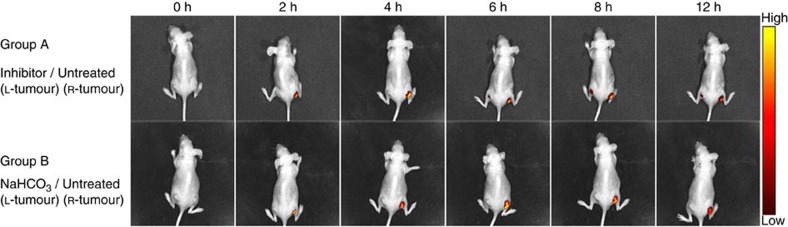
Figure 4. Pep-Acy/Glu@AuNRs-mediated in vivo fluorescence images in SCC-7 tumour-bearing mice.
L-tumour was pre-treated with MMPs inhibitor (Group A) or NaHCO3 (Group B). Images were acquired using an IVIS Lumina II in vivo imaging system.
Figure 5
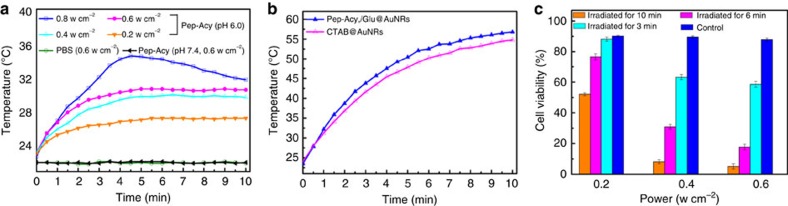
Figure 5. In vitro photothermal effects.
(a) Temperature change curves of Pep-Acy and PBS upon 808 nm laser irradiation. (b) Temperature change curves of Pep-Acy/Glu@AuNRs and CTAB@AuNRs upon 808 nm laser irradiation at 0.6 w cm−2. (c) Cell viability of Pep-Acy/Glu@AuNRs with 808 nm laser irradiation against SCC-7 cells (Control: 808 nm laser irradiation (0.6 w cm−2, 10 min) without Pep-Acy/Glu@AuNRs). Error bars are defined as s.d.
Figure 6
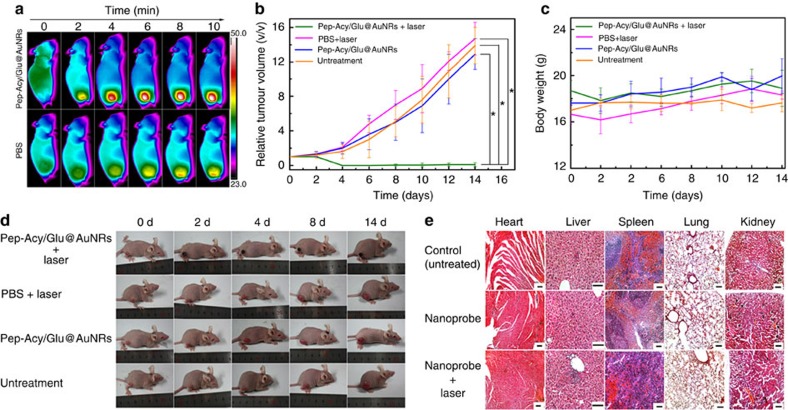
Figure 6. Pep-Acy/Glu@AuNRs-mediated in vivo photothermal therapy in SCC-7 tumour-bearing mice models.
(a) Representative thermal images of mice (tumour sites) subjected to 808 nm laser irradiation for 4 h after intravenous injection of Pep-Acy/Glu@AuNRs and PBS. (b) Relative tumour volume change of each groups of mice (*P<0.05). (c) Body weight change curves of each groups of mice. (d) Representative photos of each group of mice during the whole therapy process. (e) H&E staining of main organs of each groups of mice after treatment (Scale bar, 100 μm). Center values and error bars are defined as mean and s.d., respectively. Statistical significance is assessed by two-way ANOVA.

References

    1. Guan M. et al. Multifunctional upconversion-nanoparticles-trismethylpyridylporphyrin-fullerene nanocomposite: a near-infrared light-triggered theranostic platform for imaging-guided photodynamic therapy. NPG Asia Mater. 7, e205 (2015).
    1. Chen X. Y., Gambhir S. S. & Cheon J. Theranostic nanomedicine. Acc. Chem. Res. 44, 841 (2011). - PubMed
    1. Li Y. P. et al. A smart and versatile theranostic nanomedicine platform based on nanoporphyrin. Nat. Commun. 5, 4712 (2014). - PMC - PubMed
    1. Lee D. E. et al. Multifunctional nanoparticles for multimodal imaging and theragnosis. Chem. Soc. Rev. 41, 2656–2672 (2012). - PubMed
    1. Wang H. et al. A biomimetic hybrid nanoplatform for encapsulation and precisely controlled delivery of theranostic agents. Nat. Commun. 6, 10081 (2015). - PMC - PubMed

Publication types

LinkOut - more resources