Mood, the Circadian System, and Melanopsin Retinal Ganglion Cells
- PMID: 28525301
- PMCID: PMC5654534
- DOI: 10.1146/annurev-neuro-072116-031324
Mood, the Circadian System, and Melanopsin Retinal Ganglion Cells
Abstract
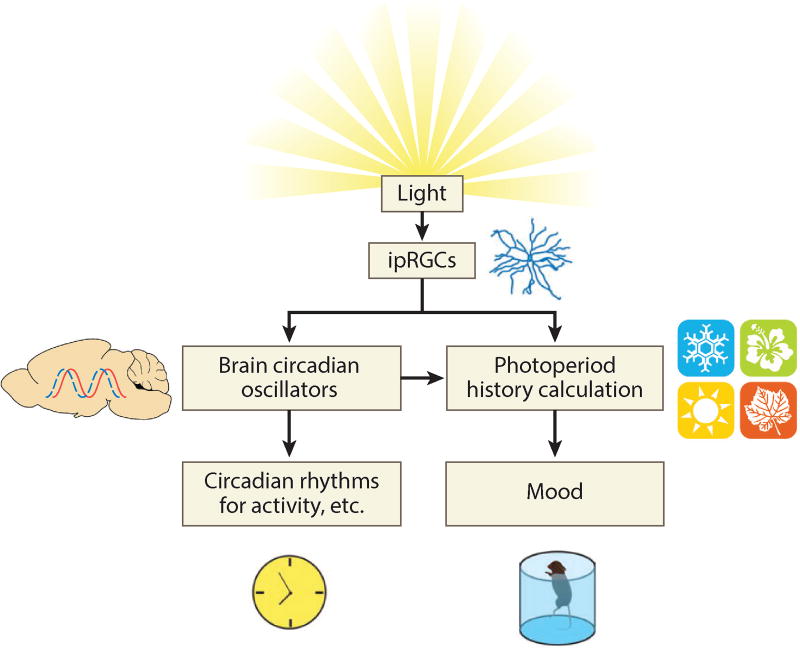
The discovery of a third type of photoreceptors in the mammalian retina, intrinsically photosensitive retinal ganglion cells (ipRGCs), has had a revolutionary impact on chronobiology. We can now properly account for numerous non-vision-related functions of light, including its effect on the circadian system. Here, we give an overview of ipRGCs and their function as it relates specifically to mood and biological rhythms. Although circadian disruptions have been traditionally hypothesized to be the mediators of light's effects on mood, here we present an alternative model that dispenses with assumptions of causality between the two phenomena and explains mood regulation by light via another ipRGC-dependent mechanism.
Keywords: circadian; ipRGC; light; mood; photoperiod; rhythms.
Figures
References
-
- Ashkenazy-Frolinger T, Kronfeld-Schor N, Juetten J, Einat H. It is darkness and not light: depression-like behaviors of diurnal unstriped Nile grass rats maintained under a short photoperiod schedule. J. Neurosci. Methods. 2010;186(2):165–70. - PubMed
Publication types
MeSH terms
Substances
Grants and funding
LinkOut - more resources
Full Text Sources
Other Literature Sources