


Varicella-zoster virus seroprevalence in children and adolescents in the pre-varicella vaccine era, Germany
- PMID: 28525973
- PMCID: PMC5438501
- DOI: 10.1186/s12879-017-2461-2
Varicella-zoster virus seroprevalence in children and adolescents in the pre-varicella vaccine era, Germany
Abstract
Background: In 2004, universal childhood varicella vaccination was introduced in Germany. We aimed to determine the age-specific prevalence of anti-varicella zoster virus (VZV) IgG-antibodies among children in the pre-varicella vaccine era in Germany, to identify factors associated with VZV seropositivity, and to assess the suitability of a commercially available ELISA for VZV seroepidemiological studies by comparing it with an in-house fluorescent antibody to membrane antigen test (FAMA) as the gold standard.
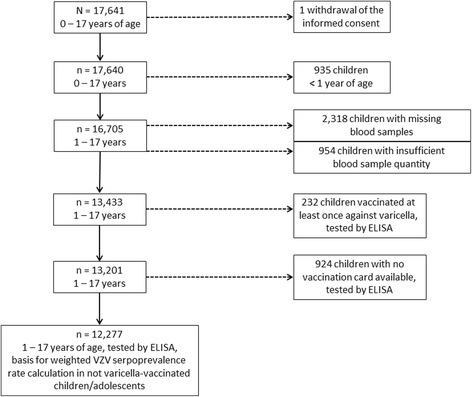
Methods: Serum samples of 13,433 children and adolescents aged 1-17 years included in the population-based German Health Interview and Examination Survey for Children and Adolescents (KiGGS; conducted 2003-2006) were tested for anti-VZV IgG by ELISA. All samples with equivocal ELISA results and a random selection of ELISA-negative and -positive samples were tested by FAMA. Statistical analyses were conducted using a weighting factor adjusting the study population to the total population in Germany. Seroprevalences were calculated as percentages (%) with a 95% confidence interval (CI). Odds ratios (OR) were computed by multivariate logistic regression to determine the association between socio-demographic factors and VZV seropositivity.
Results: The VZV seropositivity rate was 80.3% (95% CI: 79.3-81.3) in varicella-unvaccinated children and adolescents. VZV seropositivity rates differed significantly between age groups up to age 6 years, but not by gender. Of 118 retested serum samples with an equivocal ELISA result, 45.8% were FAMA-positive. The proportion of samples tested as false-negative in by ELISA varied by age group: 2.6% in children aged 1-6 and 9% in children aged 7-17 years. Multivariate analyses showed that age, having older siblings, and early daycare start were associated with seropositivity in preschoolers; migration background reduced the chance of VZV seropositivity in schoolchildren (OR: 0.65; 0.43-0.99) and adolescents (OR: 0.62; 0.4-0.97).
Conclusion: In the pre-varicella vaccine era, most children in Germany contracted varicella by age six. Schoolchildren with a migration background and children without siblings have an increased risk of being VZV seronegative and should be targeted for catch-up vaccination, if they have no history of chickenpox. ELISAs are suitable for use in population-level serosurveys on VZV, but samples with equivocal ELISA results should be retested by FAMA.
Keywords: Elisa; FAMA; Seroprevalence; Varicella vaccination; Varicella-zoster virus.
Figures


References
-
- German-Standing-Committee-on-Vacccination Empfehlungen der Ständigen Impfkommission (STIKO) am Robert Koch Institut/Stand: Juli 2004. Epidemiol Bull. 2004;30:235–250.
-
- German-Standing-Committee-on-Vacccination Empfehlungen der Ständigen Impfkommission (STIKO) am Robert Koch Institut/Stand: Juli 2009. Epidemiol Bull. 2009;30:279–298.
MeSH terms
Substances
LinkOut - more resources
Full Text Sources
Other Literature Sources
