


The basic research factors questionnaire for studying early childhood caries
- PMID: 28526003
- PMCID: PMC5437655
- DOI: 10.1186/s12903-017-0374-5
The basic research factors questionnaire for studying early childhood caries
Abstract
Background: We describe development of the Early Childhood Caries (ECC) Basic Research Factors Questionnaire (BRFQ), a battery of measures assessing common potential predictors, mediators, and moderators of ECC. Individual-, family-, and community-level factors that are linked to oral health outcomes across at-risk populations are included. Developing standard measures of factors implicated in ECC has the potential to enhance our ability to understand mechanisms underlying successful prevention and to develop more effective interventions.
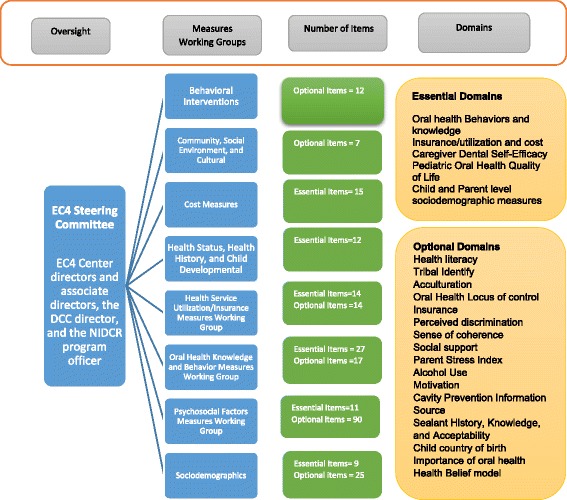
Methods: The Early Childhood Caries Collaborating Centers (EC4), funded by National Institute of Dental and Craniofacial Research, developed the BRFQ, which was used across four randomized trials to develop and test interventions for reducing ECC in at-risk populations. Forty-five investigators from across the centers and NIDCR were involved in the development process. Eight "measures working groups" identified relevant constructs and effective measurement approaches, which were then categorized as "essential" or "optional" common data elements (CDEs) for the EC4 projects.
Results: Essential CDEs include 88 items, with an additional 177 measures categorized as optional CDEs. Essential CDEs fell under the following domains: oral health knowledge, oral health behavior, utilization/insurance and cost, parent/caregiver dental self-efficacy, quality of life, caregiver and family characteristics, and child characteristics.
Conclusions: The BRFQ makes available a battery of measures that support efforts to understand population risk factors for ECC and to compare oral health outcomes across populations at risk. The BRFQ development process may be useful to other clinical research networks and consortia developing CDEs in other health research fields.
Trial registration: All the trial that used the BRFQ were registered at Clinicaltrial.gov NCT01116726 , April 29, 2010; NCT01116739 , May 3, 2010; NCT01129440 , May 21, 2010; and NCT01205971 , September 19, 2010.
Keywords: Children; Common data elements; Dental caries; Oral health; Parent/caregivers; Risk factors; Surveys.
Figures
References
MeSH terms
Associated data
Grants and funding
LinkOut - more resources
Full Text Sources
Other Literature Sources
Medical
Miscellaneous
