


Catching a floating thrombus; a case report on the treatment of a large thrombus in the ascending aorta
- PMID: 28526040
- PMCID: PMC5437532
- DOI: 10.1186/s13019-017-0600-x
Catching a floating thrombus; a case report on the treatment of a large thrombus in the ascending aorta
Abstract
Background: The ascending aorta is an uncommon site for non-infective thrombus. In non-aneurysmal and non-atherosclerotic vessels this condition becomes extremely rare, while it represents a source of potential cerebral and peripheral embolic events. Currently, there is no consensus in the guidelines on how to treat a free floating thrombus in ascending aorta, therefore we present our decision making process and therapeutic strategy.
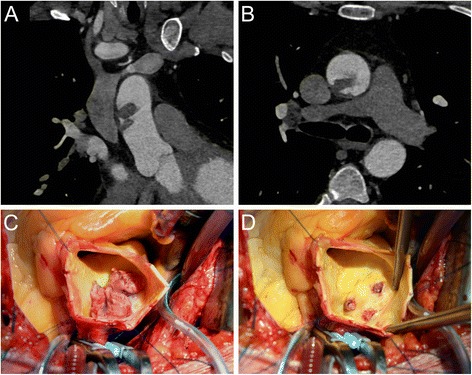
Case presentation: A healthy 48-year-old man was hospital admitted with acute abdominal pain. CT-scan showed a right renal embolism in presence of a defect in the distal ascending aorta suggestive for thrombus. After heart team discussion the patient was scheduled for surgery and successfully underwent an emergent thrombus removal. Also, owing to multiple aortic wall insertions, the ascending aorta was replaced. The patient's recovery was uneventful and histological examination showed no signs of connective tissue disorders of aortic wall while confirmed the thrombotic nature of the mass.
Conclusions: We present a patient with a floating thrombus in the ascending aorta who underwent an ascending aorta replacement. While angio-CT scan led to a prompt diagnosis, intraoperative epi-aortic echocardiography allowed to define precise location of thrombus, minimizing operative risk. This case demonstrates that multi-disciplinary heart team discussion is essential to define a successful strategy, that surgical treatment is feasible with specific tools such as epi-aortic echocardiography.
Keywords: Aortic disease; Ascending aorta; Case report; Floating thrombus.
Figures
References
-
- Erbel R, Aboyans V, Boileau C, Bossone E, Bartolomeo RD, Eggebrecht H, et al. 2014 ESC Guidelines on the diagnosis and treatment of aortic diseases: Document covering acute and chronic aortic diseases of the thoracic and abdominal aorta of the adult. The Task Force for the Diagnosis and Treatment of Aortic Diseases of the European Society of Cardiology (ESC) Eur Heart J. 2014;35(41):2873–2926. doi: 10.1093/eurheartj/ehu281. - DOI - PubMed
Publication types
MeSH terms
LinkOut - more resources
Full Text Sources
Other Literature Sources
Medical
