


Erythrocytosis Following Testosterone Therapy
- PMID: 28526632
- PMCID: PMC5690890
- DOI: 10.1016/j.sxmr.2017.04.001
Erythrocytosis Following Testosterone Therapy
Abstract
Introduction: A rapid increase in awareness of androgen deficiency has led to substantial increases in prescribing of testosterone therapy (TTh), with benefits of improvements in mood, libido, bone density, muscle mass, body composition, energy, and cognition. However, TTh can be limited by its side effects, particularly erythrocytosis. This review examines the literature on testosterone-induced erythrocytosis and polycythemia.
Aim: To review the available literature on testosterone-induced erythrocytosis, discuss possible mechanisms for pathophysiology, determine the significance of formulation, and elucidate potential thromboembolic risk.
Methods: A literature review was performed using PubMed for articles addressing TTh, erythrocytosis, and polycythemia.
Main outcome measures: Mechanism, pharmacologic contribution, and risk of testosterone-induced erythrocytosis.
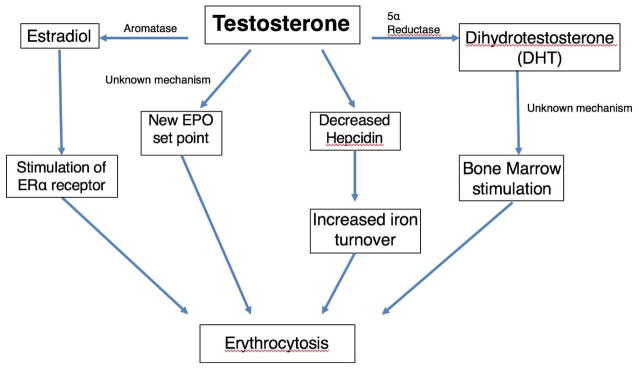
Results: For men undergoing TTh, the risk of developing erythrocytosis compared with controls is well established, with short-acting injectable formulations having the highest associated incidence. Potential mechanisms explaining the relation between TTh and erythrocytosis include the role of hepcidin, iron sequestration and turnover, erythropoietin production, bone marrow stimulation, and genetic factors. High blood viscosity increases the risk for potential vascular complications involving the coronary, cerebrovascular, and peripheral vascular circulations, although there is limited evidence supporting a relation between TTh and vascular complications.
Conclusion: Short-acting injectable testosterone is associated with greater risk of erythrocytosis compared with other formulations. The mechanism of the pathophysiology and its role on thromboembolic events remain unclear, although some data support an increased risk of cardiovascular events resulting from testosterone-induced erythrocytosis. Ohlander SJ, Varghese B, Pastuszak AW. Erythrocytosis Following Testosterone Therapy. Sex Med Rev 2018;6:77-85.
Keywords: Erythrocytosis; Hormone Replacement; Hypogonadism; Polycythemia; Testosterone.
Copyright © 2017 International Society for Sexual Medicine. Published by Elsevier Inc. All rights reserved.
Conflict of interest statement
Dr. Pastuszak is an advisory board member and consultant for Endo Pharmaceuticals Dr. Ohlander and Mr. Varghese report no conflicts
Figures
References
-
- AUA. AUA Position Statement on Testosterone Therapy 2014. 2015 Aug; [cited 2016 December 01]; Available from: http://www.auanet.org/education/testosterone-therapy.cfm.
-
- Bhasin S, et al. Testosterone therapy in men with androgen deficiency syndromes: an Endocrine Society clinical practice guideline. J Clin Endocrinol Metab. 2010;95(6):2536–59. - PubMed
-
- SMSNA. Consensus Statement and White Paper1 Executive Summary: Adult Onset Hypogonadism (AOH) 2015 [cited 2016 November 13]; Available from: http://www.smsna.org/V1/about/position-statements.
Publication types
MeSH terms
Substances
Grants and funding
LinkOut - more resources
Full Text Sources
Other Literature Sources
