


The Parasol Protocol: An Implementation Science Study of HIV Continuum of Care Interventions for Gay Men and Transgender Women in Burma/Myanmar
- PMID: 28526661
- PMCID: PMC5451637
- DOI: 10.2196/resprot.7642
The Parasol Protocol: An Implementation Science Study of HIV Continuum of Care Interventions for Gay Men and Transgender Women in Burma/Myanmar
Abstract
Background: Efforts to improve HIV diagnosis and antiretroviral therapy (ART) initiation among people living with HIV and reduce onward transmission of HIV rely on innovative interventions along multiple steps of the HIV care continuum. These innovative methods are particularly important for key populations, including men who have sex with men (MSM) and transgender women (TW). The HIV epidemic in Myanmar is concentrated among key populations, and national efforts now focus on reducing stigma and improving engagement of MSM and TW in HIV prevention and care.
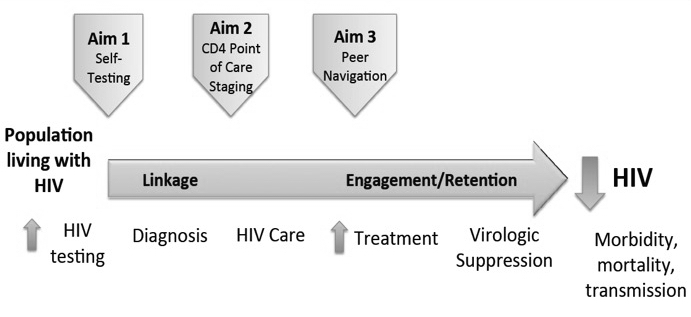
Objective: This study aims to test the use of several innovations to address losses in the HIV care continuum: (1) use of respondent-driven sampling (RDS) to reach and engage MSM and TW in HIV testing, (2) HIV self-testing (HIVST) to increase HIV testing uptake and aid early diagnosis of infection, (3) community-based CD4 point-of-care (POC) technology to rapidly stage HIV disease for those who are HIV infected, and (4) peer navigation support to increase successful health system navigation for HIV-infected MSM and TW in need of ART or HIV engagement in care.
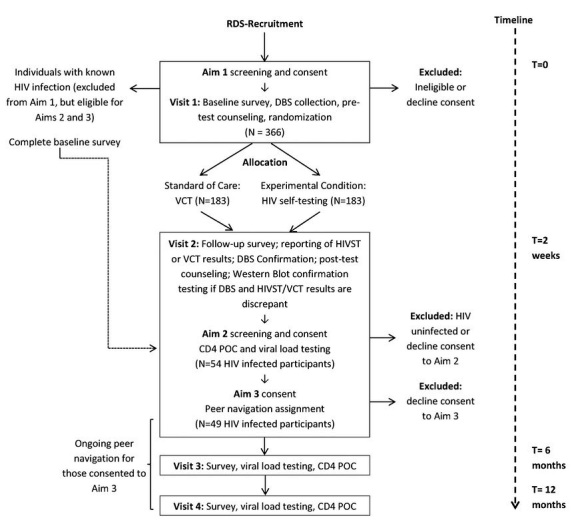
Methods: To assess the effect of HIVST, we will implement a randomized trial in which MSM and TW adults in the greater Yangon metropolitan area who are HIV uninfected will be recruited via RDS (N=366). Participants will complete a baseline socio-behavioral survey and will be randomized to standard, voluntary counseling and testing (VCT) or to HIVST. Biologic specimens will be collected during this baseline visit for confirmatory testing using dried blood spots. Participants will be asked to return to the study office to complete a second study visit in which they will report their HIV test result and answer questions on the acceptability of the assigned testing method. Aim 1 participants with confirmed HIV infection and who are not engaged in care (N=49) will be offered direct enrollment into Aims 2 and 3, which include immediate CD4 POC and the option for peer navigation, respectively. Aims 2 and 3 participants will be prospectively followed for 12 months with data collection including interviewer-administered sociobehavioral survey, CD4 POC, and viral load testing occurring biannually. Participants who accept peer navigation will be compared to those who decline peer navigation. Analyses will estimate the impact of CD4 POC on engagement in care and the impact of peer navigation on ART adherence and viral load.
Results: Formative qualitative research was conducted in June and September 2015 and led to further refinement of recruitment methods, HIVST instructions and counseling, and peer navigation methods. Aim 1 recruitment began in November 2015 with subsequent enrollment into Aims 2 and 3 and is currently ongoing.
Conclusions: These innovative interventions may resolve gaps in the HIV care continuum among MSM and TW and future implementation may aid in curbing the HIV epidemic among MSM and TW in Myanmar.
Keywords: HIV; Myanmar; antiretroviral therapy; men who have sex with men; transgender.
©Andrea L Wirtz, Soe Naing, Emily Clouse, Kaung Htet Thu, Sandra Hsu Hnin Mon, Zin Min Tun, Stefan Baral, Aung Zayar Paing, Chris Beyrer. Originally published in JMIR Research Protocols (http://www.researchprotocols.org), 17.05.2017.
Conflict of interest statement
Conflicts of Interest: None declared.
Figures

References
-
- Joint United Nations Programs on HIV/AIDS 90-90-90: An ambitious treatment target to help end the AIDS epidemic. 2014. [2017-05-07]. http://www.unaids.org/en/resources/documents/2017/90-90-90 6qIJaFVNQ.
-
- Cohen M, Chen YQ, McCauley M, Gamble T, Hosseinipour MC, Kumarasamy N, Hakim JG, Kumwenda J, Grinsztejn B, Pilotto JH, Godbole SV, Mehendale S, Chariyalertsak S, Santos BR, Mayer KH, Hoffman IF, Eshleman SH, Piwowar-Manning E, Wang L, Makhema J, Mills LA, de BG, Sanne I, Eron J, Gallant J, Havlir D, Swindells S, Ribaudo H, Elharrar V, Burns D, Taha TE, Nielsen-Saines K, Celentano D, Essex M, Fleming TR, HPTN 052 Study Team Prevention of HIV-1 infection with early antiretroviral therapy. N Engl J Med. 2011 Aug 11;365(6):493–505. doi: 10.1056/NEJMoa1105243. http://europepmc.org/abstract/MED/21767103 - DOI - PMC - PubMed
-
- UNAIDS The gap report, 2014. 2014. [2017-05-07]. http://www.unaids.org/en/resources/campaigns/2014/2014gapreport/gapreport 6qIKCrD4I.
-
- Risher K, Mayer KH, Beyrer C. HIV treatment cascade in MSM, people who inject drugs, and sex workers. Curr Opin HIV AIDS. 2015 Nov;10(6):420–429. http://europepmc.org/abstract/MED/26352393 - PMC - PubMed
Grants and funding
LinkOut - more resources
Full Text Sources
Other Literature Sources
Research Materials
