


Exploring a Possible Link between the Intestinal Microbiota and Feed Efficiency in Pigs
- PMID: 28526795
- PMCID: PMC5514681
- DOI: 10.1128/AEM.00380-17
Exploring a Possible Link between the Intestinal Microbiota and Feed Efficiency in Pigs
Abstract
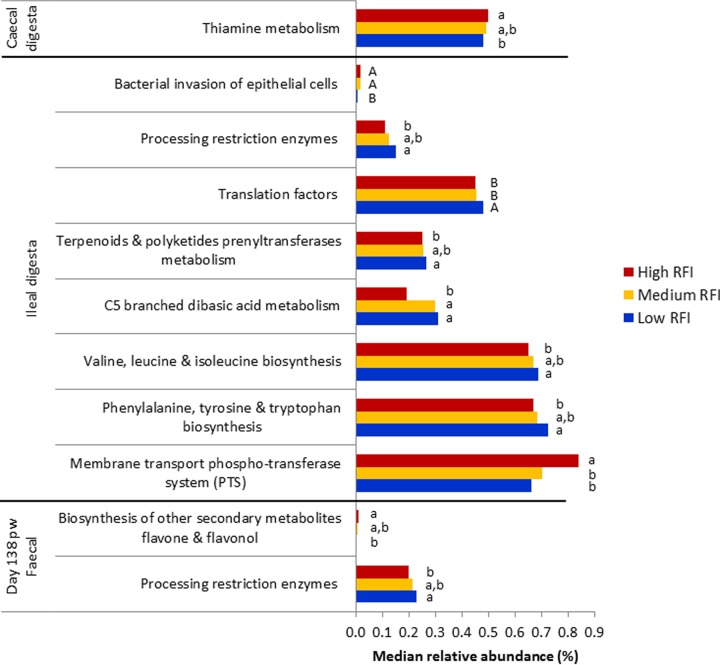
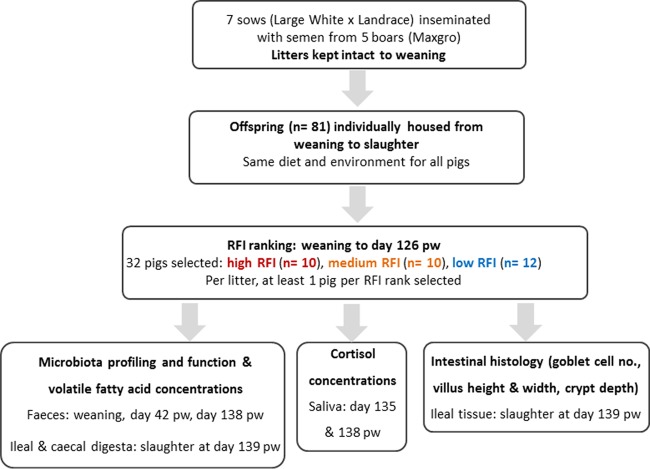
Feed efficiency (FE) is critical in pig production for both economic and environmental reasons. As the intestinal microbiota plays an important role in energy harvest, it is likely to influence FE. Therefore, our aim was to characterize the intestinal microbiota of pigs ranked as low, medium, and high residual feed intake ([RFI] a metric for FE), where genetic, nutritional, and management effects were minimized, to explore a possible link between the intestinal microbiota and FE. Eighty-one pigs were ranked according to RFI between weaning and day 126 postweaning, and 32 were selected as the extremes in RFI (12 low, 10 medium, and 10 high). Intestinal microbiota diversity, composition, and predicted functionality were assessed by 16S rRNA gene sequencing. Although no differences in microbial diversity were found, some RFI-associated compositional differences were revealed, principally among members of Firmicutes, predominantly in feces at slaughter (albeit mainly for low-abundance taxa). In particular, microbes associated with a leaner and healthier host (e.g., Christensenellaceae, Oscillibacter, and Cellulosilyticum) were enriched in low RFI (more feed-efficient) pigs. Differences were also observed in the ileum of low RFI pigs; most notably, Nocardiaceae (Rhodococcus) were less abundant. Predictive functional analysis suggested improved metabolic capabilities in these animals, especially within the ileal microbiota. Higher ileal isobutyric acid concentrations were also found in low RFI pigs. Overall, the differences observed within the intestinal microbiota of low RFI pigs compared with that of their high RFI counterparts, albeit relatively subtle, suggest a possible link between the intestinal microbiota and FE in pigs.IMPORTANCE This study is one of the first to show that differences in intestinal microbiota composition, albeit subtle, may partly explain improved feed efficiency (FE) in low residual feed intake (RFI) pigs. One of the main findings is that, although microbial diversity did not differ among animals of varying FE, specific intestinal microbes could potentially be linked with porcine FE. However, as the factors impacting FE are still not fully understood, intestinal microbiota composition may not be a major factor determining differences in FE. Nonetheless, this work has provided a potential set of microbial biomarkers for FE in pigs. Although culturability could be a limiting factor and intervention studies are required, these taxa could potentially be targeted in the future to manipulate the intestinal microbiome so as to improve FE in pigs. If successful, this has the potential to reduce both production costs and the environmental impact of pig production.
Keywords: cecum; feces; ileum; residual feed intake; swine.
Copyright © 2017 American Society for Microbiology.
Figures
References
-
- Teagasc Pig Development Department. 2015. Pig herd performance report 2015. Teagasc, Oak Park, Carlow, Ireland.
-
- Rotz CA. 2004. Management to reduce nitrogen losses in animal production. J Anim Sci 82(E Suppl):E119–E137. - PubMed
-
- Ramayo-Caldas Y, Mach N, Lepage P, Levenez F, Denis C, Lemonnier G, Leplat JJ, Billon Y, Berri M, Dore J, Rogel-Gaillard C, Estelle J. 2016. Phylogenetic network analysis applied to pig gut microbiota identifies an ecosystem structure linked with growth traits. ISME J 10:2973–2977. doi: 10.1038/ismej.2016.77. - DOI - PMC - PubMed
-
- Xiao L, Estellé J, Kiilerich P, Ramayo-Caldas Y, Xia Z, Feng Q, Liang S, Pedersen AØ, Kjeldsen NJ, Liu C, Maguin E, Doré J, Pons N, Le Chatelier E, Prifti E, Li J, Jia H, Liu X, Xu X, Ehrlich SD, Madsen L, Kristiansen K, Rogel-Gaillard C, Wang J. 2016. A reference gene catalogue of the pig gut microbiome. Nat Microbiol 2016:16161. doi: 10.1038/nmicrobiol.2016.161. - DOI - PubMed
-
- Fouhse JM, Zijlstra RT, Willing BP. 2016. The role of gut microbiota in the health and disease of pigs. Anim Front 6:30–36. doi: 10.2527/af.2016-0031. - DOI
MeSH terms
LinkOut - more resources
Full Text Sources
Other Literature Sources
Research Materials
