


Review
doi: 10.1016/j.cbpa.2017.05.001.
Epub 2017 May 17.
Engineering genetically-encoded tools for optogenetic control of protein activity
Affiliations
- PMID: 28527343
- PMCID: PMC5693790
- DOI: 10.1016/j.cbpa.2017.05.001
Item in Clipboard
Review
Engineering genetically-encoded tools for optogenetic control of protein activity
Curr Opin Chem Biol.
2017 Oct.
Abstract
Optogenetic tools offer fast and reversible control of protein activity with subcellular spatial precision. In the past few years, remarkable progress has been made in engineering photoactivatable systems regulating the activity of cellular proteins. In this review, we discuss general strategies in designing and optimizing such optogenetic tools and highlight recent advances in the field, with specific focus on applications regulating protein catalytic activity.
Copyright © 2017 Elsevier Ltd. All rights reserved.
Figures
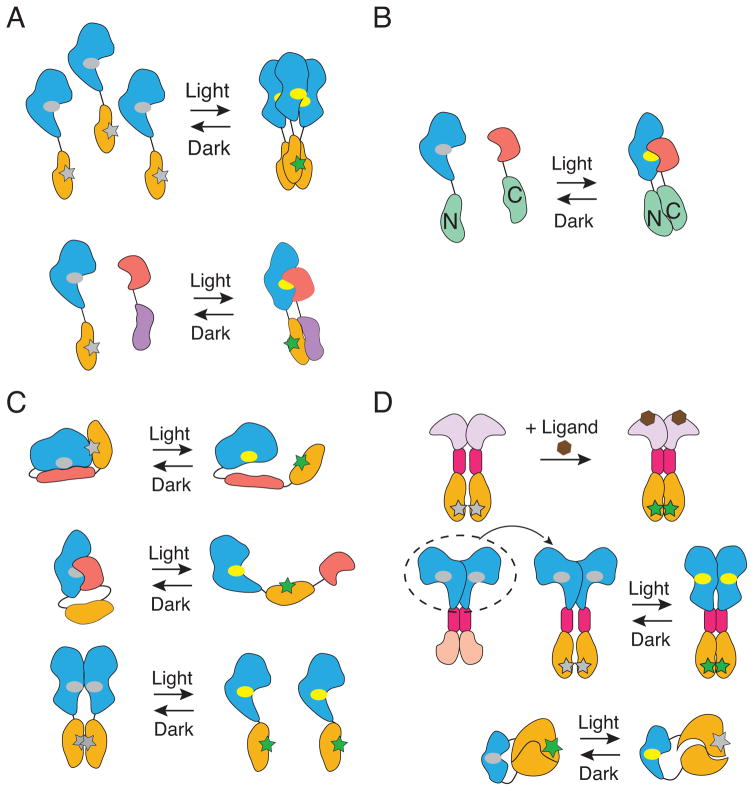
(A) Oligomerization. Light-induced conformational changes within photosensory domains (blue; the chromophore within the photosensory domain is indicated by an ellipse: grey, ground state; yellow, light activated state) increase their tendency for self-association or interaction with binding partners (red), which can be utilized for homo- (upper panel) or hetero- (lower panel) oligomerization of tethered protein targets (yellow and purple). The active site within the protein target is indicated by a star: grey, inactive; green, active). (B) Reconstituting split proteins. A target protein (green) is split into N- and C- terminal halves, which are reconstituted through light-dependent interaction between the photosensory domain and a binding partner. (C) Steric effects. The active site (indicated by a star: grey, inactive; green, active) of a target protein (yellow) can be caged via intra- (top and middle panels) or inter- (bottom panel) molecular interaction controlled by light. (D) Allosteric regulation. If a similar allosteric module (magenta) is shared between a photosensory protein (blue, photosensory domain; pale red, effector domain) and an allosterically regulated enzyme (pale purple, regulatory domain; yellow, catalytic domain), domain swapping could preserve the allosteric switching (upper panel). In other cases, a photosensory domain is inserted into a target protein at coupled allosteric sites to regulate its molecular dynamics (lower panel).
References
-
- Harper SM, Neil LC, Gardner KH. Structural basis of a phototropin light switch. Science. 2003;301:1541–1544. - PubMed
Publication types
MeSH terms
Substances
Grants and funding
LinkOut - more resources
Full Text Sources
Other Literature Sources
Miscellaneous
