Review
. 2017 Jun:24:87-96.
doi: 10.1016/j.coviro.2017.04.003. Epub 2017 May 18.

Biochemical principles and inhibitors to interfere with viral capping pathways

Affiliations
Review

Biochemical principles and inhibitors to interfere with viral capping pathways

Etienne Decroly et al. Curr Opin Virol. 2017 Jun.

Abstract

Messenger RNAs are decorated by a cap structure, which is essential for their translation into proteins. Many viruses have developed strategies in order to cap their mRNAs. The cap is either synthetized by a subset of viral or cellular enzymes, or stolen from capped cellular mRNAs by viral endonucleases ('cap-snatching'). Reverse genetic studies provide evidence that inhibition of viral enzymes belonging to the capping pathway leads to inhibition of virus replication. The replication defect results from reduced protein synthesis as well as from detection of incompletely capped RNAs by cellular innate immunity sensors. Thus, it is now admitted that capping enzymes are validated antiviral targets, as their inhibition will support an antiviral response in addition to the attenuation of viral mRNA translation. In this review, we describe the different viral enzymes involved in mRNA capping together with relevant inhibitors, and their biochemical features useful in inhibitor discovery.


Figures

Figure 1
Figure 1
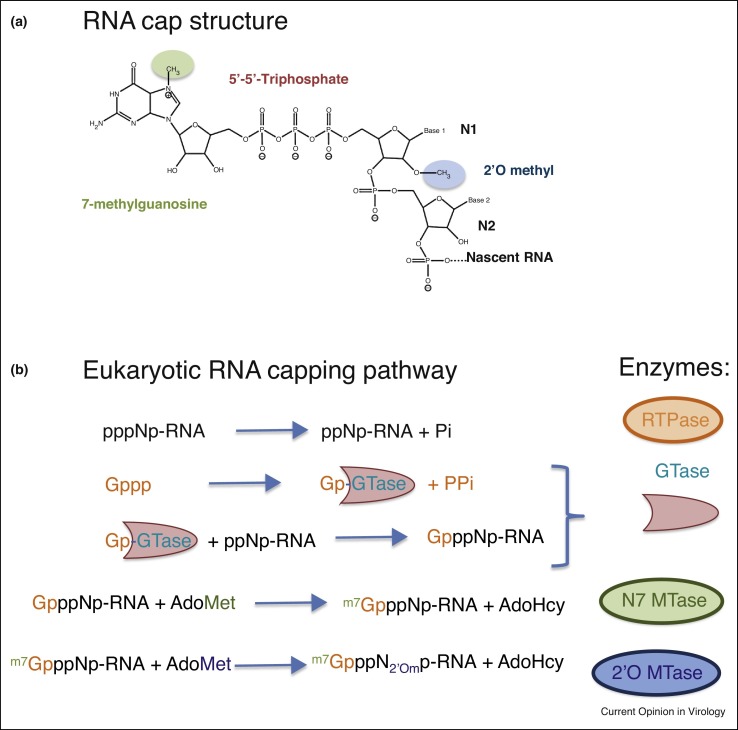
(a) Chemical structure of the eukaryotic RNA cap. (b) Eukaryotic ‘canonical’ RNA capping pathway, in which the nascent mRNA is sequentially processed by four enzymatic activities, represented as separate enzymes on the right-side of the reaction (see text for details). RTPase: RNA 5′-triphosphatase; GTase: Guanylytransferase; N7 MTase: N7-guanine RNA cap methyltransferase; 2′OMTase: Ribose 2′-O RNA methyltransferase.
Figure 2
Figure 2
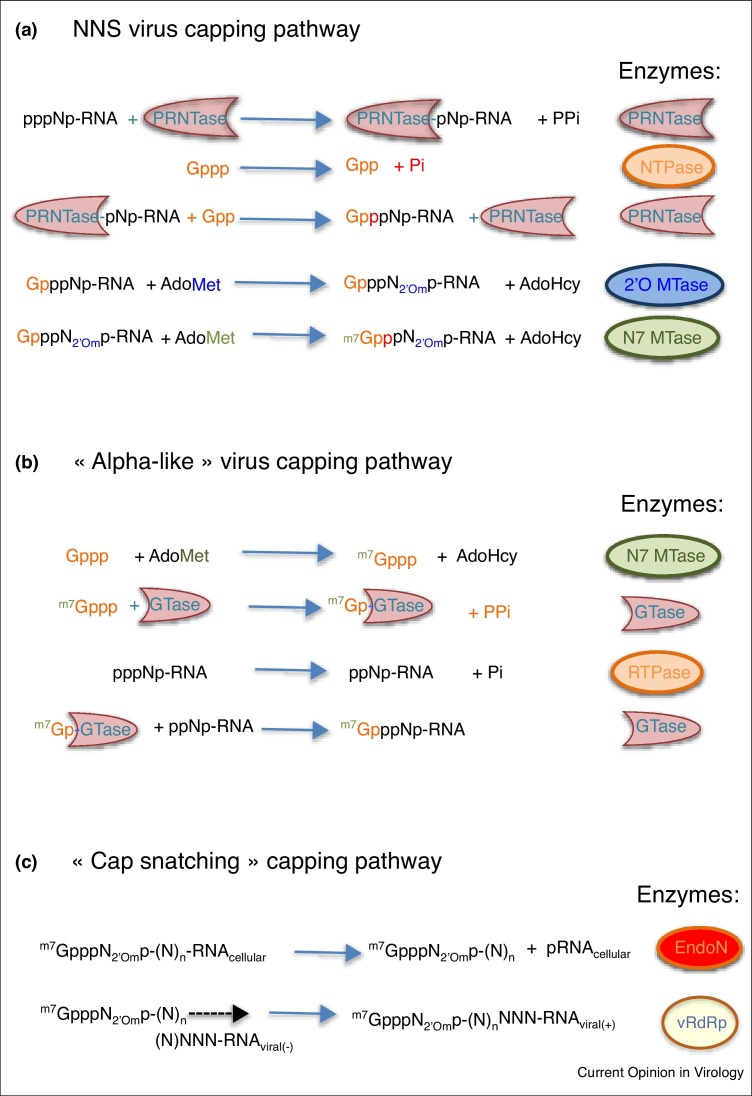
(a) Negative Non-Segmented (NNS) virus RNA capping pathway, in which the nascent viral mRNA is sequentially processed by four enzymatic activities, represented as separate enzymes on the right-side of the reaction. These enzyme activities are generally present in L, a single large polypeptide chain encompassing the viral RNA-dependent RNA polymerase. The NTPase generates a diffusible GDP molecule, and the spatial arrangement and cross-talk of PRNTase and NTPase is still unclear. (b)Togaviridae (alphavirus-like) RNA virus capping pathway. The N7-GTP MTase generates a diffusible m7GTP molecule, and here also, the spatial arrangement and cross-talk of the N7-GTP MTase and GTase is still unclear. (c) RNA cap-snatching pathway. Viral RNA-dependent RNA polymerases (RdRp) have (or may have) an RNA cap-binding site in close proximity to an endonuclease (endoN) and distinct from the polymerase active site. The size (n) of the snatched capped primer varies within viral families (see text for details). Abbreviations as in Figure 1, plus the following: PRNTase: GDP Polyribonucleotidyl Transferase; NTPase: nucleoside 5′-triphosphate phosphatase; EndoN: endonuclease.
Figure 3
Figure 3
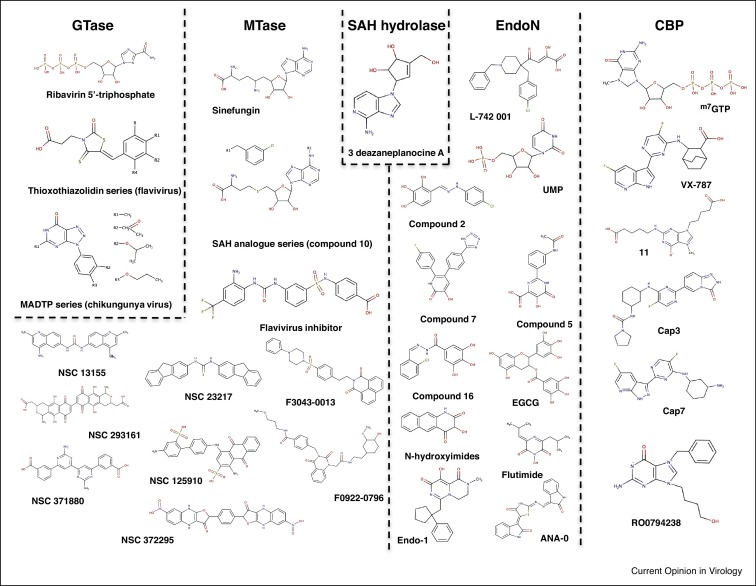
Structure of inhibitors targeting enzymes involved in viral RNA capping pathways. Few inhibitors blocking the GTase activity have been reported: Ribavirin 5′-triphosphate was first proposed to target the GTase activity of capping enzymes [55]. Screening efforts have identified thioxothiazolidin and MADTP derivative as potent inhibitors of flaviviruses and chikungunya virus GTase [45••, 57]. Several MTase inhibitors have been reported: Ribavirin 5′-triphosphate ([58], reported in the GTase panel) and the SAM/SAH analogue Sinefungin are inhibitors of several viral MTases in vitro and SAH analogues derivative (compound 10) also inhibit more specifically the flaviviral MTase [38]. Non-nucleosidic inhibitors, obtained by a fragment-based drug-design approach targeting the flaviviral MTase (Dengue and Zika virus) have also been reported recently [39, 59]. Virtual screening was also used to identify dengue MTase inhibitors (NSC series) [60] against Zika virus (F3043-0013 and F0922-0796) [40]. Compounds regulating the SAH/SAM balance such as 3-deazaneplanocine A show potent broad-spectrum antiviral activity, including Ebola virus (see text). This antiviral effect is supposedly linked to inhibition of their MTase through increase of the SAH pool. The chemical structures of representative EndoN inhibitors are shown; most of them have been crystallized within the active site of the influenza virus PA enzyme [51]. Cap analogues exemplified here with m7GTP, and several inhibitors of cap-binding protein have been identified through X-ray structure analysis of the influenza virus PB2-CBD in complex with the corresponding ligands. For RO0794238, direct binding to the PB2-CBD could not be demonstrated [52]. The VX-787 corresponds to a highly potent Influenza PB2 inhibitor [53] 1.

References

    1. Ramanathan A., Robb G.B., Chan S.-H. mRNA capping: biological functions and applications. Nucleic Acids Res. 2016;44:7511–7526. - PMC - PubMed
    2. An extensive general review of the RNA capping field, including “alternate” caps, cytoplasmic capping/de-capping, and applications of RNA capping.

    1. Leung D.W., Amarasinghe G.K. When your cap matters: structural insights into self vs non-self recognition of 5′ RNA by immunomodulatory host proteins. Curr. Opin. Struct. Biol. 2016;36:133–141. - PMC - PubMed
    1. Schuberth-Wagner C., Ludwig J., Bruder A.K., Herzner A.-M., Zillinger T., Goldeck M., Schmidt T., Schmid-Burgk J.L., Kerber R., Wolter S. A conserved histidine in the RNA sensor RIG-I controls immune tolerance to N1-2′ O-methylated self RNA. Immunity. 2015;43:41–51. - PMC - PubMed
    1. Züst R., Cervantes-Barragan L., Habjan M., Maier R., Neuman B.W., Ziebuhr J., Szretter K.J., Baker S.C., Barchet W., Diamond M.S. Ribose 2′-O-methylation provides a molecular signature for the distinction of self and non-self mRNA dependent on the RNA sensor Mda5. Nat. Immunol. 2011;12:137–143. - PMC - PubMed
    1. Daffis S., Szretter K.J., Schriewer J., Li J., Youn S., Errett J., Lin T.-Y., Schneller S., Zust R., Dong H. 2′-O methylation of the viral mRNA cap evades host restriction by IFIT family members. Nature. 2010;468:452–456. - PMC - PubMed

MeSH terms

LinkOut - more resources