


Alcohol and other substance use after bariatric surgery: prospective evidence from a U.S. multicenter cohort study
- PMID: 28528115
- PMCID: PMC5568472
- DOI: 10.1016/j.soard.2017.03.021
Alcohol and other substance use after bariatric surgery: prospective evidence from a U.S. multicenter cohort study
Abstract
Background: Empirical evidence suggests Roux-en-Y gastric bypass (RYGB) increases risk of developing alcohol use disorder (AUD). However, prospective assessment of substance use disorders (SUD) after bariatric surgery is limited.
Objective: To report SUD-related outcomes after RYGB and laparoscopic adjustable gastric banding (LAGB). To identify factors associated with incident SUD-related outcomes.
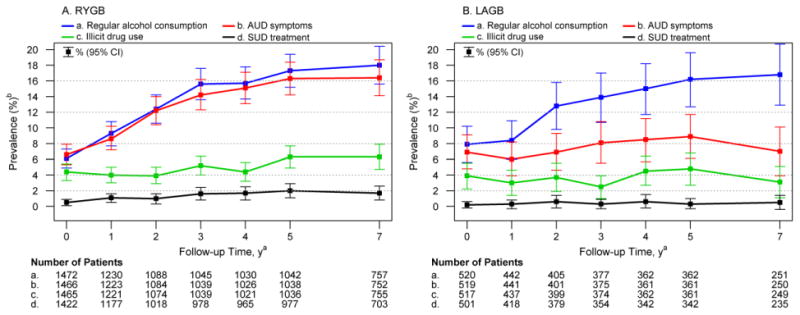
Setting: 10 U.S. hospitals METHODS: The Longitudinal Assessment of Bariatric Surgery-2 is a prospective cohort study. Participants self-reported past-year AUD symptoms (determined by the Alcohol Use Disorders Identification Test), illicit drug use (cocaine, hallucinogens, inhalants, phencyclidine, amphetamines, or marijuana), and SUD treatment (counseling or hospitalization for alcohol or drugs) presurgery and annually postsurgery for up to 7 years through January 2015.
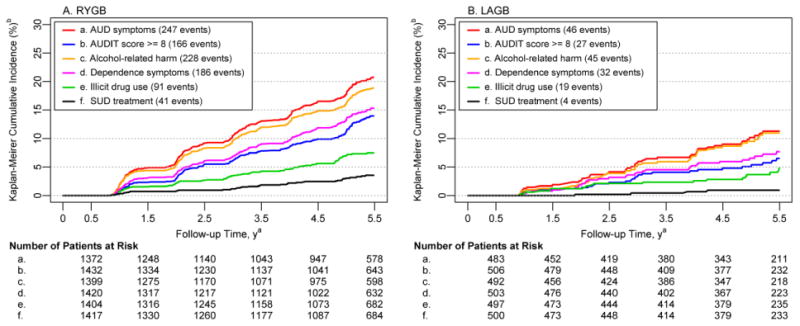
Results: Of 2348 participants who underwent RYGB or LAGB, 2003 completed baseline and follow-up assessments (79.2% women, baseline median age: 47 years, median body mass index 45.6). The year-5 cumulative incidence of postsurgery onset AUD symptoms, illicit drug use, and SUD treatment were 20.8% (95% confidence interval (CI): 18.5-23.3), 7.5% (95% CI: 6.1-9.1), and 3.5% (95% CI: 2.6-4.8), respectively, post-RYGB, and 11.3% (95% CI: 8.5-14.9), 4.9% (95% CI: 3.1-7.6), and .9% (95% CI: .4-2.5) post-LAGB. Undergoing RYGB versus LAGB was associated with higher risk of incident AUD symptoms (adjusted hazard ratio or AHR = 2.08 [95% CI: 1.51-2.85]), illicit drug use (AHR = 1.76 [95% CI: 1.07-2.90]) and SUD treatment (AHR = 3.56 [95% CI: 1.26-10.07]).
Conclusions: Undergoing RYGB versus LAGB was associated with twice the risk of incident AUD symptoms. One-fifth of participants reported incident AUD symptoms within 5 years post-RYGB. AUD education, screening, evaluation, and treatment referral should be incorporated in pre- and postoperative care.
Keywords: Abuse; Addiction; Disorder; Gastric band; Obese; Roux-en-Y gastric bypass; Substance use; Treatment.
Copyright © 2017 American Society for Bariatric Surgery. All rights reserved.
Conflict of interest statement
Conflicts of Interest:
Figures
Comment in
-
Comment on: Alcohol and other substance use after bariatric surgery: prospective evidence from a us multicenter cohort study.Surg Obes Relat Dis. 2017 Aug;13(8):1402-1404. doi: 10.1016/j.soard.2017.04.014. Epub 2017 Apr 20. Surg Obes Relat Dis. 2017. PMID: 28549638 No abstract available.
References
-
- Steffen KJ, Engel SG, Wonderlich JA, Pollert GA, Sondag C. Alcohol and other addictive disorders following bariatric surgery: Prevalence, risk factors and possible etiologies. Eur Eat Disord Rev. 2015;23(6):442–50. - PubMed
Publication types
MeSH terms
Grants and funding
LinkOut - more resources
Full Text Sources
Other Literature Sources
Medical
Research Materials
Miscellaneous
