Short-term memory and long-term memory are still different
- PMID: 28530428
- PMCID: PMC5578362
- DOI: 10.1037/bul0000108
Short-term memory and long-term memory are still different
Abstract
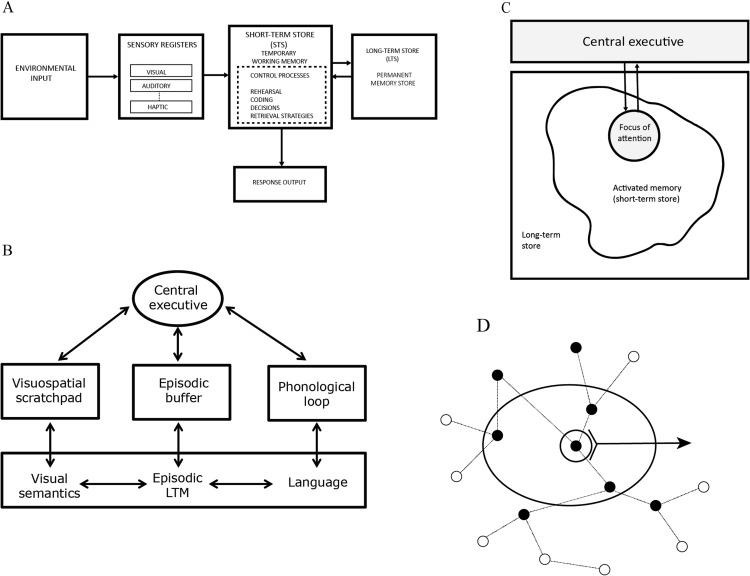
A commonly expressed view is that short-term memory (STM) is nothing more than activated long-term memory. If true, this would overturn a central tenet of cognitive psychology-the idea that there are functionally and neurobiologically distinct short- and long-term stores. Here I present an updated case for a separation between short- and long-term stores, focusing on the computational demands placed on any STM system. STM must support memory for previously unencountered information, the storage of multiple tokens of the same type, and variable binding. None of these can be achieved simply by activating long-term memory. For example, even a simple sequence of digits such as "1, 3, 1" where there are 2 tokens of the digit "1" cannot be stored in the correct order simply by activating the representations of the digits "1" and "3" in LTM. I also review recent neuroimaging data that has been presented as evidence that STM is activated LTM and show that these data are exactly what one would expect to see based on a conventional 2-store view. (PsycINFO Database Record
(c) 2017 APA, all rights reserved).
Figures
Comment in
-
Short-term memory based on activated long-term memory: A review in response to Norris (2017).Psychol Bull. 2019 Aug;145(8):822-847. doi: 10.1037/bul0000199. Psychol Bull. 2019. PMID: 31328941 Free PMC article.
-
Even an activated long-term memory system still needs a separate short-term store: A reply to Cowan (2019).Psychol Bull. 2019 Aug;145(8):848-853. doi: 10.1037/bul0000204. Psychol Bull. 2019. PMID: 31328942 Free PMC article.
References
-
- Anderson J. R. (1983). The Architecture of Cognition. Cambridge, MA: Harvard University Press.
-
- Atkinson R. C., & Shiffrin R. M. (1966). Some two-process models for memory. Tech. Rep. No. 107. Institute for Mathematical Studies in the Social Sciences, Stanford.
Publication types
MeSH terms
Grants and funding
LinkOut - more resources
Full Text Sources
Other Literature Sources