. 2017 Jun 6;114(23):5930-5934.
doi: 10.1073/pnas.1701280114. Epub 2017 May 22.

Confined catalysis under two-dimensional materials

Affiliations

Confined catalysis under two-dimensional materials

Haobo Li et al. Proc Natl Acad Sci U S A. .

Abstract

Confined microenvironments formed in heterogeneous catalysts have recently been recognized as equally important as catalytically active sites. Understanding the fundamentals of confined catalysis has become an important topic in heterogeneous catalysis. Well-defined 2D space between a catalyst surface and a 2D material overlayer provides an ideal microenvironment to explore the confined catalysis experimentally and theoretically. Using density functional theory calculations, we reveal that adsorption of atoms and molecules on a Pt(111) surface always has been weakened under monolayer graphene, which is attributed to the geometric constraint and confinement field in the 2D space between the graphene overlayer and the Pt(111) surface. A similar result has been found on Pt(110) and Pt(100) surfaces covered with graphene. The microenvironment created by coating a catalyst surface with 2D material overlayer can be used to modulate surface reactivity, which has been illustrated by optimizing oxygen reduction reaction activity on Pt(111) covered by various 2D materials. We demonstrate a concept of confined catalysis under 2D cover based on a weak van der Waals interaction between 2D material overlayers and underlying catalyst surfaces.

Keywords: confined catalysis; density functional theory; graphene; oxygen reduction reaction; two-dimensional materials.


Conflict of interest statement

The authors declare no conflict of interest.

Figures
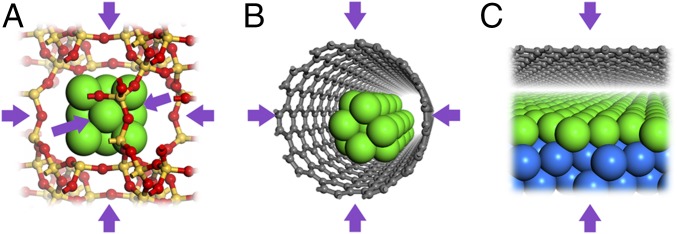
Fig. 1.
Fig. 1.
Schemes for confined catalysis within various microenvironments including (A) 0D pores of zeolites, (B) 1D channels of CNTs, and (C) 2D space under 2D materials. Catalytic sites (in green color) and reaction molecules are confined in three dimensions, two dimensions, and one dimension (marked with arrows), respectively, in the above three systems.
Fig. 2.
Fig. 2.
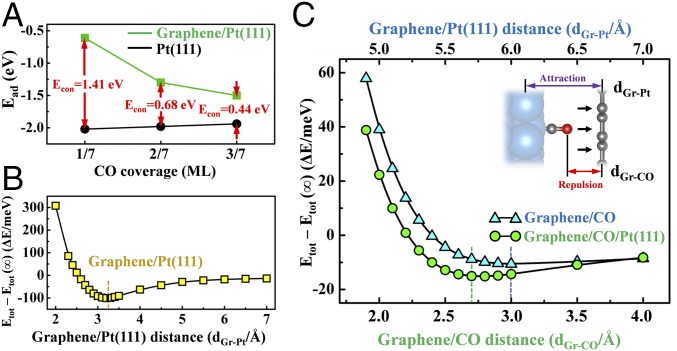
Confinement effect of graphene on CO interaction with Pt(111) and the confinement energy. (A) Adsorption energies of CO on Pt(111) (black) and Gr/Pt(111) (green) surfaces and the derived confinement energies (Econ) with CO coverage at 1/7, 2/7, and 3/7 ML. (B) Total energy differences of the Gr/Pt(111) system (averaged to each C atom of Gr) at each specific distance between Gr and Pt(111) surface (dGr-Pt) relative to infinity (d). The equilibrium distance is 3.2 Å. (C) Total energy differences of the Gr/CO and Gr/CO/Pt(111) systems (averaged to each C atom of Gr) at each specific distance between Gr and CO (dGr-CO) relative to infinity. The equilibrium distances are 2.7 and 3.0 Å in the Gr/CO and Gr/CO/Pt(111) systems, respectively. (Inset) Interaction between Gr layer, CO molecule, and Pt slab.
Fig. 3.
Fig. 3.
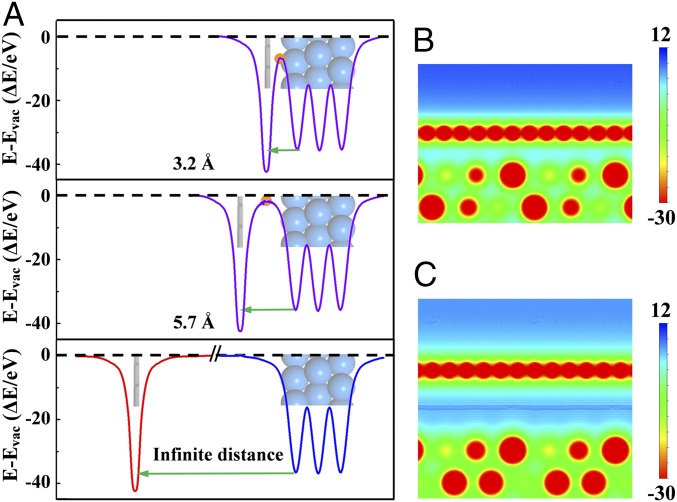
Confinement field in the 2D confined spaces. (A) The 1D local potential distribution between Gr and Pt(111) surface with dGr-Pt at 3.2 Å (Top), 5.7 Å (Middle), and infinity (Bottom). The potential at vacuum is set to zero. (Insets) The corresponding schematic atomic structures in the real space. (B and C) The maximum points between Gr and Pt(111) surface are shown in orange dots. The 2D potential distribution (side view) at the Gr/Pt(111) interfaces with dGr-Pt at (B) 3.2 and (C) 5.7 Å.
Fig. 4.
Fig. 4.
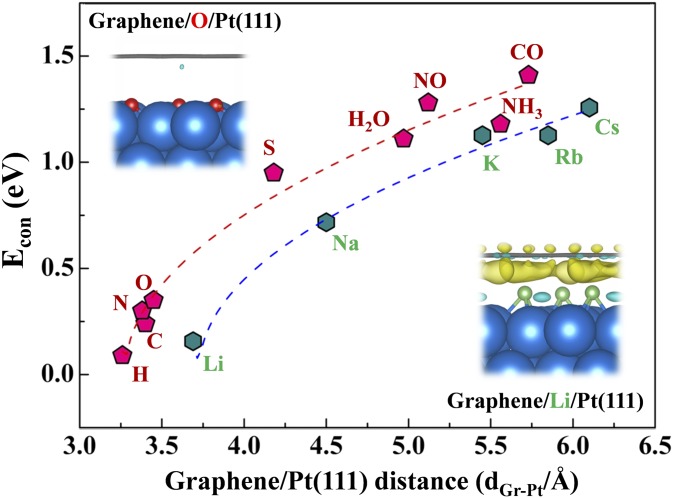
Econ for 1/7 ML nonmetal atoms and molecules (pink dots), as well as alkali metal atoms (green dots) in between Gr and Pt(111) with various dGr-Pt values. The pink dots and green dots are fitted in red and blue dashed lines, respectively. (Insets) Cross-section views of Gr/O/Pt(111) and Gr/Li/Pt(111) interfaces shown with electron density difference at the interface. ; Gr, gray sticks; Li, green balls; O, red balls; and Pt, blue balls. Light blue and yellow contours in the electron density difference are for electron depletion and electron accumulation, respectively. The isosurface levels are set to be 0.002 e/Bohr3.
Fig. 5.
Fig. 5.
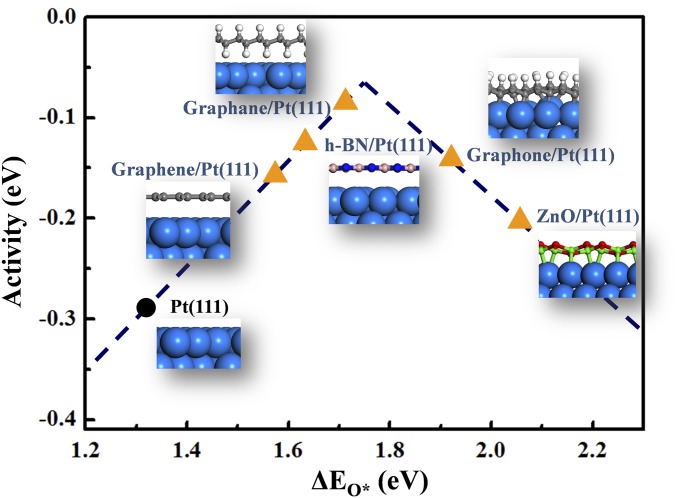
The volcano curve relation between ORR activity and binding energies of O atoms (ΔEO*) on Pt surface. (Insets) The interfacial structures. B, purple balls; C, gray balls; H, white balls; N, dark blue balls; O, red balls; Pt, light blue balls; and Zn, green balls.

References

    1. Nørskov JK, et al. The nature of the active site in heterogeneous metal catalysis. Chem Soc Rev. 2008;37:2163–2171. - PubMed
    1. Somorjai G, McCrea K, Zhu J. Active sites in heterogeneous catalysis: Development of molecular concepts and future challenges. Top Catal. 2002;18:157–166.
    1. Thomas JM. The tortuous tale of the catalytically active site. Top Catal. 2006;38:3–5.
    1. Schoenbaum CA, Schwartz DK, Medlin JW. Controlling the surface environment of heterogeneous catalysts using self-assembled monolayers. Acc Chem Res. 2014;47:1438–1445. - PubMed
    1. Schwartz TJ, et al. Engineering catalyst microenvironments for metal-catalyzed hydrogenation of biologically derived platform chemicals. Angew Chem Int Ed Engl. 2014;53:12718–12722. - PubMed

Publication types