


Vortioxetine reduces BOLD signal during performance of the N-back working memory task: a randomised neuroimaging trial in remitted depressed patients and healthy controls
- PMID: 28533517
- PMCID: PMC5984095
- DOI: 10.1038/mp.2017.104
Vortioxetine reduces BOLD signal during performance of the N-back working memory task: a randomised neuroimaging trial in remitted depressed patients and healthy controls
Abstract
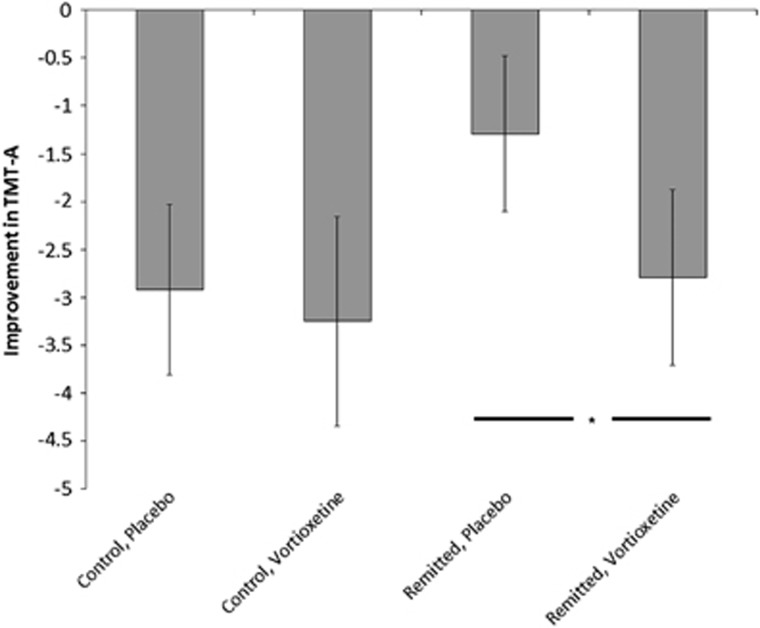
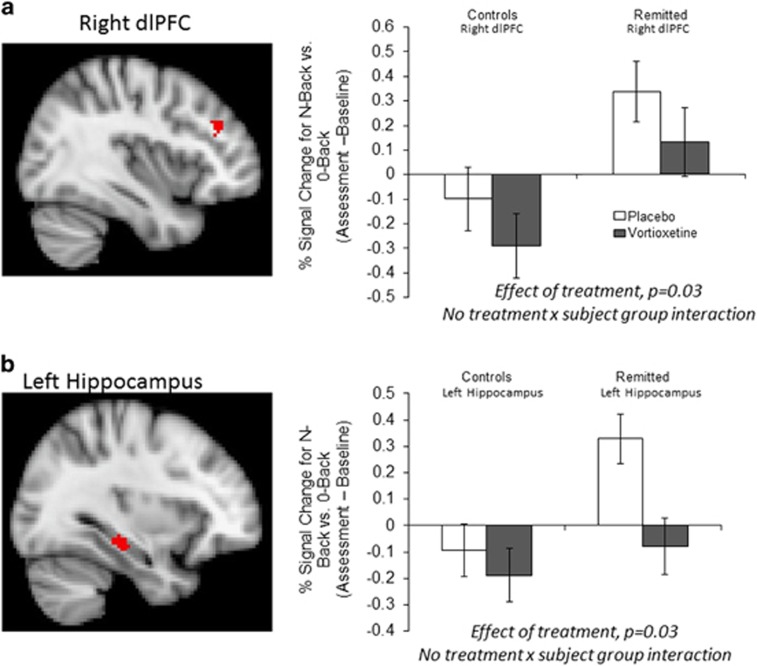
Cognitive dysfunction is common in depression during both acute episodes and remission. Vortioxetine is a novel multimodal antidepressant that has improved cognitive function including executive function in depressed patients in randomised placebo-controlled clinical trials. However, it is unclear whether vortioxetine is able to target directly the neural circuitry implicated in the cognitive deficits in depression. Remitted depressed (n=48) and healthy volunteers (n=48) were randomised to receive 14 days treatment with 20 mg vortioxetine or placebo in a double-blind design. The effects of treatment on functional magnetic resonance imaging responses during an N-back working memory task were assessed at baseline and at the end of treatment. Neuropsychological measures of executive function, speed and information processing, attention and learning and memory were examined with the Trail Making Test (TMT), Rey Auditory Learning Test and Digit Symbol Substitution Test before and after treatment; subjective cognitive function was assessed using the Perceived Deficits Questionnaire (PDQ). Compared with placebo, vortioxetine reduced activation in the right dorsolateral prefrontal cortex and left hippocampus during the N-back task compared with placebo. Vortioxetine also increased TMT-A performance and self-reported cognitive function on the PDQ. These effects were seen across both subject groups. Vortioxetine modulates neural responses across a circuit subserving working memory in a direction opposite to the changes described in depression, when performance is maintained. This study provides evidence that vortioxetine has direct effects on the neural circuitry supporting cognitive function that can be dissociated from its effects on the mood symptoms of depression.
Conflict of interest statement
MB is employed by P1vital and has received travel expenses from Lundbeck for attending conferences. JFD in the past 5 years has held grants from Servier, AZ and P1vital and given talks/advice for Servier, J&J, AZ and Lilly. Fees are paid as reimbursement for his time to the University of Manchester. CJH has received consultancy payments from Lundbeck, P1vital and Servier and is a shareholder in P1vital. She is a company director of Oxford Psychologists and holds shares in the same company. GG has held grants from Servier, received honoraria for speaking or chairing educational meetings from Abbvie, AZ, GSK, Lilly, Lundbeck, Medscape, Servier and advised AZ, Cephalon/Teva, Lundbeck, Merck, Otsuka, P1vital, Servier, Sunovion and Takeda, holds shares in P1vital and acted as an expert witness for Lilly. GRD is an employee of and is an owner holding shares in P1vital. SC has received travel expenses from Lundbeck for attending a conference and has received consultancy payments from P1vital. SRC, KGL and CKO are employed by Lundbeck. JB was employed by Lundbeck (at study development and initiation) and is now employed by Novartis. JS, RS, PH, and RM have no conflict of interest.
Figures
References
-
- Austin MP, Mitchell P, Goodwin GM. Cognitive deficits in depression: possible implications for functional neuropathology. Br J Psychiatry J Ment Sci 2001; 178: 200–206. - PubMed
-
- Baune BT, Miller R, McAfoose J, Johnson M, Quirk F, Mitchell D. The role of cognitive impairment in general functioning in major depression. Psychiatry Res 2010; 176: 183–189. - PubMed
-
- Gorwood P, Corruble E, Falissard B, Goodwin GM. Toxic effects of depression on brain function: impairment of delayed recall and the cumulative length of depressive disorder in a large sample of depressed outpatients. Am J Psychiatry 2008; 165: 731–739. - PubMed
-
- Greer TL, Kurian BT, Trivedi MH. Defining and measuring functional recovery from depression. CNS Drugs 2010; 24: 267–284. - PubMed
Publication types
MeSH terms
Substances
Grants and funding
LinkOut - more resources
Full Text Sources
Other Literature Sources
