


Novel mutations and phenotypic associations identified through APC, MUTYH, NTHL1, POLD1, POLE gene analysis in Indian Familial Adenomatous Polyposis cohort
- PMID: 28533537
- PMCID: PMC5440391
- DOI: 10.1038/s41598-017-02319-6
Novel mutations and phenotypic associations identified through APC, MUTYH, NTHL1, POLD1, POLE gene analysis in Indian Familial Adenomatous Polyposis cohort
Abstract
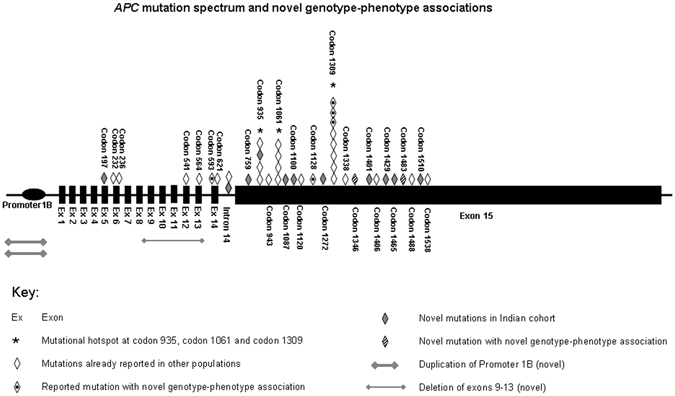
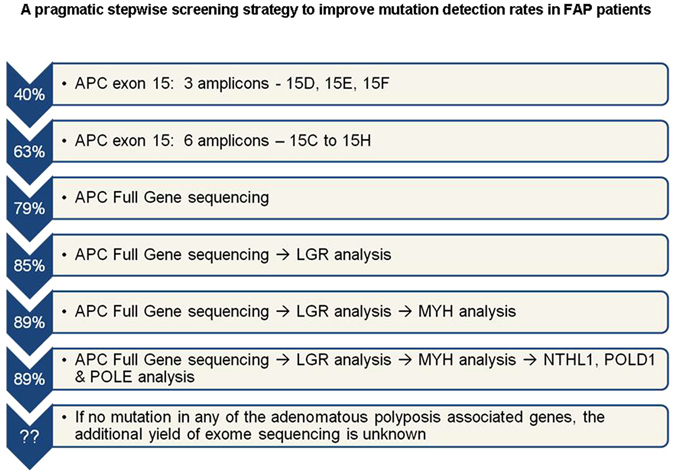
Colo-Rectal Cancer is a common cancer worldwide with 5-10% cases being hereditary. Familial Adenomatous Polyposis (FAP) syndrome is due to germline mutations in the APC or rarely MUTYH gene. NTHL1, POLD1, POLE have been recently reported in previously unexplained FAP cases. Unlike the Caucasian population, FAP phenotype and its genotypic associations have not been widely studied in several geoethnic groups. We report the first FAP cohort from South Asia and the only non-Caucasian cohort with comprehensive analysis of APC, MUTYH, NTHL1, POLD1, POLE genes. In this cohort of 112 individuals from 53 FAP families, we detected germline APC mutations in 60 individuals (45 families) and biallelic MUTYH mutations in 4 individuals (2 families). No NTHL1, POLD1, POLE mutations were identified. Fifteen novel APC mutations and a new Indian APC mutational hotspot at codon 935 were identified. Eight very rare FAP phenotype or phenotypes rarely associated with mutations outside specific APC regions were observed. APC genotype-phenotype association studies in different geo-ethnic groups can enrich the existing knowledge about phenotypic consequences of distinct APC mutations and guide counseling and risk management in different populations. A stepwise cost-effective mutation screening approach is proposed for genetic testing of south Asian FAP patients.
Conflict of interest statement
The authors declare that they have no competing interests.
Figures
References
-
- Stoffel EM, et al. Hereditary Colorectal Cancer Syndromes: American Society of Clinical Oncology Clinical Practice Guideline Endorsement of the Familial Risk–Colorectal Cancer: European Society for Medical Oncology Clinical Practice Guideline. Journal of Clinical Oncology. 2015;33:209–217. doi: 10.1200/JCO.2014.58.1322. - DOI - PMC - PubMed
Publication types
MeSH terms
Substances
LinkOut - more resources
Full Text Sources
Other Literature Sources
Research Materials
Miscellaneous
