. 2017 May 8:8:736.
doi: 10.3389/fpls.2017.00736. eCollection 2017.

Jasmonoyl-L-Tryptophan Disrupts IAA Activity through the AUX1 Auxin Permease

Affiliations

Jasmonoyl-L-Tryptophan Disrupts IAA Activity through the AUX1 Auxin Permease

Paul Staswick et al. Front Plant Sci. .

Abstract

Amide-linked conjugates between tryptophan (Trp) and jasmonic (JA) or indole-3-acetic (IAA) acids interfered with gravitropism and other auxin-dependent activities in Arabidopsis, but the mechanism was unclear. To identify structural features necessary for activity several additional Trp conjugates were synthesized. The phenylacetic acid (PAA) conjugate was active, while several others were not. Common features of active conjugates is that they have ring structures that are linked to Trp through an acetic acid side chain, while longer or shorter linkages are inactive or less active. A dominant mutant, called tryptophan conjugate response1-D that is insensitive to JA-Trp, but still sensitive to other active conjugates, was identified and the defect was found to be a substitution of Asn for Asp456 in the C-terminal domain of the IAA cellular permease AUX1. Mutant seedling primary root growth in the absence of added conjugate was 15% less than WT, but otherwise plant phenotype appeared normal. These results suggest that JA-Trp disrupts AUX1 activity, but that endogenous JA-Trp has only a minor role in regulating plant growth. In contrast with IAA- and JA-Trp, which are present at <2 pmole g-1 FW, PAA-Trp was found at about 30 pmole g-1 FW. The latter, or other undiscovered Trp conjugates, may still have important endogenous roles, possibly helping to coordinate other pathways with auxin response.

Keywords: AUX1; auxin; conjugate; gravitropism; indole-3-acetic acid; jasmonic acid; phenylacetic acid; tryptophan.


Figures
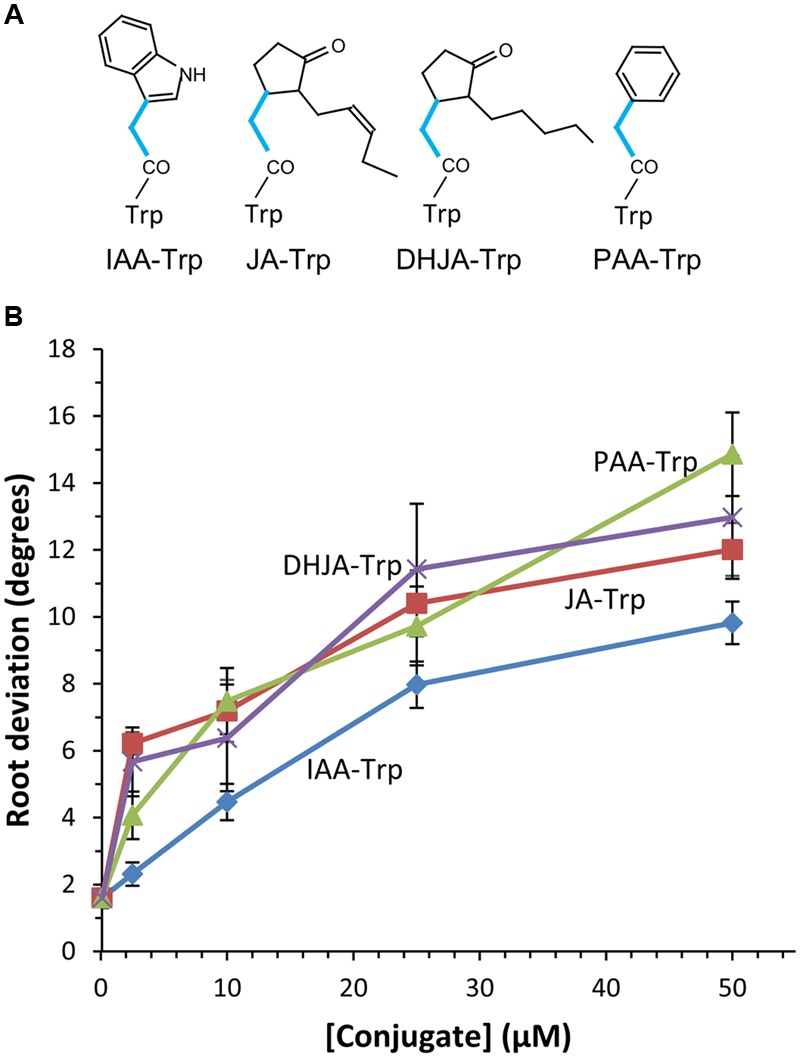
FIGURE 1
FIGURE 1
Agravitropic activity of tryptophan (Trp) conjugates. (A) The single carbon linkage between the ring structure of the acyl group and the amide linkage to Trp found in active conjugates is shown (blue lines). Abbreviations for the acids are noted in the text. (B) Agravitropic seedling root response to Trp conjugates after 6 days growth. Values are the means with SE (n = 30 seedlings). Significant differences from the control for each conjugate occurred at ≥1 μM for JA-Trp and DHJA-Trp, ≥2.5 μM for PAA-Trp and ≥10 μM for IAA-Trp (p < 0.01, t-test).
FIGURE 2
FIGURE 2
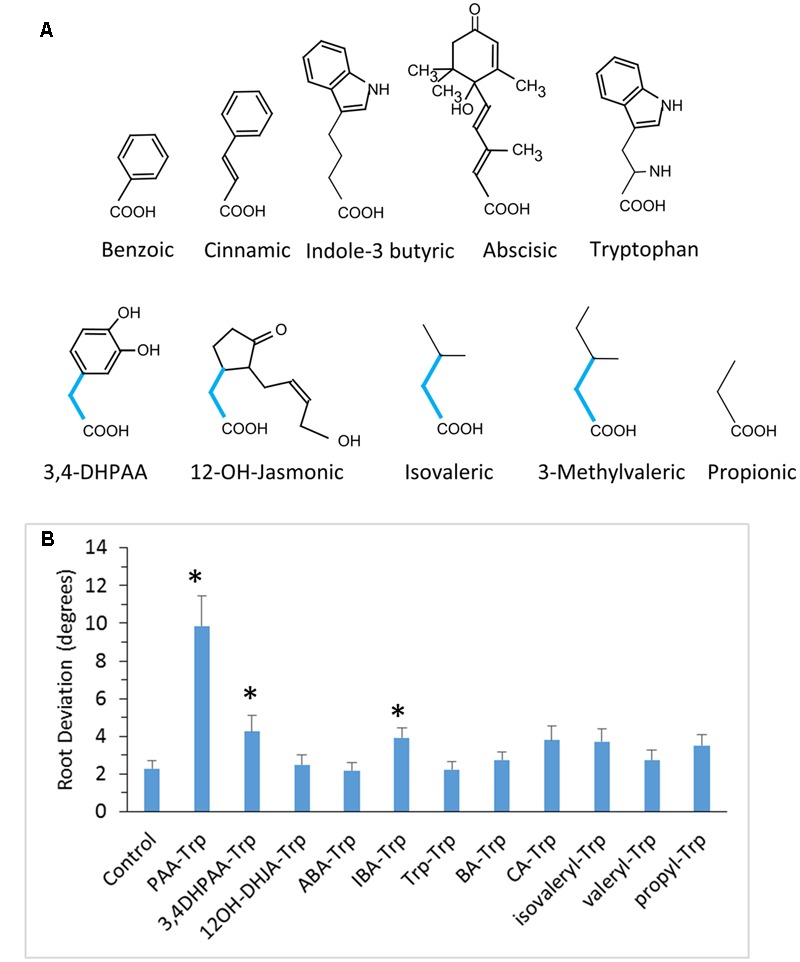
Conjugates with little or no ability to disrupt root gravitropism. (A) Structures of the relevant acids are shown. Bottom row shows acids with an acetic acid side chain that appears to be a required structural feature for active conjugates. (B) Root deviation for conjugates tested at 50 μM. Values are means with SE (n = 20 seedling roots). Asterisks indicate significant difference from control (p < 0.05, t-test).
FIGURE 3
FIGURE 3
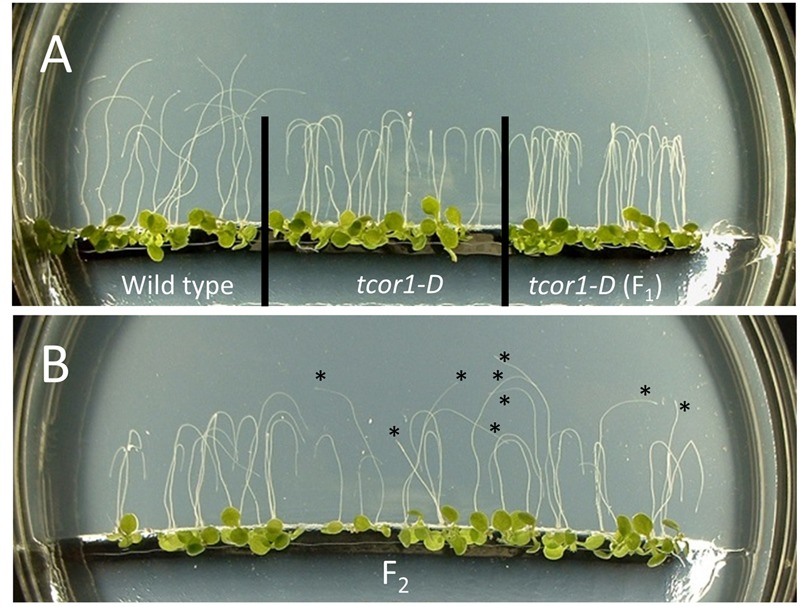
Genetic characterization of DHJA-Trp insensitive mutant tcor1-D. Seedlings were grown 4 days on MS agar plates with 40 μM DHJA-Trp, then rotated 180° for 36 h. (A) The impaired gravitropic response of wild type is evident, while roots of tcor1-D reoriented their growth in the direction of the new gravity vector (down in this image). The F1 was from a cross between wild type Col-0 (female) and homozygous tcor1-D (male). (B) F2 seedlings from a single F1 plant segregated 9:23 (sensitive: resistant; sensitive seedlings indicated with asterisks), consistent with a dominant mutation.
FIGURE 4
FIGURE 4
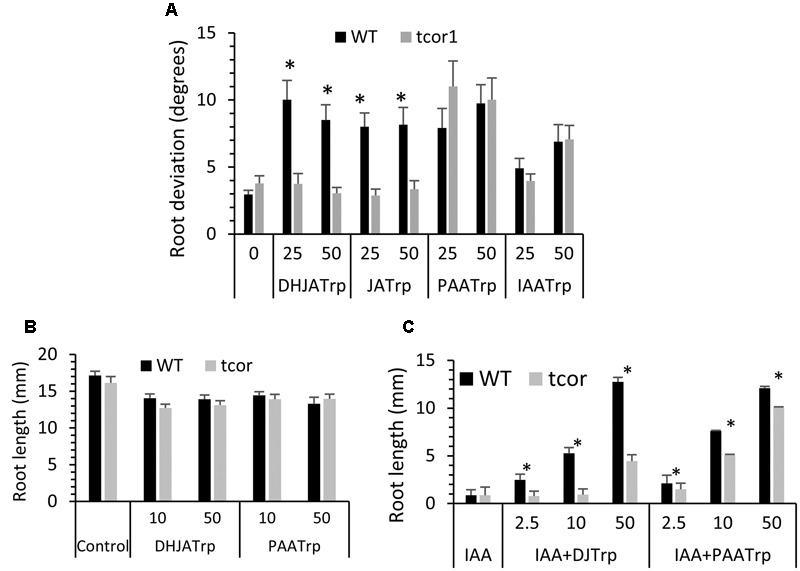
Response of tcor1-D to Trp conjugates. (A) Agravitropic response to conjugates at the indicated concentrations (μM). Growth conditions were the same as for Figure 1. (B) Seedling primary root length after 6 days growth on indicated conjugates (μM). (C) Same conditions as B but with 2 μM IAA included in medium for all tests. Values are means with SE, asterisks indicate significant difference between WT and mutant pairs (t-test, p < 0.01, n = 16–29).
FIGURE 5
FIGURE 5
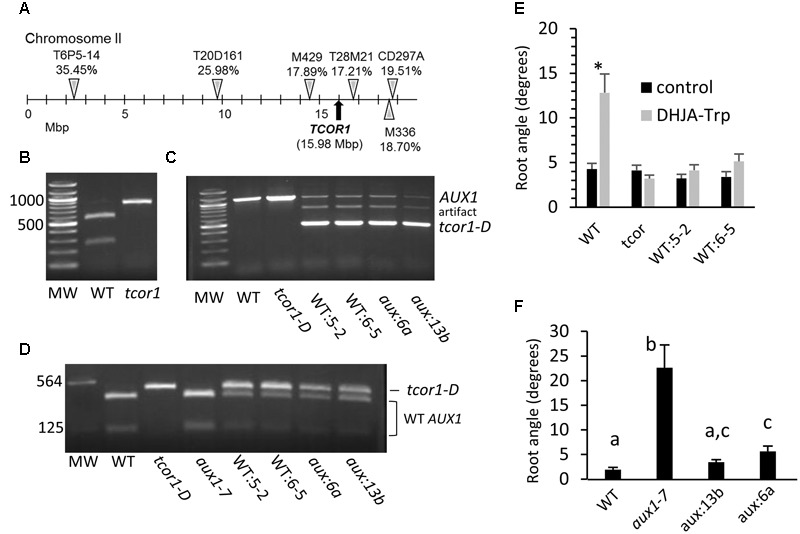
Mapping of tcor1-D locus and transformation with the mutant AUX1 cDNA. (A) Details for the markers used are found in Supplementary Table 1. Percentages indicate proportion of recombinant chromosomes for individual markers seen among 110 to 123 F2 individuals each. (B) Genomic amplification products spanning the mutation site of the AUX1 gene after cleavage with Sal1. (C) Uncleaved amplification products of AUX1 genomic DNA from WT (WT:5-2, WT:6-5) and aux1-7 (aux:6a, aux13b) plants transformed with tcor1-D cDNA. (D) cDNA amplification products of indicated genotypes. Endogenous AUX1 wild type cDNA is cleaved by Sal1, tcor1-D cDNA transgene is not. (E) Mean root angles with SE for WT seedlings transformed with tcor1-D cDNA on control and 25 μM DHJA-Trp medium. Significant difference between treatments for each genotype indicated by an asterisk (t-tests, p < 0.05, n = 14–36 seedlings). (F) Growth of aux1-7 transformants on control medium. Means with same letters not significantly different (t-test, p ≤ 0.05, n = 17–21 seedlings).
FIGURE 6
FIGURE 6
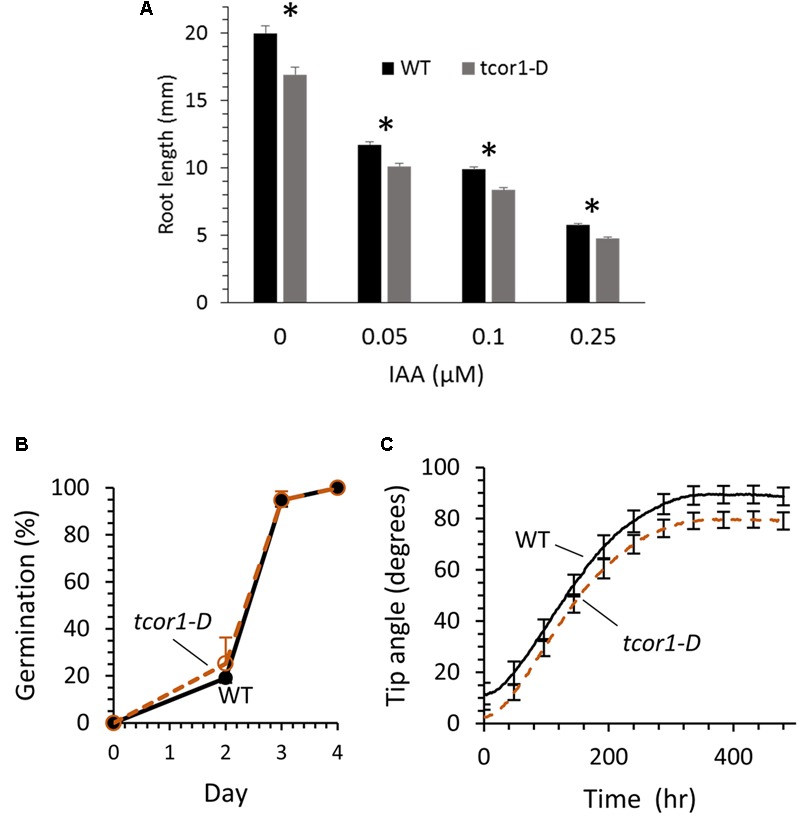
Comparison of WT and tcor1-D growth. (A) Mean root length for tcor1-D and WT seedlings grown 6 days in agar media with the concentration of IAA shown. Values are means with SE (n = 51–60 seedlings). Asterisks indicate significant difference between genotypes for each treatment (p < 0.01, t-test). (B) Germination rate for WT and tcor1-D seeds. Values are means for three experiments with SE (n = 28–35 seeds each experiment). Seeds were sown on MS medium and were counted as germinated when the emerged radical reached 1 mm in length. Growth was in a 16 h day/8 h night incubator at 21°C. (C) Combined gravitropic response for seedlings grown from seed obtained from three pairs of WT and tcor1-D plants. Tip angle measurements were taken every 2 h, SE of means shown only for every 24th time point.
FIGURE 7
FIGURE 7
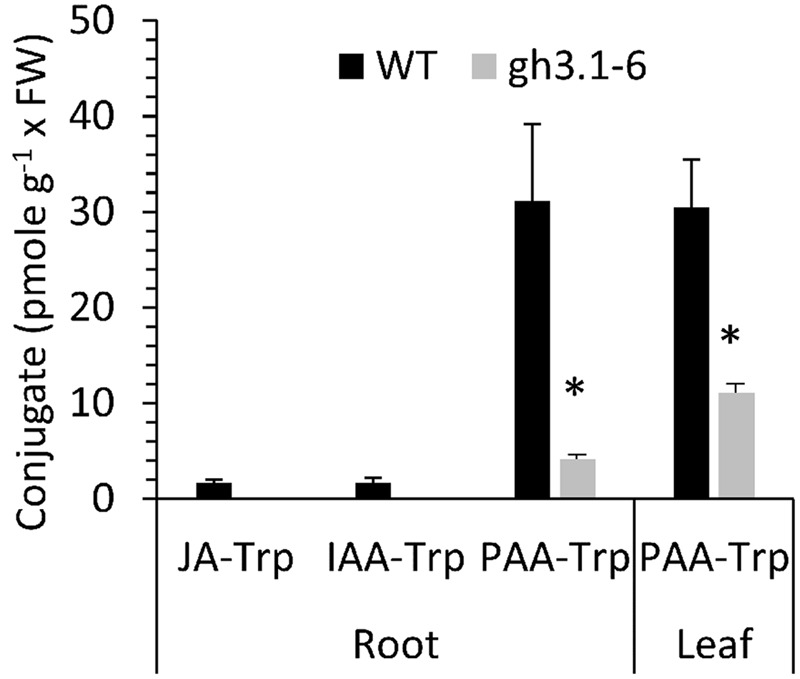
Amount of PAA-Trp in Arabidopsis tissues. Values are means for three independent biological replicates, with SE. Values for JA-Trp and IAA-Trp (Wild type only) determined previously (Staswick, 2009) are shown for comparison. Asterisks indicate significant difference between WT and sextuple mutant gh3.1,2,3,4,5,6 (p < 0.05, t-test).
FIGURE 8
FIGURE 8
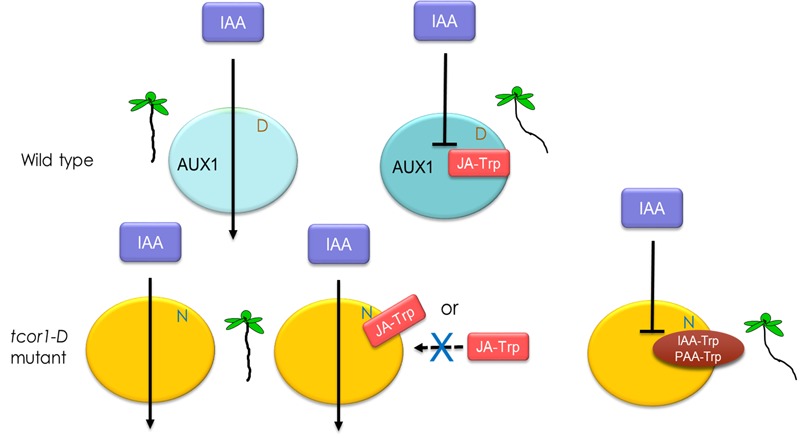
Model for the action of Trp conjugates in IAA transport. Turquoise ovals represent wild type AUX1 and yellow, the tcor1-D mutant version with the Asn for Asp substitution. Transport of IAA via AUX1 is indicated by arrows. Interaction of JA-Trp, IAA-Trp or PAA-Trp with AUX1 blocks IAA transport in wild type plants. In the mutant either JA-Trp doesn’t interact or does so in a way that does not interfere with IAA polar movement. The other conjugates are still effective at promoting an agravitropic root response, as indicated by the seedling representations.

References

    1. Adamowski M., Friml J. (2015). PIN-dependent auxin transport: action, regulation, and evolution. Plant Cell 27 20–32. 10.1105/tpc.114.134874 - DOI - PMC - PubMed
    1. Adie B., Chini A., Fonseca S., Hamberg M., Kramell R., Miersch O., et al. (2009). (+)-7-iso-Jasmonoyl-L-isoleucine is the endogenous bioactive jasmonate. Nat. Chem. Biol. 5 344–350. 10.1038/nchembio.161 - DOI - PubMed
    1. Blakeslee J. J., Bandyopadhyay A., Lee O. R., Mravec J., Titapiwatanakun B., Sauer M., et al. (2007). Interactions among PIN-FORMED and P-glycoprotein auxin transporters in Arabidopsis. Plant Cell 19 131–147. 10.1105/tpc.106.040782 - DOI - PMC - PubMed
    1. Chai C., Wang Y., Valliyodan B., Nguyen H. T. (2016). Comprehensive analysis of the soybean (Glycine max) GmLAX auxin transporter gene family. Front. Plant Sci. 7:282 10.3389/fpls.2016.00282 - DOI - PMC - PubMed
    1. Durham Brooks T. L., Miller N. D., Spalding E. P. (2010). Plasticity of Arabidopsis root gravitropism throughout a multidimensional condition space quantified by automated image analysis. Plant Physiol. 152 206–216. 10.1104/pp.109.145292 - DOI - PMC - PubMed

LinkOut - more resources