. 2017 May 23:8:15546.
doi: 10.1038/ncomms15546.

A light-driven artificial flytrap

Affiliations

A light-driven artificial flytrap

Owies M Wani et al. Nat Commun. .

Abstract

The sophistication, complexity and intelligence of biological systems is a continuous source of inspiration for mankind. Mimicking the natural intelligence to devise tiny systems that are capable of self-regulated, autonomous action to, for example, distinguish different targets, remains among the grand challenges in biomimetic micro-robotics. Herein, we demonstrate an autonomous soft device, a light-driven flytrap, that uses optical feedback to trigger photomechanical actuation. The design is based on light-responsive liquid-crystal elastomer, fabricated onto the tip of an optical fibre, which acts as a power source and serves as a contactless probe that senses the environment. Mimicking natural flytraps, this artificial flytrap is capable of autonomous closure and object recognition. It enables self-regulated actuation within the fibre-sized architecture, thus opening up avenues towards soft, autonomous small-scale devices.


Conflict of interest statement

The authors declare no competing financial interests.

Figures
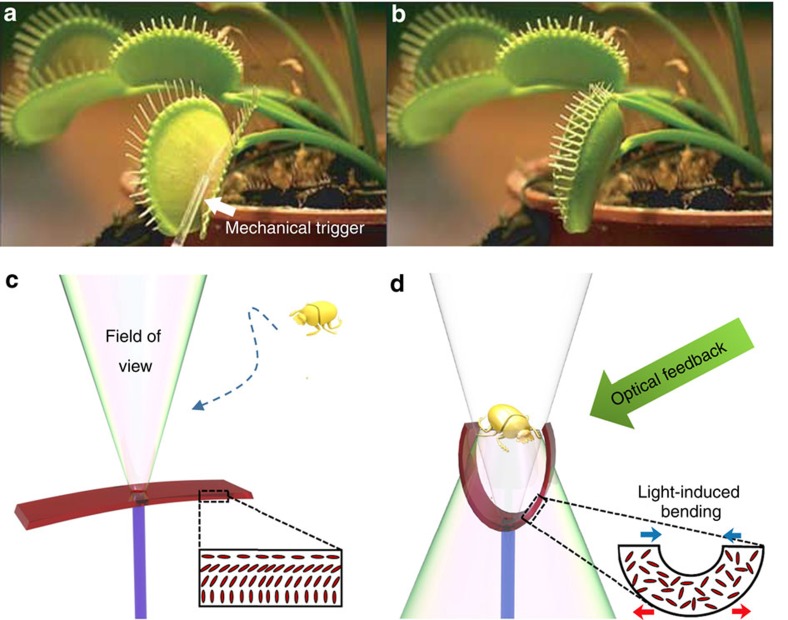
Figure 1
Figure 1. Flytrap-inspired light-powered soft robot.
(a) A Venus flytrap at its open stage, (b) closes upon mechanical stimulation. Reprinted with permission from ref. . (c) Schematic drawing of the light-triggered artificial flytrap at its open stage, when no object has entered its field of view. No light is back-reflected to the LCE actuator, which remains in the open stage. (d) The flytrap closes when an object enters its field of view and causes optical feedback to the LCE actuator. Light-induced bending of the LCE leads to closure action, thus capturing the object. The insets of c and d show the schematic molecular orientation in LCE actuator at the open and closed stages.
Figure 2
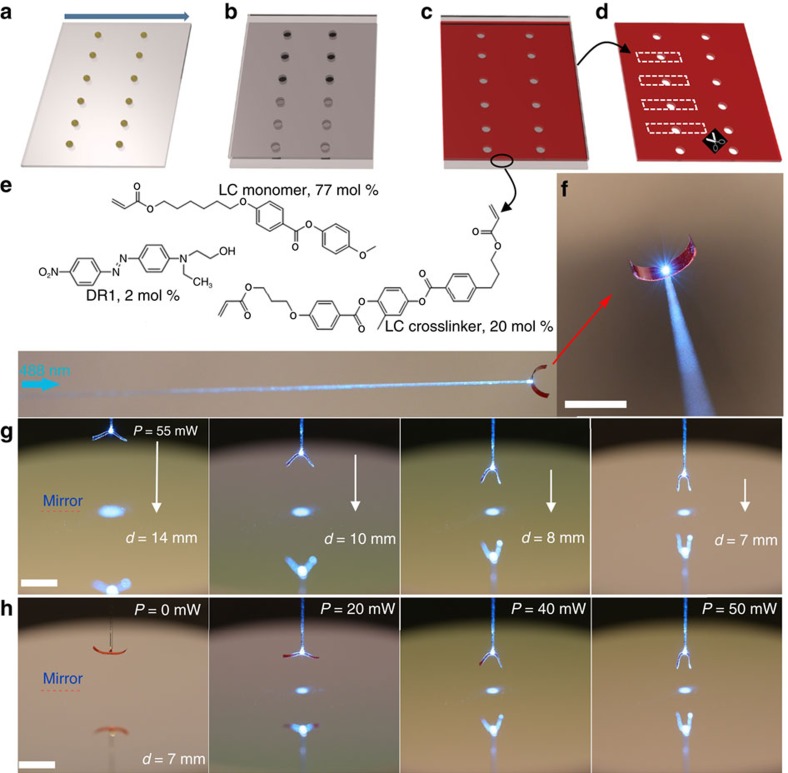
Figure 2. Realization of the autonomous gripper.
Schematic pictures of the fabrication process: (a) Arrays of UV curable resin are put on a glass substrate coated with rubbed PVA (the arrow indicates the rubbing direction). (b) A 20 μm LC cell is prepared by placing another glass slide coated with homeotropic alignment layer on the top, and subsequent curing with UV light to solidify the resin. (c) Liquid crystal monomers are infiltrated into the cell, and then UV-polymerized at 30 °C. (d) The cell is opened, and strips of LCE actuator are cut out from the substrate along the rubbing direction. (e) Chemical composition of the LC monomer mixture. (f) Optical images of the fabricated gripper after connecting to the fibre tip. (g) Gripper automatically closes while approaching to the mirror surface with a constant power of 55 mW. (h) At a constant distance d=7 mm, gripper can be switched between closed and open stages by manually tuning the light power (0, 20, 40, 50 mW). All scale bars correspond to 5 mm.
Figure 3
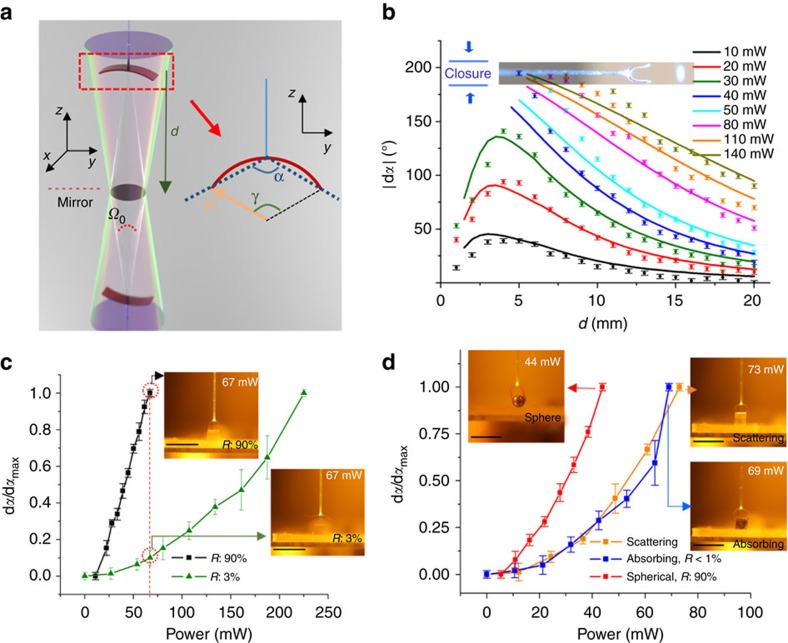
Figure 3. Recognition between targets by using feedback-type optical actuation.
(a) Schematic drawing of the geometry of the flytrap gripper. (b) Change in gripping angle |dα| as a function of distance d at different output powers P (points and lines are experimental and calculated data, respectively). Inset: photograph of the closed gripper with a maximum value in |dα|. Error bars indicate the imaging system accuracy (4°) in every single measurement. (c) Measured bending ratio dα/dαmax as a function of input power P for targets with high (R=90%) and low (R=3%) reflectivity. Insets: photographs of the gripper at its closed and open stages when meeting high-reflectivity and low-reflectivity targets, respectively (power 67 mW in both cases). (d) Measured bending ratio dα/dαmax as a function of input power P for a glass micro-sphere (R=90%), a highly absorbing (R<1%) and highly scattering PDMS targets. Insets: photographs of the closed gripper meeting different targets with different threshold powers: 44 mW for the micro-sphere, 73 mW for the scattering and 69 mW for the absorbing target. The error bars in c and d indicate the imaging system accuracy (4°) plus the s.d. for n=3 measurements. All scale bars correspond to 5 mm. An optical filter is used to block wavelengths below 500 nm for all the photographs.
Figure 4
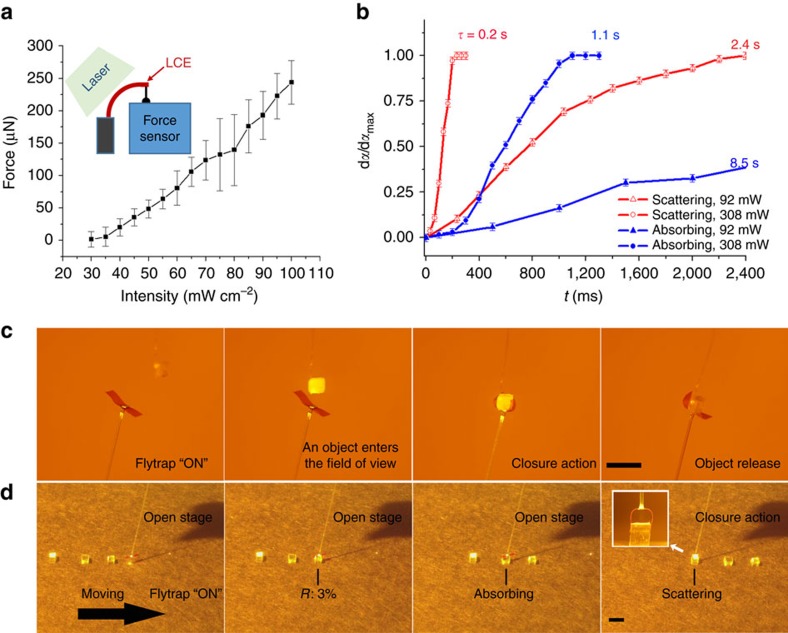
Figure 4. Flytrap-type capture motion and applications.
(a) Measured force from one LCE actuating arm as a function of illuminated laser intensity. Inset: schematic drawing of the experimental set up. Error bars indicate force sensor accuracy (10 μN) plus the s.d. for n = 3 measurements. (b) Response time of gripping motion for scattering and absorbing targets by using different laser powers. The error bars indicate the imaging system accuracy (4°) in single measurement. (c) The optical flytrap mimics the motion of a natural flytrap by capturing a small scattering object falling on the gripper (P=200 mW). (d) Demonstration of self-detection in a moving production line: no response to a transparent cubic (low reflectivity) or an absorbing cubic (long response time), automatic closure when meeting a highly scattering cubic, creating sufficient optical feedback. P=150 mW. Inset: zoom-in side-view optical image of gripping of the scattering cubic. All scale bars are 5 mm. An optical filter is used to block wavelengths below 500 nm for all the photographs.

References

    1. Wegst U. G. K., Bai H., Saiz E., Tomsia A. P. & Ritchie R. O. Bioinspired structural materials. Nat. Mater. 14, 23–36 (2014). - PubMed
    1. Zhao Y. et al. Progressive macromolecular self-assembly: from biomimetic chemistry to bio-inspired materials. Adv. Mater. 25, 5215–5256 (2013). - PubMed
    1. Morris E., Chavez M. & Tan C. Dynamic biomaterials: toward engineering autonomous feedback. Curr. Opin. Biotechnol. 39, 97–104 (2016). - PubMed
    1. Cully A., Clune J., Tarapore D. & Mouret J. B. Robots that can adapt like animals. Nature 521, 503–507 (2015). - PubMed
    1. Pfeifer R., Lungarella M. & Iida F. Self-organization, embodiment, and biologically inspired robotics. Science 318, 1088–1093 (2007). - PubMed

Publication types