Comparative Study
. 2017 May 23;7(5):e1137.
doi: 10.1038/tp.2017.104.

Shifting brain inhibitory balance and connectivity of the prefrontal cortex of adults with autism spectrum disorder

Affiliations
Comparative Study

Shifting brain inhibitory balance and connectivity of the prefrontal cortex of adults with autism spectrum disorder

L A Ajram et al. Transl Psychiatry. .

Abstract

Currently, there are no effective pharmacologic treatments for the core symptoms of autism spectrum disorder (ASD). There is, nevertheless, potential for progress. For example, recent evidence suggests that the excitatory (E) glutamate and inhibitory (I) GABA systems may be altered in ASD. However, no prior studies of ASD have examined the 'responsivity' of the E-I system to pharmacologic challenge; or whether E-I modulation alters abnormalities in functional connectivity of brain regions implicated in the disorder. Therefore, we used magnetic resonance spectroscopy ([1H]MRS) to measure prefrontal E-I flux in response to the glutamate and GABA acting drug riluzole in adult men with and without ASD. We compared the change in prefrontal 'Inhibitory Index'-the GABA fraction within the pool of glutamate plus GABA metabolites-post riluzole challenge; and the impact of riluzole on differences in resting-state functional connectivity. Despite no baseline differences in E-I balance, there was a significant group difference in response to pharmacologic challenge. Riluzole increased the prefrontal cortex inhibitory index in ASD but decreased it in controls. There was also a significant group difference in prefrontal functional connectivity at baseline, which was abolished by riluzole within the ASD group. Our results also show, for we believe the first time in ASD, that E-I flux can be 'shifted' with a pharmacologic challenge, but that responsivity is significantly different from controls. Further, our initial evidence suggests that abnormalities in functional connectivity can be 'normalised' by targeting E-I, even in adults.


Conflict of interest statement

The authors declare no conflict of interest.

Figures
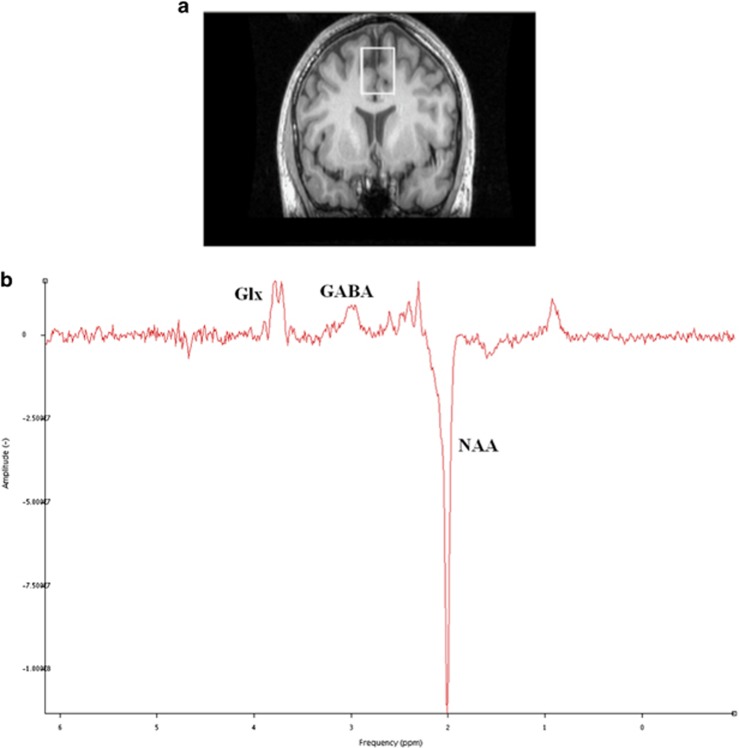
Figure 1
Figure 1
[1H]MRS voxel positions and example spectra. (a) Cortical region of interest; medial prefrontal cortex (mPFC) (25 × 30 × 40 mm3) outlined in white, comprising primarily of anterior cingulate cortex. (b) Example spectroscopy output from the prefrontal voxel (Glx (glutamate+glutamine); GABA; N-acetylaspartate (NAA) identified using jMRUI spectroscopy software.
Figure 2
Figure 2
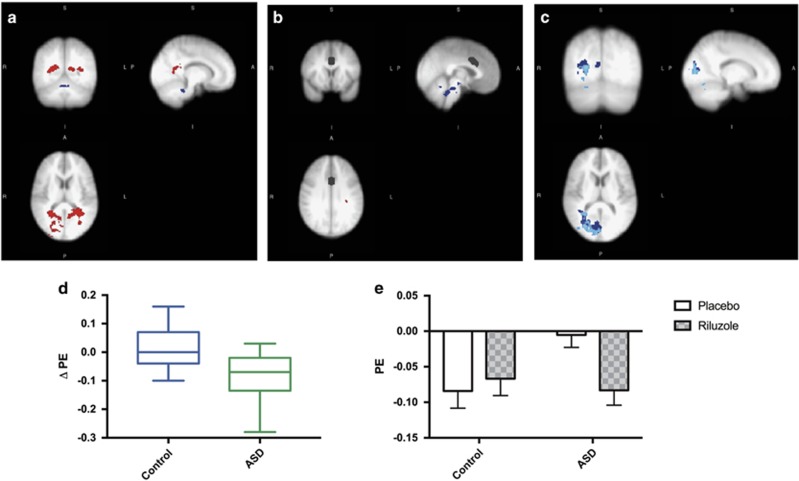
Functional connectivity differences between controls and ASD. (a) BASELINE: In the control group there was greater connectivity (an inverse correlation) between a prefrontal seed region and posterior regions compared to ASD (red). (b) The seed region (mPFC) is shown in black. (Also indicated is a restricted region of connectivity between mPFC and the brain stem/cerebellum (blue) in ASD at baseline). (c) RILUZOLE: Riluzole increased connectivity (an inverse correlation) between the prefrontal seed and posterior cortices in ASD only. Blue: riluzole<placebo (P<0.05, cluster-corrected). Light blue: voxels in which the within-subjects effect of riluzole vs. placebo is negative in ASD (P<0.05, cluster-corrected). (d) Change in functional connectivity elicited by Riluzole is significantly different between groups (t(26)=0.394, P<0.005). (e) Riluzole did not alter the functional connectivity of the prefrontal lobe in controls but ‘restored’ functional connectivity in the ASD group to control levels post riluzole (connectivity × group Interaction, two-way repeated measures ANOVA; F(1, 26)=9.696, P<0.005).
Figure 3
Figure 3
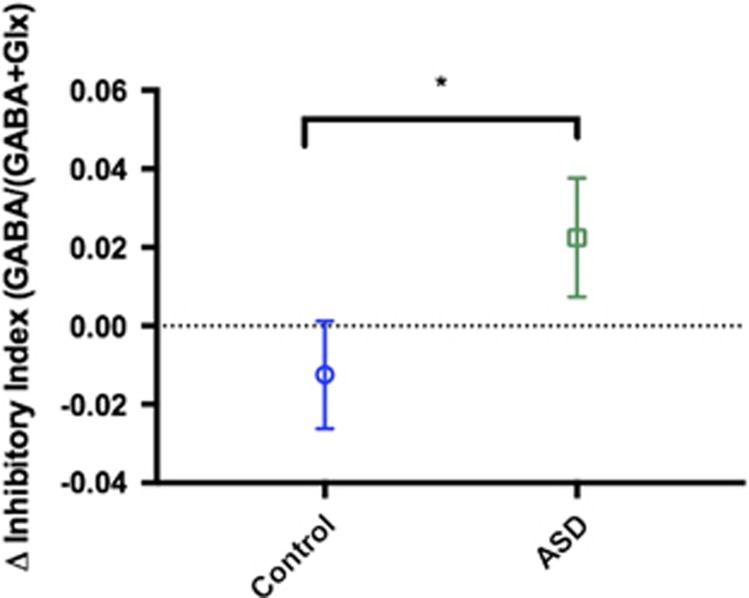
Riluzole increases inhibition in the prefrontal cortex of the autism spectrum disorder (ASD) group only. Riluzole increased the inhibitory index in the ASD group, not controls: *Drug × group interaction; F(1, 24)=4.288, P<0.05. Post-hoc analyses demonstrate a significant difference between groups in the change in inhibitory index after riluzole administration: ANCOVA; F(1, 27)=4.290, P<0.05. Results are expressed as mean (±s.e.m.) and are corrected for State anxiety score.
Figure 4
Figure 4
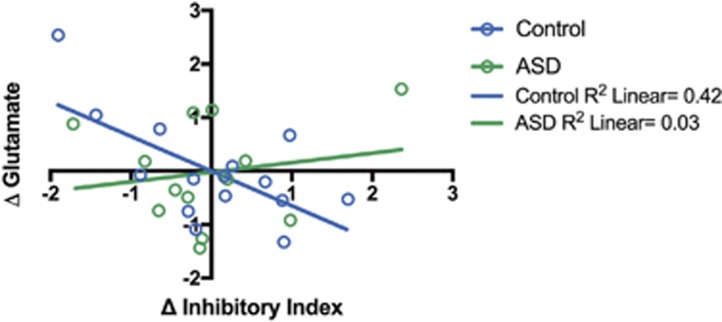
Inhibitory tone is regulated differently in men with and without autism spectrum disorder (ASD). The change in inhibitory index was negatively correlated with changes in Glx in controls (Pearson correlation; r=−0.705, P<0.01), but not men with ASD (r=0.357, P=0.28). Furthermore, there was a significant group difference in correlation coefficient (Fisher r to z transform, z=2.23, P<0.01). Results are expressed as z-scores ((value−mean)/standard deviation) and are corrected for State anxiety score.

References

    1. American Psychiatric Association.Diagnostic and Statistical Manual Of Mental Disorders, 5th edn. American Psychiatric Publishing: Arlington, VA, 2013.
    1. Gillberg C, Billstedt E. Autism and Asperger syndrome: coexistence with other clinical disorders. Acta Psychiatr Scand 2000; 102: 321–330. - PubMed
    1. Ecker C, Spooren W, Murphy DGM. Translational approaches to the biology of Autism: false dawn or a new era? Mol Psychiatry 2012; 18: 435–442. - PMC - PubMed
    1. Ching MSL, Shen Y, Tan W-H, Jeste SS, Morrow EM, Chen X et al. Deletions of NRXN1 (neurexin-1) predispose to a wide spectrum of developmental disorders. Am J Med Genet B Neuropsychiatr Genet 2010; 153B: 937–947. - PMC - PubMed
    1. Jamain S, Quach H, Betancur C, Råstam M, Colineaux C, Gillberg IC et al. Mutations of the X-linked genes encoding neuroligins NLGN3 and NLGN4 are associated with autism. Nat Genet. 2003; 34: 27–29. - PMC - PubMed

Publication types

MeSH terms