. 2017 Jun 22;60(12):4805-4817.
doi: 10.1021/acs.jmedchem.6b01336. Epub 2017 Jun 7.

BET Bromodomain Inhibitors with One-Step Synthesis Discovered from Virtual Screen

Affiliations

BET Bromodomain Inhibitors with One-Step Synthesis Discovered from Virtual Screen

Alex M Ayoub et al. J Med Chem. .

Erratum in

Abstract

Chemical inhibition of epigenetic regulatory proteins BrdT and Brd4 is emerging as a promising therapeutic strategy in contraception, cancer, and heart disease. We report an easily synthesized dihydropyridopyrimidine pan-BET inhibitor scaffold, which was uncovered via a virtual screen followed by testing in a fluorescence anisotropy assay. Dihydropyridopyimidine 3 was subjected to further characterization and is highly selective for the BET family of bromodomains. Structure-activity relationship data and ligand deconstruction highlight the importance of the substitution of the uracil moiety for potency and selectivity. Compound 3 was also cocrystallized with Brd4 for determining the ligand binding pose and rationalizing subsequent structure-activity data. An additional series of dihydropyridopyrimidines was synthesized to exploit the proximity of a channel near the ZA loop of Brd4, leading to compounds with submicromolar affinity and cellular target engagement. Given these findings, novel and easily synthesized inhibitors are being introduced to the growing field of bromodomain inhibitor development.


Figures
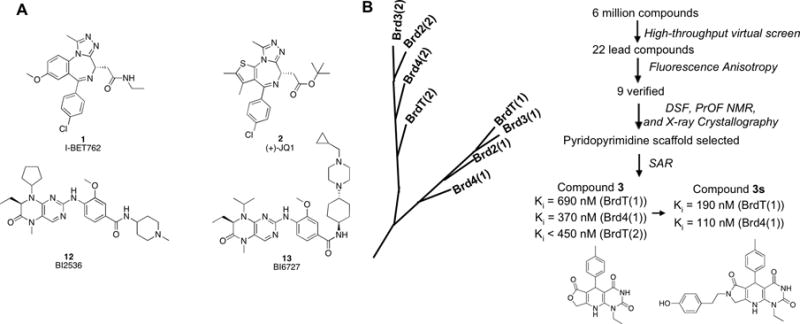
Figure 1
Figure 1
(A) BET bromodomain inhibitors 1, 2, BI2536 (12), and BI6727 (13). (B) Members of the BET branch of the bromodomain phylogenetic tree. Hits were identified by virtual screening, and binding potential of hits was assessed by fluorescence anisotropy (FA), differential scanning fluorimetry (DSF), and protein-observed 19F NMR (PrOF NMR). Structure-activity relationship (SAR) studies were subsequently conducted to probe the indicated dihydropyridopyrimidine hit compound. Optimization of compound 3 based on an x-ray co-crystal structure led to the development of compound 3s, with improved potency for both Brd4(1) and BrdT(1). The Ki values shown were determined by fluorescence anisotropy.
Figure 2
Figure 2
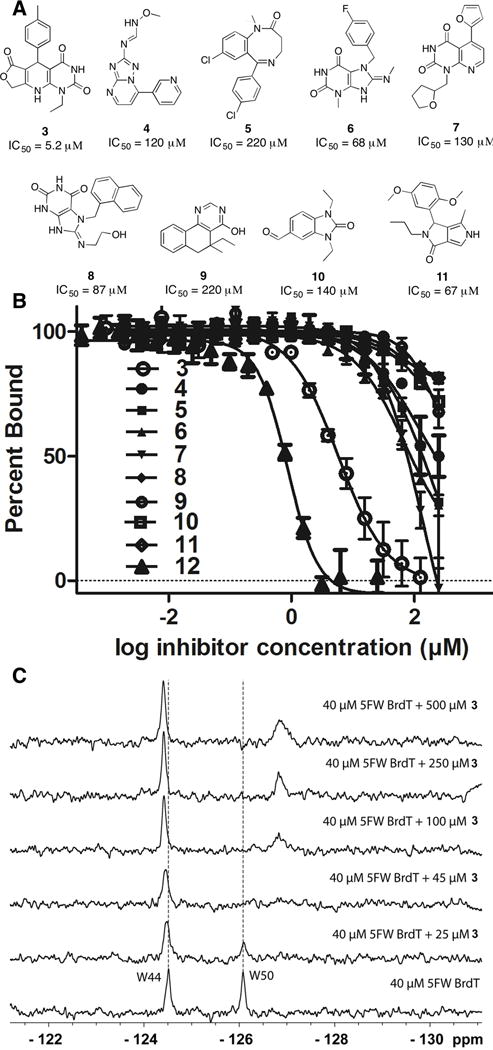
Compounds from high-throughput virtual screen tested for binding to BrdT(1) in a fluorescence anisotropy assay. (A) Of the 22 compounds tested, the nine shown here bound to BrdT(1). (B) Fluorescence anisotropy binding of compounds 312 to BrdT(1). Compound 3 (open circles), the tightest binder, was selected for further studies. (C) PrOF NMR titration of compound 3 into 5FW-BrdT(1). The dashed lines indicate the location of the unperturbed resonance.
Figure 3
Figure 3
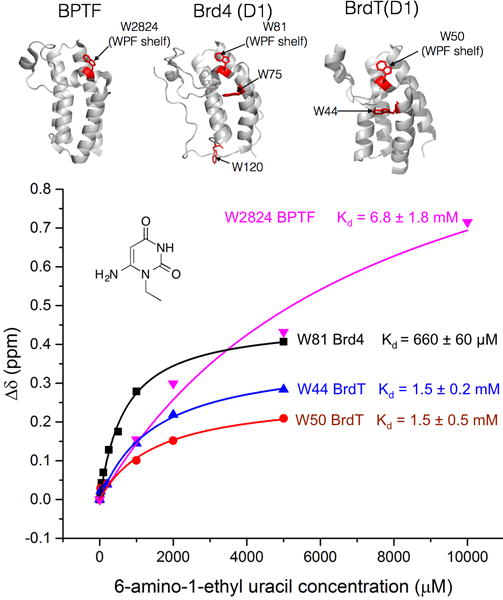
Binding isotherm showing chemical shift perturbation from a PrOF NMR titration of 6-amino-1-ethyluracil into 50 μM 5FW-Brd4(1), -BrdT(1), and -BPTF. Perturbed resonances for each protein and their respective Kd values are shown. The ribbon structure for each protein is also shown with tryptophan residues labeled in red. Residue assignment for 5FW-BrdT(1) is shown in Figure S9.
Figure 4
Figure 4
(A) PrOF NMR confirms binding of compound 3 to 5FW-Brd4(1). W81 in Brd4 and W50 in BrdT are broadened at 25 μM 3, and a new resonance begins to grow in at higher concentrations. Dashed lines reference the position of the resonance in the absence of ligand. The protein concentration was 45 μM in all experiments. (B) Compound 3 does not bind to non-BET bromodomain BPTF, shown by the similar spectra in the presence and absence of ligand. Protein concentration was 50 μM in all experiments. (C) Selectivity of 3 against a panel of bromodomains. BET bromodomains are in bromodomain family II.
Figure 5
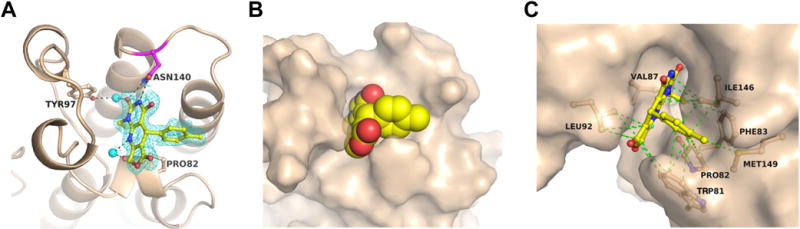
Figure 5. Co-crystal structure of Brd4(1) with compound 3
(A) Direct hydrogen bonding interactions (black dotted lines) of compound 3 with Asn140 and water-mediated interactions with Tyr97 and Pro82. The inhibitor is shown in yellow and the 2Fo−Fc electron density map (contoured at 1σ) is indicated as blue mesh. Water molecules are shown as cyan spheres. (B) Space filling model of the inhibitor bound to the acetylated lysine binding site. (C) Van der Waals interactions (green dotted lines) with mostly hydrophobic residues of the acetylated lysine binding site.
Figure 6
Figure 6
Western blot analysis of the effect of compounds 3p, 3q, 3r, and 3s on c-Myc and p21Cip1 levels. Compound 2 served as a positive control, and vinculin served as a loading control.
Scheme 1
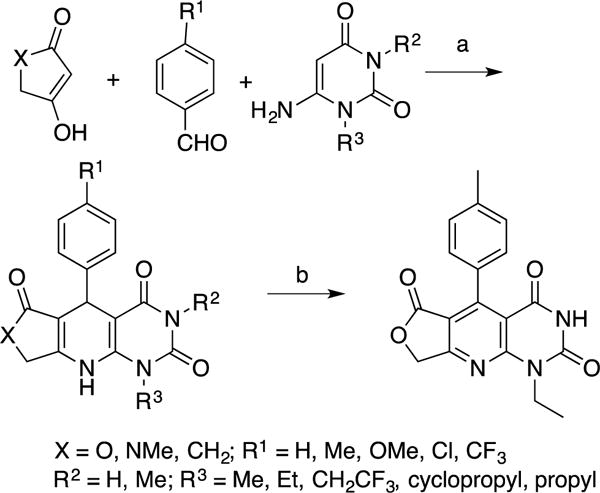
Scheme 1. Synthesis of dihydropyridopyrimidines 3–3m and pyridine 3na
aReagents and reaction conditions: (a) Acetic acid, 110 °C, 6 h, N2, 11–81%; (b) Compound 3, chloranil, DMSO, rt, 2 h, 87%.

References

    1. Matzuk MM, McKeown MR, Filippakopoulos P, Li Q, Ma L, Agno JE, Lemieux ME, Picaud S, Yu RN, Qi J, Knapp S, Bradner JE. Small-Molecule Inhibition of BRDT for Male Contraception Cell. 2012;150:673–684. - PMC - PubMed
    1. Prinjha RK, Witherington J, Lee K. Place Your BETs: the Therapeutic Potential of Bromodomains. Trends Pharmacol Sci. 2012;33:146–153. - PubMed
    1. Delmore JE, Issa GC, Lemieux ME, Rahl PB, Shi J, Jacobs HM, Kastritis E, Gilpatrick T, Paranal RM, Qi J, Chesi M, Schinzel AC, McKeown MR, Heffernan TP, Vakoc CR, Bergsagel PL, Ghobrial IM, Richardson PG, Young RA, Hahn WC, Anderson KC, Kung AL, Bradner JE, Mitsiades CS. BET Bromodomain Inhibition as a Therapeutic Strategy to Target C-Myc. Cell. 2011;146:904–917. - PMC - PubMed
    1. Filippakopoulos P, Knapp S. Targeting Bromodomains: Epigenetic Readers of Lysine Acetylation. Nat Rev Drug Discovery. 2014;13:337–356. - PubMed
    1. Li Z, Guo J, Wu Y, Zhou Q. The BET Bromodomain Inhibitor JQ1 Activates HIV Latency Through Antagonizing Brd4 Inhibition of Tat-Transactivation. Nucleic Acids Res. 2013;41:277–287. - PMC - PubMed

MeSH terms

LinkOut - more resources