


Housing First and harm reduction: a rapid review and document analysis of the US and Canadian open-access literature
- PMID: 28535804
- PMCID: PMC5442650
- DOI: 10.1186/s12954-017-0158-x
Housing First and harm reduction: a rapid review and document analysis of the US and Canadian open-access literature
Abstract
Background: Housing First is an evidence-based practice intended to serve chronically homeless individuals with co-occurring serious mental illness and substance use disorders. Despite housing active substance users, harm reduction is an often-overlooked element during the Housing First implementation process in real-world settings. In this paper, we explore the representation of the Housing First model within the open-access scholarly literature as a potential contributing factor for this oversight.
Methods: We conducted a rapid review of the US and Canadian open-access Housing First literature. We followed a document analysis approach, to form an interpretation of the articles' content related to our primary research questions.
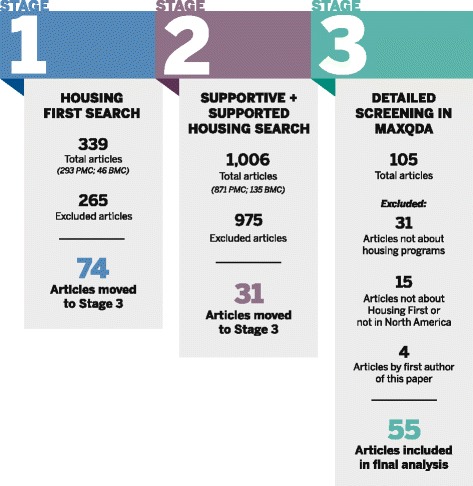
Results: A total of 55 articles on Housing First were included in the final analysis. Only 21 of these articles (38.1%) included explicit mention of harm reduction. Of the 34 articles that did not discuss harm reduction, 22 provided a description of the Housing First model indicating it does not require abstinence from substance use; however, descriptions did not all clearly indicate abstinence was not required beyond program entry. Additional Housing First descriptions focused on the low-barrier entry criteria and/or the intervention's client-centeredness.
Conclusions: Our review demonstrated a lack of both explicit mention and informed discussion of harm reduction in the Housing First literature, which is likely contributing to the Housing First research-practice gap to some degree. Future Housing First literature should accurately explain the role of harm reduction when discussing it in the context of Housing First programming, and public agencies promoting Housing First uptake should provide resources for proper implementation and monitor program fidelity to prevent model drift.
Keywords: Document analysis; Drug use; Fidelity; Harm reduction; Housing; Housing First; Implementation; Rapid review; Substance use.
Figures
References
-
- Tsemberis S, Asmussen S. From streets to homes—the Pathways to Housing Consumer Preference Supported Housing Model. Alcohol Treat Q. 1999;17:113–131. doi: 10.1300/J020v17n01_07. - DOI
-
- Gaetz S, Scott F, Gulliver T. Housing First in Canada: supporting communities to end homelessness. Canada Homelessness Research Network; 2013. https://yorkspace.library.yorku.ca/xmlui/handle/10315/29317. Accessed 22 Feb 2017.
-
- Homelessness USIC on. Opening doors: federal strategic plan to prevent and end homelessness. US Interagency Council on Homelessness; 2010.
-
- U.S. Substance Abuse and Mental Health Services Administration (SAMHSA). National Registry of Evidence-Based Programs and Practices. 2015. http://www.samhsa.gov/nrepp. Accessed 5 Feb 2017.
Publication types
MeSH terms
Grants and funding
LinkOut - more resources
Full Text Sources
Other Literature Sources
Miscellaneous
