


Income is an independent risk factor for worse asthma outcomes
- PMID: 28535964
- PMCID: PMC5696111
- DOI: 10.1016/j.jaci.2017.04.036
Income is an independent risk factor for worse asthma outcomes
Abstract
Background: Socioeconomic status (SES) is associated with asthma morbidity in observational studies, but the factors underlying this association are uncertain.
Objective: We investigated whether 3 SES correlates-low income, low education, and high perceived stress-were independent risk factors for treatment failure and asthma exacerbations in the context of a randomized controlled trial.
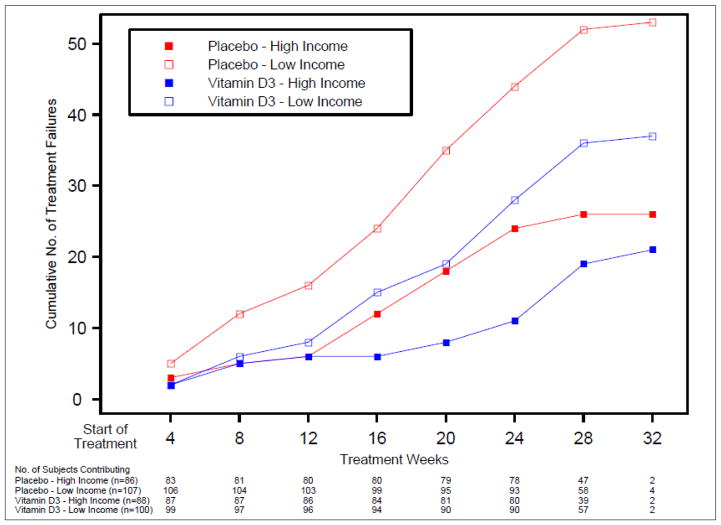
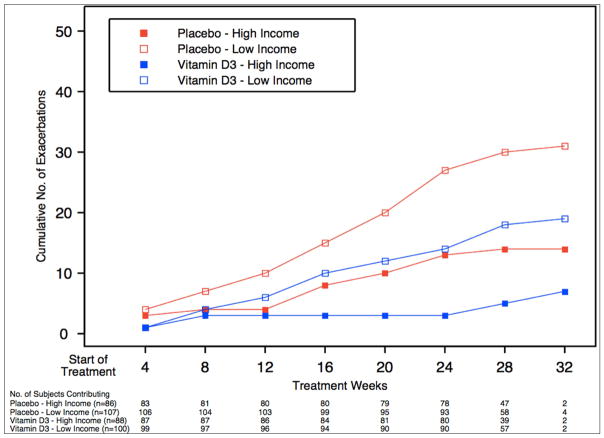
Methods: The effect of low SES (household income of <$50,000/y and household educational level of less than a Bachelor's degree) and high perceived stress (defined as a score of >20 on a perceived stress scale) on asthma morbidity was analyzed in 381 participants by using Poisson regression models. The primary outcome was treatment failure (defined in the trial protocol as a significant clinical or airflow deterioration), and the secondary outcome was asthma exacerbations requiring systemic corticosteroids.
Results: Fifty-four percent of participants had a low income, 40% had a low educational level, and 17% had high perceived stress levels. Even after adjusting for race and other important confounders, participants with lower income had higher rates of both treatment failures (rate ratio, 1.6; 95% CI, 1.1-2.3; P = .03) and exacerbations (rate ratio, 1.9; 95% CI, 1.1-3.3; P = .02). Adherence with inhaled corticosteroids was similarly high for both income categories. Education and perceived stress were not significantly associated with either outcome.
Conclusions: In the context of a randomized controlled trial, participants with lower income were more likely to experience adverse asthma outcomes independent of education, perceived stress, race, and medication adherence.
Keywords: Disparities; Vitamin D Add-On Therapy Enhances Corticosteroid trial; asthma exacerbation; education; low income; psychological stress; socioeconomic status.
Copyright © 2017 American Academy of Allergy, Asthma & Immunology. Published by Elsevier Inc. All rights reserved.
Conflict of interest statement
Figures
References
-
- Chen E, Paterson LQ. Neighborhood, family, and subjective socioeconomic status: How do they relate to adolescent health? Health Psychol. 2006;25:704–14. - PubMed
-
- Chen E, Miller GE. Socioeconomic status and health: mediating and moderating factors. Annu Rev Clin Psychol. 2013;9:723–49. - PubMed
-
- Chen E, Martin AD, Matthews KA. Socioeconomic status and health: do gradients differ within childhood and adolescence? Soc Sci Med. 2006;62:2161–70. - PubMed
Publication types
MeSH terms
Grants and funding
- UL1 TR000430/TR/NCATS NIH HHS/United States
- UL1 TR000150/TR/NCATS NIH HHS/United States
- U10 HL098075/HL/NHLBI NIH HHS/United States
- U19 AI095219/AI/NIAID NIH HHS/United States
- T32 AI007635/AI/NIAID NIH HHS/United States
- U10 HL098102/HL/NHLBI NIH HHS/United States
- U10 HL098115/HL/NHLBI NIH HHS/United States
- UL1 TR000050/TR/NCATS NIH HHS/United States
- UL1 TR000439/TR/NCATS NIH HHS/United States
- UL1 TR002003/TR/NCATS NIH HHS/United States
- UL1 TR000448/TR/NCATS NIH HHS/United States
- K12 HS022986/HS/AHRQ HHS/United States
- UL1 TR002345/TR/NCATS NIH HHS/United States
- U10 HL098098/HL/NHLBI NIH HHS/United States
- U01 AI110397/AI/NIAID NIH HHS/United States
- U10 HL098107/HL/NHLBI NIH HHS/United States
- U10 HL098096/HL/NHLBI NIH HHS/United States
- K23 AI125785/AI/NIAID NIH HHS/United States
- U10 HL098177/HL/NHLBI NIH HHS/United States
- UL1 TR001422/TR/NCATS NIH HHS/United States
- UL1 TR000454/TR/NCATS NIH HHS/United States
- U10 HL098103/HL/NHLBI NIH HHS/United States
- T32 AI007172/AI/NIAID NIH HHS/United States
- T32 HS000063/HS/AHRQ HHS/United States
- UL1 TR001082/TR/NCATS NIH HHS/United States
- UL1 TR001102/TR/NCATS NIH HHS/United States
- U10 HL098090/HL/NHLBI NIH HHS/United States
- U10 HL098112/HL/NHLBI NIH HHS/United States
- U10 HL064313/HL/NHLBI NIH HHS/United States
- K24 AI106822/AI/NIAID NIH HHS/United States
