. 2017 Jun 14;37(24):5960-5973.
doi: 10.1523/JNEUROSCI.0462-17.2017. Epub 2017 May 23.

Contrasting Modulatory Effects from the Dorsal and Ventral Premotor Cortex on Primary Motor Cortex Outputs

Affiliations

Contrasting Modulatory Effects from the Dorsal and Ventral Premotor Cortex on Primary Motor Cortex Outputs

Sandrine L Côté et al. J Neurosci. .

Abstract

The dorsal and ventral premotor cortices (PMd and PMv, respectively) each take part in unique aspects for the planning and execution of hand movements. These premotor areas are components of complex anatomical networks that include the primary motor cortex (M1) of both hemispheres. One way that PMd and PMv could play distinct roles in hand movements is by modulating the outputs of M1 differently. However, patterns of effects from PMd and PMv on the outputs of M1 have not been compared systematically. Our goals were to study how PMd within the same (i.e., ipsilateral or iPMd) and in the opposite hemisphere (i.e., contralateral or cPMd) can shape M1 outputs and then compare these effects with those induced by PMv. We used paired-pulse protocols with intracortical microstimulation techniques in sedated female cebus monkeys while recording EMG signals from intrinsic hand and forearm muscles. A conditioning stimulus was delivered in iPMd or cPMd concurrently or before a test stimulus in M1. The patterns of modulatory effects from PMd were compared with those from PMv collected in the same animals. Striking differences were revealed. Conditioning stimulation in iPMd induced more frequent and powerful inhibitory effects on M1 outputs compared with iPMv. In the opposite hemisphere, cPMd conditioning induced more frequent and powerful facilitatory effects than cPMv. These contrasting patterns of modulatory effects could allow PMd and PMv to play distinct functions for the control of hand movements and predispose them to undertake different, perhaps somewhat opposite, roles in motor recovery after brain injury.SIGNIFICANCE STATEMENT The dorsal and ventral premotor cortices (PMd and PMv, respectively) are two specialized areas involved in the control of hand movements in primates. One way that PMd and PMv could participate in hand movements is by modulating or shaping the primary motor cortex (M1) outputs to hand muscles. Here, we studied the patterns of modulation from PMd within the same and in the opposite hemisphere on the outputs of M1 and compared them with those from PMv. We found that PMd and PMv have strikingly different effects on M1 outputs. These contrasting patterns of modulation provide a substrate that may allow PMd and PMv to carry distinct functions for the preparation and execution of hand movements and for recovery after brain injury.

Keywords: cortex; hand movement; interaction; interhemispheric; intrahemispheric; network.


Figures

Figure 1.
Figure 1.
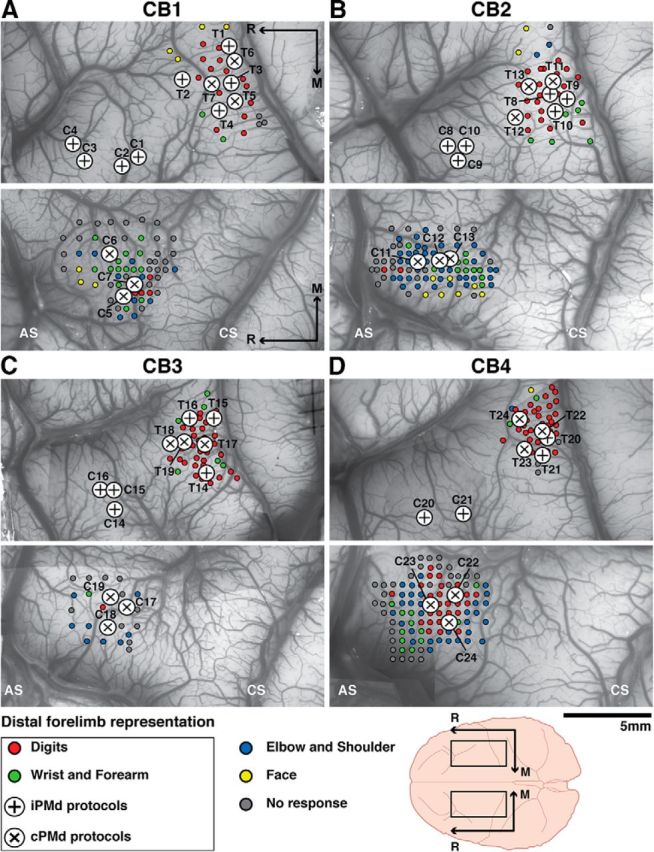
Cortical locations of the Cstim and Tstim electrodes selected for paired-pulse protocols. Motor mapping data evoked with ICMS trains (small colored dots) and cortical locations selected for Cstim and Tstim electrodes (large circles) for the paired-pulse protocols in CB1 (A), CB2 (B), CB3 (C), and CB4 (D). In each monkey, we first located the hand representations of M1 and cPMd with motor mapping techniques using ICMS trains and visual inspection of evoked movements. The hand representation of iPMd was then easily located by stimulating cortical sites in the area homotopic to cPMd in the ipsilateral hemisphere. Evoked movements with ICMS trains at threshold current intensity are color coded according to the legend at the bottom of the figure. Within M1, iPMd, and cPMd, only cortical sites evoking clear EMG activity in at least one intrinsic hand or forearm muscle with ICMS trains were selected for paired-pulse protocols. All of these sites were thus in the distal forelimb representations of M1, iPMd, and cPMd. Large circles with + show cortical sites used in protocols testing the effects of iPMd on M1 outputs and large circles with X show cortical sites used in protocols testing the effects of cPMd. CS, Central sulcus; AS, arcuate sulcus; M, medial; R, rostral.
Figure 2.
Figure 2.
Comparison of the conditioned responses with the probability distribution. A, Example of responses evoked in the PL with the C-only condition (n = 150) in iPMd for a given protocol. Because the current intensity for Cstim was subthreshold, no clear MEP is observed. Data across all following panels were recorded in PL during the same protocol. B, C, Responses evoked with the T-only condition (n = 150; B) and when the Cstim and Tstim were delivered simultaneously (ISI0; n = 150; C). D, Example of mean responses evoked in PL in the C+T condition with different ISIs in relation with the ± SD (gray area) obtained from the predicted MEPs (see Materials and Methods). Here, traces show responses when the Cstim preceded the Tstim by 0, 4, and 6 ms: ISI0 (red), ISI4 (gray), and ISI6 (blue), respectively. Open circles show EMG peak maximum values. E, Histogram of the probability distribution of predicted MEP peak amplitudes (n = 10,000) showing the probability of occurrence (y-axis) of predicted peaks with different amplitudes (x-axis). The black line and whiskers above the histogram indicate the mean and SD of the probability distribution. The colored dots on top show the values of the average peak amplitude obtained with ISI0 (red), ISI4 (gray), and ISI6 (blue) from the traces in D. The average peak amplitude with ISI0 was clearly greater than the probability distribution (Z-score = 10.47; p < 0.001) and the effect of iPMd was considered significantly facilitatory with this ISI. In contrast, the average peak amplitude with ISI6 was smaller than the probability distribution (Z-score = −4.45; p < 0.001) and the effect of iPMd was considered significantly inhibitory with this ISI. Finally, the average peak amplitude with ISI4 was within the probability distribution (Z-score = 0.16; p = 0.87) and it was concluded that this iPMd site had no effect on M1 outputs to PL with this ISI.
Figure 3.
Figure 3.
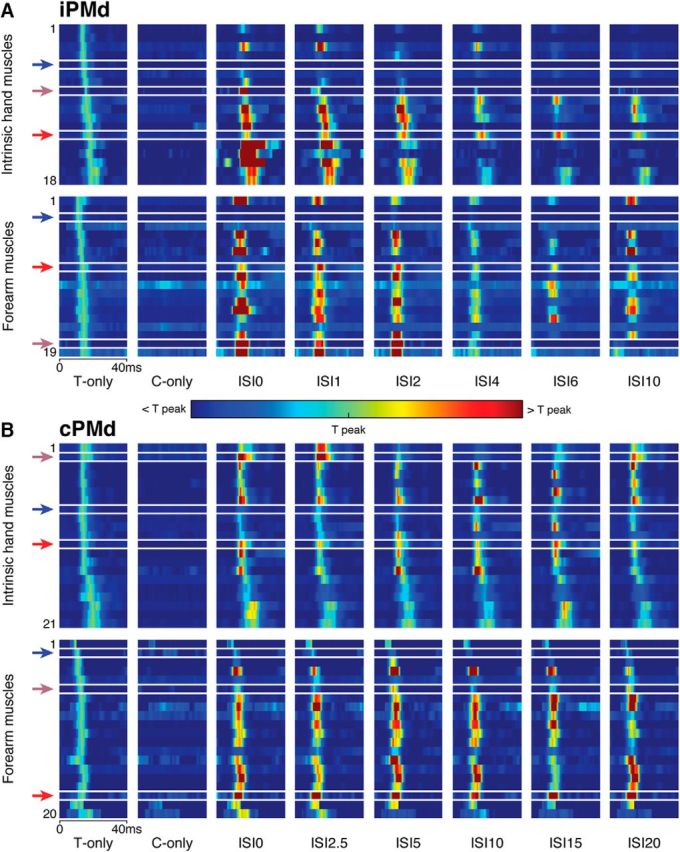
Complete dataset of modulatory effects of iPMd and cPMd on M1 outputs. A, Effects of iPMd conditioning on the 18 MEPs recorded in intrinsic hand muscles (FPB, APB; top) and the 19 MEPs recorded in forearm muscles (ECU, EDC, PL, FDS; bottom). Columns from left to right show the activity for 40 ms after the stimulation (time = 0) evoked in T-only trials, C-only trials, and the six different tested ISIs (0, 1, 2, 4, 6, and 10 ms). These responses are normalized to MEP peak intensity in the T-only condition (color scale below). Each row in the plots is an individual MEP ordered from top to bottom based on the peak latency in the T-only condition. Because the intensity of the Cstim was purposefully subthreshold, little activity is observed in the C-only condition. The red, blue, and purple arrows, respectively, highlight examples in which the conditioning stimulation in iPMd induced pure facilitation, pure inhibition, and opposite effects across ISIs. In general, iPMd conditioning appeared to induce more cases of facilitation (yellow to red colors) with shorter ISIs (ISI0, ISI1, and ISI2) and more cases of inhibition (light to dark blue colors) with longer ISIs (ISI4, ISI6, and ISI10). B, Effects of cPMd conditioning on the 21 MEPs recorded in intrinsic hand muscles (top) and the 20 MEPs recorded in forearm muscles (bottom). Columns and arrows are as in A, although different latencies were used for the tested ISIs (0, 2.5, 5, 10, 15, and 20 ms). In general, cPMd appeared to induce more facilitation with all ISIs, especially in forearm muscles.
Figure 4.
Figure 4.
Quantification of modulatory effects of iPMd and cPMd with each ISI. A, Incidence (left) and magnitude (right) of modulations in intrinsic hand muscles produced by iPMd with the different tested ISIs. In the left panel, each bar shows the proportion of the 18 MEPs that were significantly facilitated (red) or inhibited (blue) with each ISI. For example, when both the Cstim and Tstim were applied simultaneously (ISI0), 11 of the 18 MEPs (61.1%) had a significant increase of peak amplitude compared with the distribution of predicted peaks (facilitation) and four (22.2%) had a significant decrease of peak amplitude (inhibition). The right panel shows the magnitude of the modulations in intrinsic hand muscles produced by iPMd conditioning. The histogram presents the mean (±SE) of the positive and negative Z-scores with the different ISIs. B, Incidence (left) and magnitude (right) of modulations in forearm muscles produced by iPMd conditioning with each ISI. C, Data with all tested ISIs pooled for the incidence (left) and magnitude (right) to reveal the general modulatory effects produced by iPMd conditioning. Inhibitory effects induced by iPMd were significantly more powerful in intrinsic hand than in forearm muscles. D, Incidence (left) and magnitude (right) of modulations in intrinsic hand muscles produced by cPMd with the different tested ISIs. E, Incidence (left) and magnitude (right) of modulations in forearm muscles produced by cPMd with each ISI. F, Data with all tested ISIs pooled for the incidence (left) and magnitude (right) of modulations produced by cPMd conditioning. Facilitatory effects were significantly more common and more powerful in forearm than in intrinsic hand muscles. *Significant effects.
Figure 5.
Figure 5.
Comparison of the modulatory effects of PMd and PMv with each ISI. A, Comparison of the incidence (left) and magnitude (right) of modulations produced by iPMd and iPMv conditioning in all muscles combined with each ISI. The effects induced with iPMv conditioning (see-through gray) are overlaid on those induced with iPMd (red, facilitation; blue, inhibition). Accordingly, when PMv data overlap PMd data, the bar appears in light grayish red for facilitation and in light grayish blue for inhibition. B, Data with all tested ISIs pooled for the incidence (left) and magnitude (right) of modulations produced by iPMd and iPMv. Inhibitory effects were significantly more frequent and more powerful following iPMd compared with iPMv conditioning. C, Comparison of the incidence (left) and magnitude (right) of modulations produced by cPMd and cPMv conditioning in all muscles combined with each ISI. D, Data with all tested ISIs pooled for the incidence (left) and magnitude (right) of modulations produced by cPMd and cPMv. Facilitatory effects were significantly more frequent and more powerful after cPMd compared with cPMv conditioning. Inhibitory effects were significantly less frequent after cPMd compared with cPMv conditioning. *Significant effects.
Figure 6.
Figure 6.
Groups of modulatory effects across ISIs for PMd and PMv. A, Incidence of pure facilitatory, pure inhibitory, and opposite effects across ISIs for iPMd (colored bars) and iPMv (gray bars). For iPMd, there were fewer cases of pure facilitation (red) than pure inhibition (blue) and more cases of opposite effects across ISIs (purple). For iPMv, cases of pure facilitation were most common and opposite effects were the least common. However, the patterns of iPMd and iPMv across ISIs were not significantly different. B, Incidence of pure facilitatory, pure inhibitory, and opposite effects across ISIs for cPMd (colored bars) and cPMv (gray bars). For cPMd, we found many more cases of pure facilitation (red) than pure inhibition (blue) or opposite effects (purple) across ISIs. The proportions of pure facilitation and pure inhibition induced by cPMd and cPMv were significantly different. *Significant effects.
Figure 7.
Figure 7.
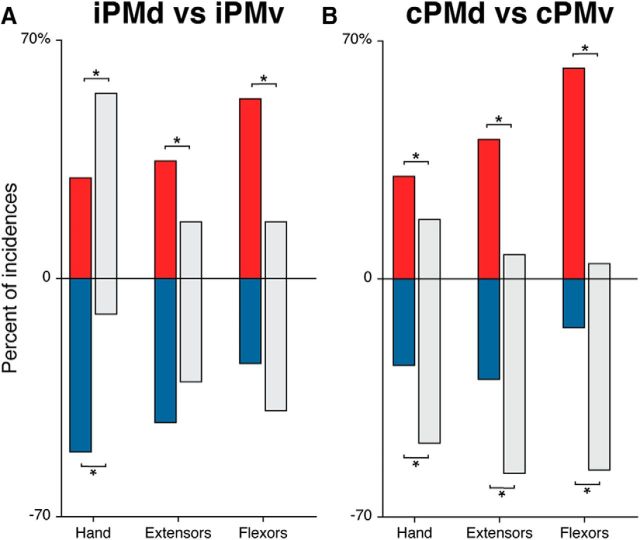
Modulatory effects of PMd and PMv on different muscle categories. A, Incidence of significant modulation induced by iPMd (colored bars) and iPMv (gray bars) in each functional category of muscles (hand, intrinsic hand; extensors, forearm extensors; flexors, forearm flexors). Conditioning stimulation in iPMd induced significantly fewer facilitatory effects (red) in intrinsic hand and more facilitatory effects in forearm muscles compared with iPMv. In contrast, significant differences in incidence of inhibitory effects were only observed for intrinsic hand muscles and they were more common after iPMd conditioning (blue) compared with iPMv conditioning. B, Incidence of significant modulation induced by cPMd (colored bars) and cPMv (gray bars) in each functional category of muscles. Facilitatory effects were significantly more common in all three muscle categories after cPMd conditioning (red) compared with cPMv conditioning. In contrast, inhibitory effects were significantly less common in all three muscle categories after cPMd conditioning (blue) compared with cPMv conditioning. These differences between the modulatory patterns of cPMd and cPMv were more pronounced in forearm muscles, especially in flexor muscles. *Significant effects.
Figure 8.
Figure 8.
Groups of modulatory effects across muscles for PMd and PMv. A, Incidence of pure facilitatory, pure inhibitory, and mixed effects across muscles for iPMd (colored bars) and iPMv (gray bars). Each bar represents the proportion of cases in which a given paired-pulse protocol (i.e., interactions between two cortical sites) induced pure facilitatory, pure inhibitory, or mixed effects across the various muscles modulated with a given ISI. We found that iPMd induced significantly more cases of pure inhibitory effects (blue) and fewer cases of mixed effects (purple) across muscles than iPMv. B, Incidence of pure facilitatory, pure inhibitory, and mixed effects across muscles for cPMd (colored bars) and cPMv (gray bars). We found that cPMd induced significantly more cases of pure facilitatory effects (red) and fewer cases of pure inhibitory effects (blue) across muscles than iPMv. *Significant effects.

References

    1. Asanuma H, Okuda O (1962) Effects of transcallosal volleys on pyramidal tract cell activity of cat. J Neurophysiol 25:198–208. - PubMed
    1. Baker SN, Lemon RN (1995) Non-linear summation of responses in averages of rectified EMG. J Neurosci Methods 59:175–181. 10.1016/0165-0270(94)00180-O - DOI - PubMed
    1. Baker SN, Olivier E, Lemon RN (1998) An investigation of the intrinsic circuitry of the motor cortex of the monkey using intra-cortical microstimulation. Exp Brain Res 123:397–411. 10.1007/s002210050585 - DOI - PubMed
    1. Bäumer T, Bock F, Koch G, Lange R, Rothwell JC, Siebner HR, Münchau A (2006) Magnetic stimulation of human premotor or motor cortex produces interhemispheric facilitation through distinct pathways. J Physiol 572:857–868. 10.1113/jphysiol.2006.104901 - DOI - PMC - PubMed
    1. Borra E, Belmalih A, Gerbella M, Rozzi S, Luppino G (2010) Projections of the hand field of the macaque ventral premotor area F5 to the brainstem and spinal cord. J Comp Neurol 518:2570–2591. - PubMed

Publication types

LinkOut - more resources