. 2017 Jul;9(7):906-917.
doi: 10.15252/emmm.201707608.

Abnormal glycogen chain length pattern, not hyperphosphorylation, is critical in Lafora disease

Affiliations

Abnormal glycogen chain length pattern, not hyperphosphorylation, is critical in Lafora disease

Felix Nitschke et al. EMBO Mol Med. 2017 Jul.

Abstract

Lafora disease (LD) is a fatal progressive epilepsy essentially caused by loss-of-function mutations in the glycogen phosphatase laforin or the ubiquitin E3 ligase malin. Glycogen in LD is hyperphosphorylated and poorly hydrosoluble. It precipitates and accumulates into neurotoxic Lafora bodies (LBs). The leading LD hypothesis that hyperphosphorylation causes the insolubility was recently challenged by the observation that phosphatase-inactive laforin rescues the laforin-deficient LD mouse model, apparently through correction of a general autophagy impairment. We were for the first time able to quantify brain glycogen phosphate. We also measured glycogen content and chain lengths, LBs, and autophagy markers in several laforin- or malin-deficient mouse lines expressing phosphatase-inactive laforin. We find that: (i) in laforin-deficient mice, phosphatase-inactive laforin corrects glycogen chain lengths, and not hyperphosphorylation, which leads to correction of glycogen amounts and prevention of LBs; (ii) in malin-deficient mice, phosphatase-inactive laforin confers no correction; (iii) general impairment of autophagy is not necessary in LD We conclude that laforin's principle function is to control glycogen chain lengths, in a malin-dependent fashion, and that loss of this control underlies LD.

Keywords: Lafora disease; glycogen chain length; glycogen phosphorylation; laforin; malin.


Figures

Figure 1
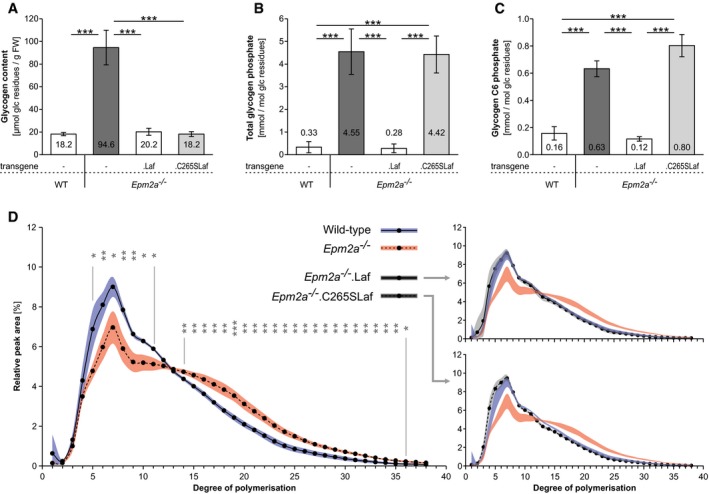
Figure 1. Phosphatase‐inactive laforin does not correct LD muscle glycogen hyperphosphorylation, but does correct its chain length distribution and prevents abnormal glycogen accumulation
Laf indicates WT laforin and C265Laf indicates phosphatase‐inactive laforin transgenes, respectively, expressed in indicated LD mouse model (Epm2a −/−).
  1. Glycogen content.

  2. Glycogen total phosphate content.

  3. Glycogen carbon C6 phosphate content.

  4. Chain length distribution analyses.

Data information: Means of > 5 biological replicates are presented as bars in (A–C) or as circles in (D). Standard deviations are presented as error bars in (A–C), or as blue (WT), red (Epm2a −/−) or grey shades (Epm2a −/−.Laf and Epm2a −/−.C265SLaf) in (D). Asterisks, statistical significance by ANOVA and post hoc analyses (*P < 0.05, **P < 0.01, ***P < 0.001; Appendix Table S1).
Figure 2
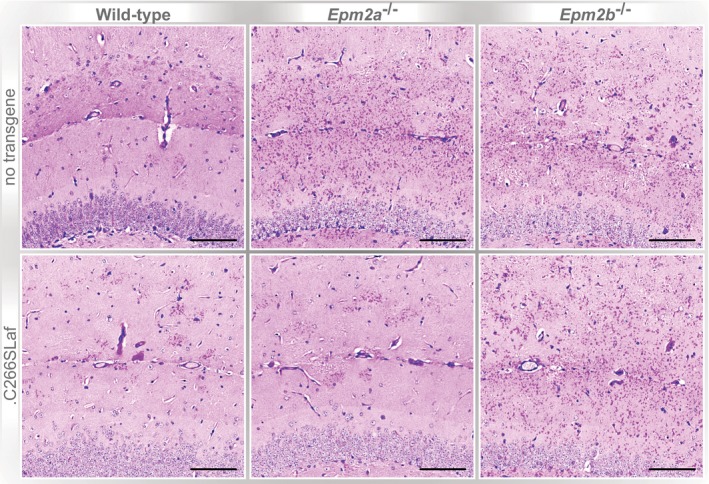
Figure 2. Phosphatase‐inactive laforin prevents Epm2a −/− but not Epm2b −/− from LB formation
Representative PASD‐stained sections of hippocampi from WT, Epm2a −/− and Epm2b −/− mice in the absence or presence of the human C266S mutated laforin transgene (.C266SLaf). Scale bar equals 100 μm.Source data are available online for this figure.
Figure 3
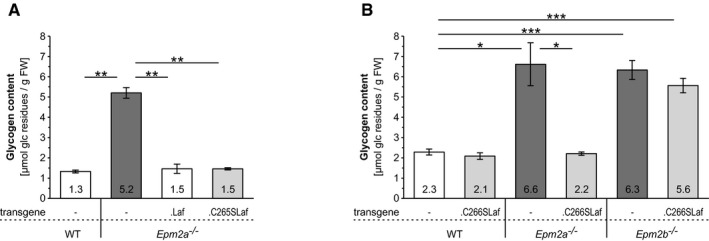
Figure 3. Phosphatase‐inactive laforin rescues Epm2a −/−, but not Epm2b −/− abnormal glycogen accumulation in the brain
  1. Brain glycogen levels in the presence or absence of WT (.Laf) or C265S mutated (.C265Laf) murine laforin transgene (tissues from the Gayarre et al, 2014 study).

  2. Brain glycogen levels of WT, Epm2a −/− and Epm2b −/− mice in the presence or absence of human C266S mutated laforin (.C266SLaf) (tissues from the new mice generated in the present study).
Data information: Data are presented as means of at least five biological replicates ± SEM. Asterisks, statistical significance by ANOVA and post hoc analyses (*P < 0.05, **P < 0.01, ***P < 0.001; Appendix Table S2).
Figure 4
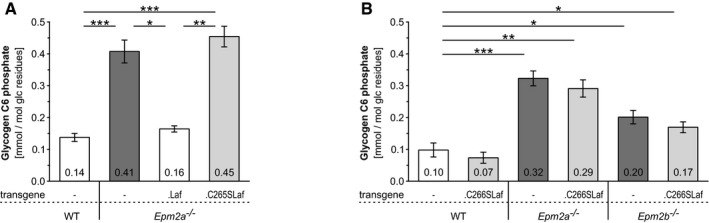
Figure 4. Phosphatase‐inactive laforin does not rescue glycogen hyperphosphorylation in Epm2a −/− or Epm2b −/− brain
  1. Brain glycogen carbon C6 phosphate levels in the presence or absence of WT (.Laf) or C265S mutated (.C265Laf) murine laforin transgene.

  2. Brain glycogen C6 phosphate levels of WT, Epm2a −/− and Epm2b −/− mice in the presence or absence of human C266S mutated laforin (.C266SLaf).
Data information: Data are presented as means of at least five biological replicates ± SEM. Asterisks, statistical significance by ANOVA and post hoc analyses (*P < 0.05, **P < 0.01, ***P < 0.001; Appendix Table S3).
Figure 5
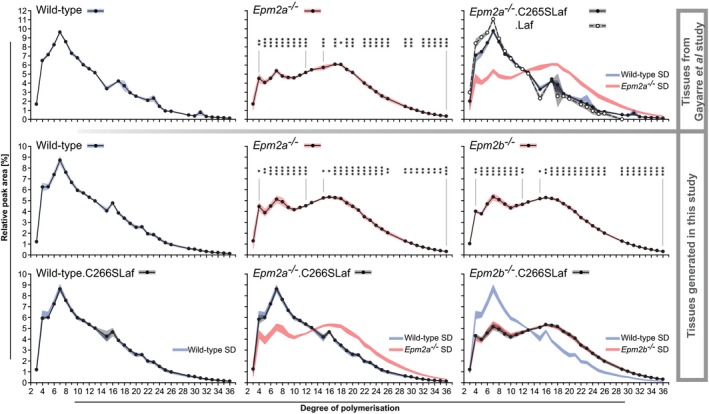
Figure 5. Phosphatase‐inactive laforin rescues brain glycogen chain length distribution in Epm2a −/− but not Epm2b −/− LD
Top row from tissues from the Gayarre et al (2014) study; bottom two rows from mice generated in the present work. Chain lengths (x‐axes) are given as degrees of polymerization (DP), that is, numbers of glucose units per chain. Laf indicates WT laforin transgene expressed in indicated LD genotype. C265SLaf and C266SLaf indicate phosphatase‐inactive murine or human laforin, respectively, expressed in indicated LD genotype. Data are presented as means of relative peak areas for each DP with shades representing standard deviation (SD; blue, WT; red, Epm2a −/− or Epm2b −/−; grey, indicated transgenic mice; n > 5, for Epm2a −/−.Laf samples were pooled). In all panels relating to transgenic mice, in addition to the chain length distribution in these mice, SD shades of WT or respective knockout mutants (Epm2a −/− or Epm2b −/−) are shown to allow direct comparisons of the chain length distribution curves. Asterisks, statistical significance by ANOVA and post hoc analyses with regard to DP abundances in respective WT glycogen (*P < 0.05, **P < 0.01, ***P < 0.001; Appendix Table S4).
Figure 6
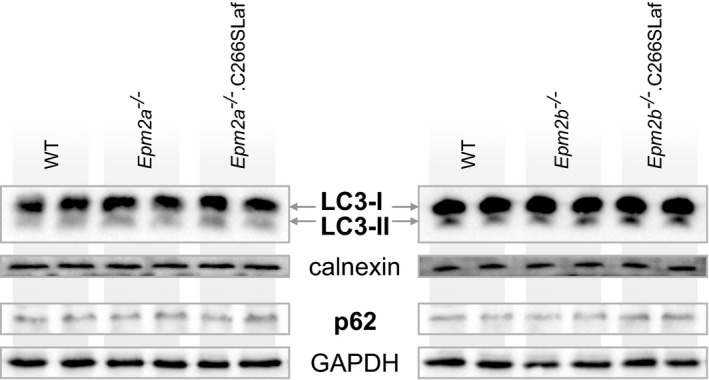
Figure 6. C266S laforin's effect on LD‐associated general defect in autophagy
Representative Western blots of autophagy markers LC3 and p62 in protein extracts from laforin‐ and malin‐deficient mouse brains and their respective WT tissues. Loading controls were calnexin for LC3 detection in an autophagosome‐enriched membrane fraction and GAPDH for soluble p62.
Figure 7
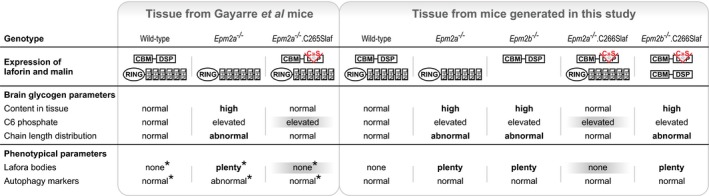
Figure 7. Summary of phosphatase‐inactive laforin's effect in LD mouse model brains
LD‐associated phenotypical parameters such as hippocampal LBs and autophagy impairment as well as brain glycogen content are compared with respect to the presence of laforin, malin, and the phosphatase‐inactive laforin transgene. Asterisks mark previously published results (Gayarre et al, 2014). Grey shadows emphasize the dissociation between hyperphosphorylation and LB occurrence. Bold letters indicate the association between abnormal chain length distribution and LBs.

References

    1. Aguado C, Sarkar S, Korolchuk VI, Criado O, Vernia S, Boya P, Sanz P, de Cordoba SR, Knecht E, Rubinsztein DC (2010) Laforin, the most common protein mutated in Lafora disease, regulates autophagy. Hum Mol Genet 19: 2867–2876 - PMC - PubMed
    1. Cenci U, Nitschke F, Steup M, Minassian BA, Colleoni C, Ball SG (2014) Transition from glycogen to starch metabolism in Archaeplastida . Trends Plant Sci 19: 18–28 - PubMed
    1. Chan EM, Bulman DE, Paterson AD, Turnbull J, Andermann E, Andermann F, Rouleau GA, Delgado‐Escueta AV, Scherer SW, Minassian BA (2003) Genetic mapping of a new Lafora progressive myoclonus epilepsy locus (EPM2B) on 6p22. J Med Genet 40: 671–675 - PMC - PubMed
    1. Chan EM, Ackerley CA, Lohi H, Ianzano L, Cortez MA, Shannon P, Scherer SW, Minassian BA (2004) Laforin preferentially binds the neurotoxic starch‐like polyglucosans, which form in its absence in progressive myoclonus epilepsy. Hum Mol Genet 13: 1117–1129 - PubMed
    1. Chu CT, Plowey ED, Dagda RK, Hickey RW, Cherra IS, Clark RSB (2009) Chapter 11 autophagy in neurite injury and neurodegeneration: in vitro and in vivo models In Methods in Enzymol, Klionsky DJ. (ed.), Vol. 453, pp 217–249. San Diego, CA: Academic Press; - PMC - PubMed