Review
. 2016 Jul 11;4(3):14.
doi: 10.3390/biomedicines4030014.

Antibody-Drug Conjugates for Cancer Therapy

Affiliations
Review

Antibody-Drug Conjugates for Cancer Therapy

Adam C Parslow et al. Biomedicines. .

Abstract

Antibody-drug conjugates (ADCs) take advantage of the specificity of a monoclonal antibody to deliver a linked cytotoxic agent directly into a tumour cell. The development of these compounds provides exciting opportunities for improvements in patient care. Here, we review the key issues impacting on the clinical success of ADCs in cancer therapy. Like many other developing therapeutic classes, there remain challenges in the design and optimisation of these compounds. As the clinical applications for ADCs continue to expand, key strategies to improve patient outcomes include better patient selection for treatment and the identification of mechanisms of therapy resistance.

Keywords: ADC; antibody–drug conjugate; cancer; immunotherapy; monoclonal antibodies; resistance.


Conflict of interest statement

Hui Gan has research funding from AbbVie Pharmaceuticals, is on an Advisory board for AbbVie and Merck Serono, and has received travel support/honoraria/speaker bureau for Merck Serono, AbbVie, Pfizer, Bayer, Novartis, and Merck. Andrew Scott has research funding support from AbbVie Pharmaceutics and Daiichi-Sankyo Co, is an inventor of mAb806, and has a consultancy and stock ownership of Life Science Pharmaceuticals. The authors have no other relevant affiliations or financial involvement with any organisation or entity with a financial interest in or financial conflict with the subject matter or materials discussed in the manuscript apart from those disclosed.

Figures
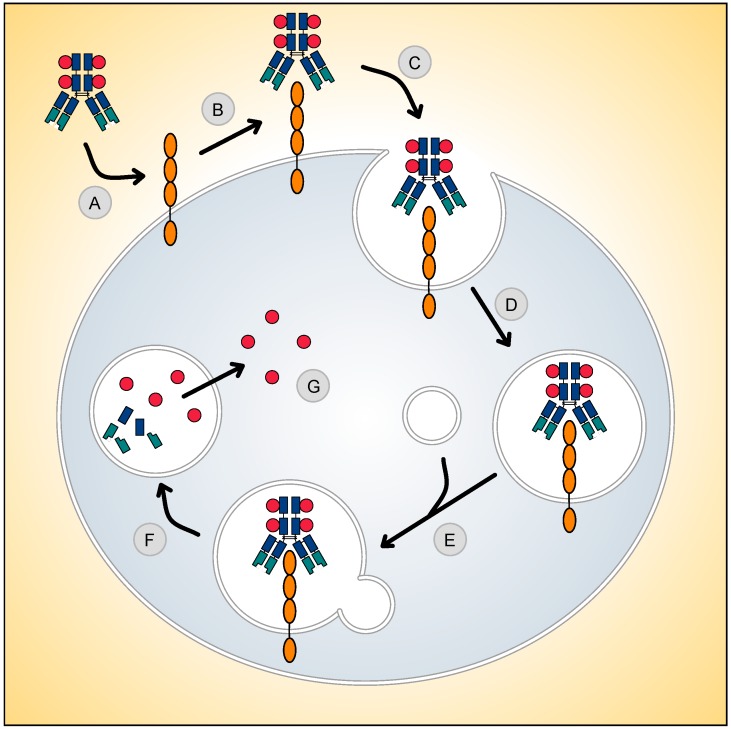
Figure 1
Figure 1
Mechanism of antibody–drug conjugate (ADC) action. (A) An ideal antigen target for ADC therapy is accessible via the circulation. (B) Following antigen binding, (C) the antigen-ADC complex is rapidly internalised into (D) endosomal vesicles and is processed along the (E) endosomal-lysosomal pathway. (F) In this acidic and proteolytic rich environment, degradation occurs, (G) resulting in the intracellular release of cytotoxic compound.
Figure 2
Figure 2
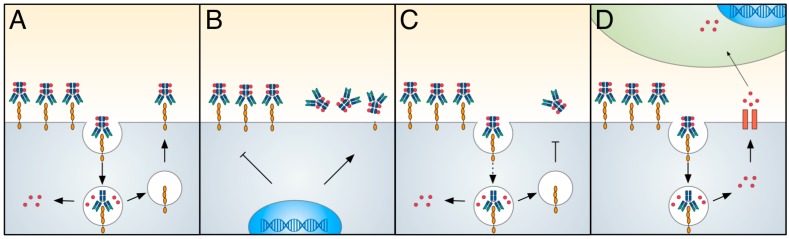
Resistance mechanism for antibody–drug conjugate (ADC) therapies. (A) An effective ADC therapy is dependent on high levels of intracellular cytotoxic payload delivery. Multiple mechanisms have been identified which influence the delivery and retention of cytotoxic payloads. (B) Reduced antigen on the cell surface can result from reduced target gene expression or presence of increased antigen mutations. (C) Reduced cell surface trafficking or recycling will also reduce ADC internalisation. (D) ADC payloads are targets for multidrug resistance (MDR) transporter efflux out of the cell, potentially inducing bystander killing effects (payload-dependent).

References

    1. Schwartz R.S. Paul Ehrlich’s magic bullets. N. Engl. J. Med. 2004;350:1079–1080. doi: 10.1056/NEJMp048021. - DOI - PubMed
    1. Scott A.M., Wolchok J.D., Old L.J. Antibody therapy of cancer. Nat. Rev. Cancer. 2012;12:278–287. doi: 10.1038/nrc3236. - DOI - PubMed
    1. Shuptrine C.W., Surana R., Weiner L.M. Monoclonal antibodies for the treatment of cancer. Semin. Cancer Biol. 2012;22:3–13. doi: 10.1016/j.semcancer.2011.12.009. - DOI - PMC - PubMed
    1. Kubota T., Niwa R., Satoh M., Akinaga S., Shitara K., Hanai N. Engineered therapeutic antibodies with improved effector functions. Cancer Sci. 2009;100:1566–1572. doi: 10.1111/j.1349-7006.2009.01222.x. - DOI - PMC - PubMed
    1. Sievers E.L., Senter P.D. Antibody–Drug Conjugates in Cancer Therapy. Annu. Rev. Med. 2013;64:15–29. doi: 10.1146/annurev-med-050311-201823. - DOI - PubMed