


Core Outcome Measures for Clinical Research in Acute Respiratory Failure Survivors. An International Modified Delphi Consensus Study
- PMID: 28537429
- PMCID: PMC5694837
- DOI: 10.1164/rccm.201702-0372OC
Core Outcome Measures for Clinical Research in Acute Respiratory Failure Survivors. An International Modified Delphi Consensus Study
Abstract
Rationale: Research evaluating acute respiratory failure (ARF) survivors' outcomes after hospital discharge has substantial heterogeneity in terms of the measurement instruments used, creating barriers to synthesizing study data.
Objectives: To identify a minimum set of core outcome measures that are essential to include in all clinical research studies evaluating ARF survivors after discharge.
Methods: We conducted a three-round modified Delphi consensus process with 77 participants (47% female, 55% outside the United States), including clinical researchers from more than 16 countries across six continents, patients/caregivers, clinicians, and research funders. Participants reviewed standardized information on measure instruments for seven consensus-derived outcomes plus one recommended outcome.
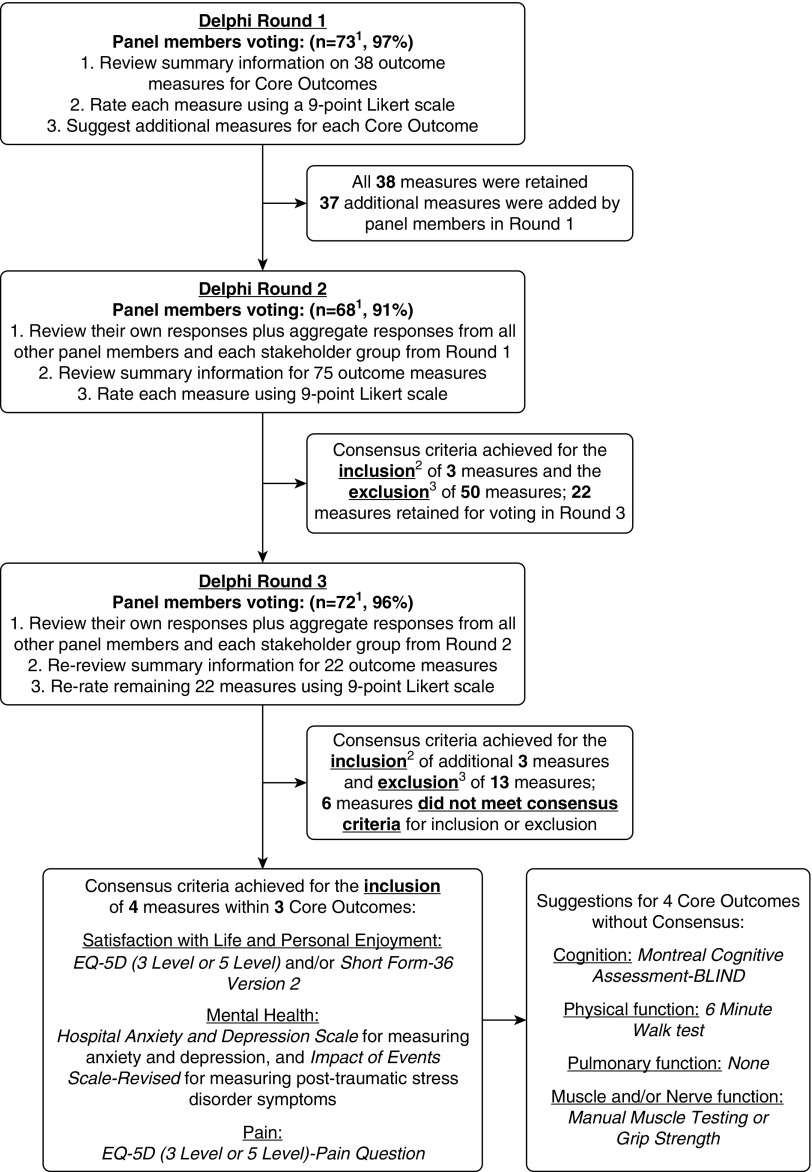
Measurements and main results: Response rates were 91 to 97% across the three rounds. Among 75 measurement instruments evaluated, the following met a priori consensus criteria: EQ-5D and 36-item Short Form Health Survey version 2 (optional) for the "satisfaction with life and personal enjoyment" and "pain" outcomes, and both the Hospital Anxiety and Depression Scale and the Impact of Events Scale-Revised for the "mental health" outcome. No measures reached consensus for the following outcomes: cognition, muscle and/or nerve function, physical function, and pulmonary function. All measures considered for pulmonary function met consensus criteria for exclusion. The following measures did not reach the threshold for consensus but achieved the highest scores for their respective outcomes: the Montreal Cognitive Assessment (cognition), manual muscle testing and handgrip dynamometry (muscle and/or nerve function), and 6-minute-walk test (physical function).
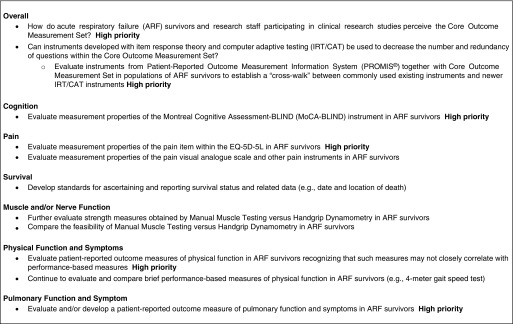
Conclusions: This Core Outcome Measurement Set is recommended for use in all clinical research evaluating ARF survivors after hospital discharge. In the future, researchers should evaluate measures for outcomes not reaching consensus.
Keywords: Core Outcome Measurement Set; clinical trials; follow-up studies; intensive care; patient outcome assessment.
Figures
Comment in
-
Coloring by Number? Core Outcome Measures and the Canvas of Intensive Care Unit Survivorship.Am J Respir Crit Care Med. 2017 Nov 1;196(9):1087-1089. doi: 10.1164/rccm.201706-1239ED. Am J Respir Crit Care Med. 2017. PMID: 28699762 Free PMC article. No abstract available.
References
-
- Angus DC, Mira JP, Vincent JL. Improving clinical trials in the critically ill. Crit Care Med. 2010;38:527–532. - PubMed
-
- Angus DC, Carlet J 2002 Brussels Roundtable Participants. Surviving intensive care: a report from the 2002 Brussels Roundtable. Intensive Care Med. 2003;29:368–377. - PubMed
-
- Lieu TA, Au D, Krishnan JA, Moss M, Selker H, Harabin A, Taggart V, Connors A Comparative Effectiveness Research in Lung Diseases Workshop Panel. Comparative effectiveness research in lung diseases and sleep disorders: recommendations from the National Heart, Lung, and Blood Institute workshop. Am J Respir Crit Care Med. 2011;184:848–856. - PMC - PubMed
-
- Needham DM, Davidson J, Cohen H, Hopkins RO, Weinert C, Wunsch H, Zawistowski C, Bemis-Dougherty A, Berney SC, Bienvenu OJ, et al. Improving long-term outcomes after discharge from intensive care unit: report from a stakeholders’ conference. Crit Care Med. 2012;40:502–509. - PubMed
MeSH terms
Grants and funding
LinkOut - more resources
Full Text Sources
Other Literature Sources
Medical
Miscellaneous
