Beyond Body Mass Index: Using Anthropometric Measures and Body Composition Indicators to Assess Odds of an Endometriosis Diagnosis
- PMID: 28537460
- PMCID: PMC5646748
- DOI: 10.1089/jwh.2016.6128
Beyond Body Mass Index: Using Anthropometric Measures and Body Composition Indicators to Assess Odds of an Endometriosis Diagnosis
Abstract
Background: Body mass index (BMI) and endometriosis have been inversely associated. To address gaps in this research, we examined associations among body composition, endometriosis, and physical activity.
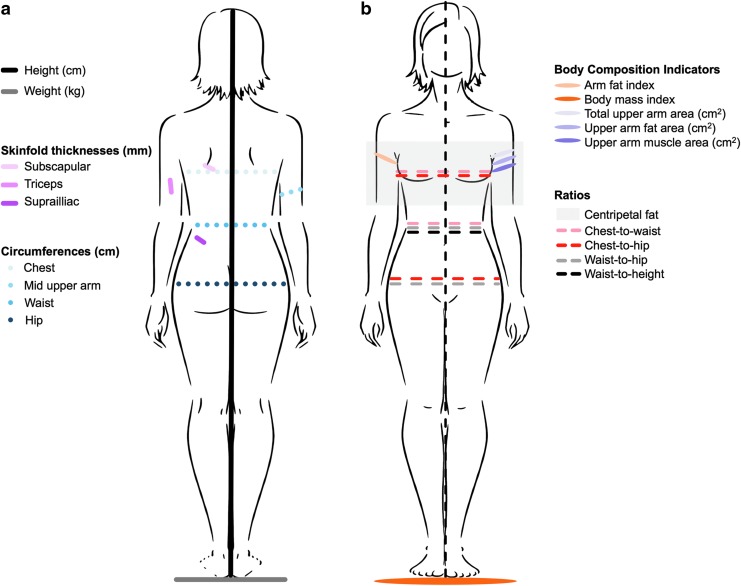
Materials and methods: Women from 14 clinical sites in the Salt Lake City, Utah and San Francisco, California areas and scheduled for laparoscopy/laparotomy were recruited during 2007-2009. Participants (N = 473) underwent standardized anthropometric assessments to estimate body composition before surgery. Using a cross-sectional design, odds of an endometriosis diagnosis (adjusted odds ratio [aOR]; 95% confidence interval [CI]) were calculated for anthropometric and body composition measures (weight in kg; height in cm; mid upper arm, waist, hip, and chest circumferences in cm; subscapular, suprailiac, and triceps skinfold thicknesses in mm; arm muscle and fat areas in cm2; centripetal fat, chest-to-waist, chest-to-hip, waist-to-hip, and waist-to-height ratios; arm fat index; and BMI in kg/m2). Physical activity (metabolic equivalent of task-minutes/week) and sedentariness (average minutes sitting on a weekday) were assessed using the International Physical Activity Questionnaire-Short Form. Measures were modeled continuously and in quartiles based on sample estimates. Adjusted models were controlled for age (years, continuous), site (Utah/California), smoking history (never, former, or current smoker), and income (below, within 180%, and above of the poverty line). Findings were standardized by dividing variables by their respective standard deviations. We used adjusted models to examine whether odds of an endometriosis diagnosis were moderated by physical activity or sedentariness.
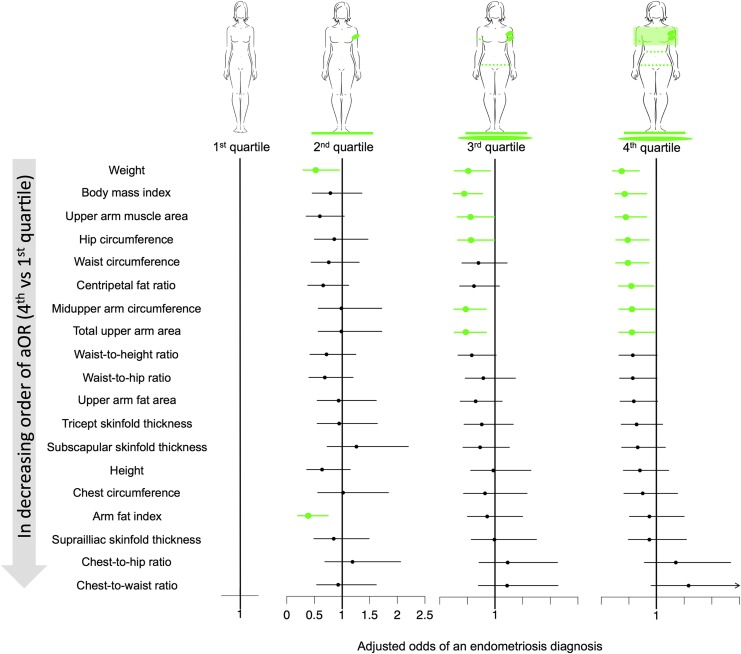
Results: Inverse relationships were observed between endometriosis and standardized: weight (aOR = 0.71, 95% CI 0.57-0.88); subscapular skinfold thickness (aOR = 0.79, 95% CI 0.65-0.98); waist and hip circumferences (aOR = 0.79, 95% CI 0.64-0.98 and aOR = 0.76, 95% CI 0.61-0.94, respectively); total upper arm and upper arm muscle areas (aOR = 0.76, 95% CI 0.61-0.94 and aOR = 0.74, 95% CI 0.59-0.93, respectively); and BMI (aOR = 0.75, 95% CI 0.60-0.93), despite similar heights. Women in the highest versus lowest quartile had lower adjusted odds of an endometriosis diagnosis for: weight; mid-upper arm, hip, and waist circumferences; total upper arm and upper arm muscle areas; BMI; and centripetal fat ratio. There was no evidence of a main effect or moderation of physical activity or sedentariness.
Conclusion: In a surgical cohort, endometriosis was inversely associated with anthropometric measures and body composition indicators.
Keywords: adiposity; anthropometry; body composition; endometriosis; muscle mass.
Conflict of interest statement
None of the authors have any commercial associations that might create a conflict of interest in connection with submitted article.
Figures
References
-
- Olive DL, Schwartz LB. Endometriosis. N Engl J Med 1993;328:1759–1769 - PubMed
Publication types
MeSH terms
Grants and funding
LinkOut - more resources
Full Text Sources
Other Literature Sources
Medical