


Older Australians Can Achieve High Adherence to the Mediterranean Diet during a 6 Month Randomised Intervention; Results from the Medley Study
- PMID: 28538676
- PMCID: PMC5490513
- DOI: 10.3390/nu9060534
Older Australians Can Achieve High Adherence to the Mediterranean Diet during a 6 Month Randomised Intervention; Results from the Medley Study
Abstract
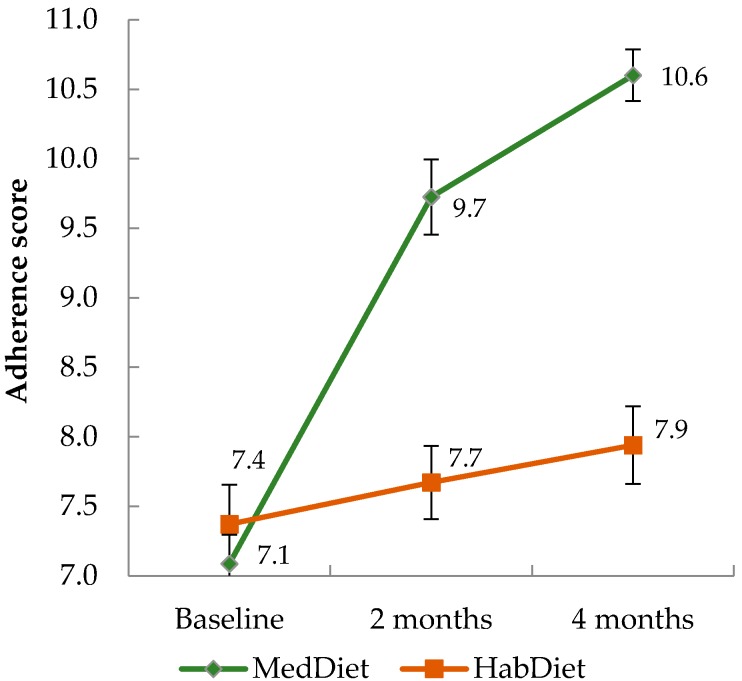
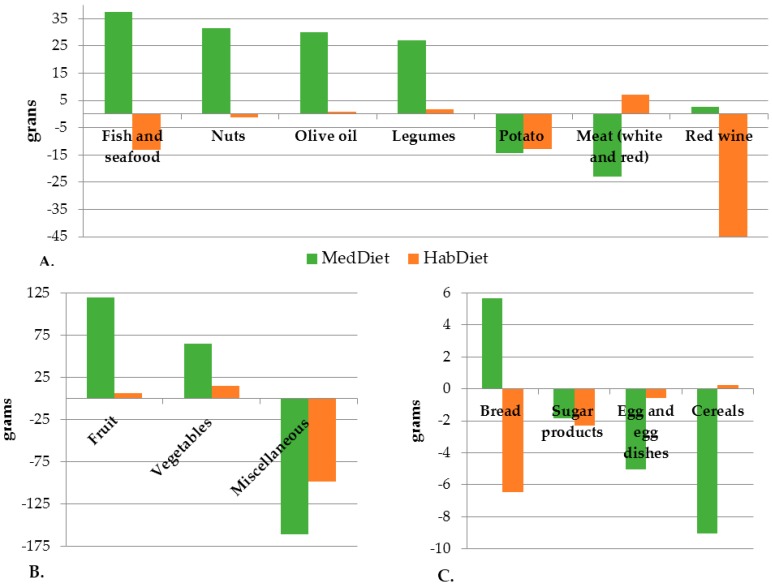
Adherence to a Mediterranean diet (MedDiet) is thought to be achievable in non-Mediterranean regions, but this has yet to be investigated. We aimed to determine if an older Australian population could adhere to a MedDiet for six months. We conducted a randomised, parallel dietary intervention trial with two dietary arms: the Mediterranean diet (MedDiet) group and the habitual diet (HabDiet) control group. A 15-point Mediterranean diet adherence score and food and nutrient intakes were estimated from three-day weighed food records collected at baseline, two and four months. Erythrocyte fatty acids, serum carotenoids and urinary metabolites were assessed at baseline, three and six months. We enrolled 166 participants; 152 commenced and 137 completed the study (70 in the MedDiet group, 67 in the HabDiet group). Adherence scores were significantly higher in the MedDiet group at two months (between group difference 2.2, 95% CI 1.3, 2.9) and four months (between group difference 2.6, 95% CI 1.9, 3.3). Consumption of vegetables, fruits, fish, legumes, nuts and olive oil significantly increased in the MedDiet group compared to the control, and discretionary food intake decreased (p < 0.01). Measures of compliance including serum β-carotene, lycopene and erythrocyte monounsaturated fatty acids were significantly higher in the MedDiet group at three and six months (p < 0.05). Our results indicate that a population of older Australians can adopt a Mediterranean diet over a six month period.
Keywords: Australia; Mediterranean diet; adherence; elderly; food intake; nutrients.
Conflict of interest statement
The authors declare no conflict of interest. The founding sponsors had no role in the design of the study; in the collection, analyses, or interpretation of data; in the writing of the manuscript, and in the decision to publish the results.
Figures
References
-
- Kromhout D., Menotti A., Bloemberg B., Aravanis C., Blackburn H., Buzina R., Dontas A.S., Fidanza F., Giampaoli S., Jansen A., et al. Dietary saturated and trans fatty acids and cholesterol and 25-year mortality from coronary heart disease: The Seven Countries Study. Prev. Med. 1995;24:308–315. doi: 10.1006/pmed.1995.1049. - DOI - PubMed
-
- Kromhout D., Keys A., Aravanis C., Buzina R., Fidanza F., Giampaoli S., Jansen A., Menotti A., Nedeljkovic S., Pekkarinen M., et al. Food consumption patterns in the 1960s in seven countries. Am. J. Clin. Nutr. 1989;49:889–894. - PubMed
-
- Willett W.C., Sacks F., Trichopoulou A., Drescher G., Ferro-Luzzi A., Helsing E., Trichopoulos D. Mediterranean diet pyramid: A cultural model for healthy eating. Am. J. Clin. Nutr. 1995;61(Suppl. S6):1402S–1406S. - PubMed
Publication types
MeSH terms
Substances
LinkOut - more resources
Full Text Sources
Other Literature Sources
