


Effects of age-related shifts in cellular function and local microenvironment upon the innate immune response to implants
- PMID: 28539184
- PMCID: PMC5612855
- DOI: 10.1016/j.smim.2017.05.001
Effects of age-related shifts in cellular function and local microenvironment upon the innate immune response to implants
Abstract
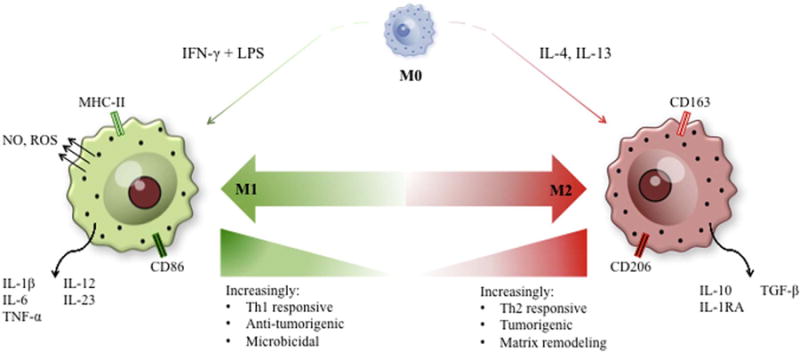
The host macrophage response is now well recognized as a predictor of the success or failure of biomaterial implants following placement. More specifically, shifts from an "M1" pro-inflammatory towards a more "M2-like" anti-inflammatory macrophage polarization profile have been shown to result in enhanced material integration and/or tissue regeneration downstream. As a result, a number of biomaterials-based approaches to controlling macrophage polarization have been developed. However, the ability to promote such activity is predicated upon an in-depth, context-dependent understanding of the host response to biomaterials. Recent work has shown the impacts of both tissue location and tissue status (i.e. underlying pathology) upon the host innate immune response to implants, representing a departure from a focus upon implant material composition and form. Thus, the ideas of "biocompatibility," the host macrophage reaction, and ideal material requirements and modification strategies may need to be revisited on a patient, tissue, and disease basis. Immunosenescence, dysregulation of macrophage function, and delayed resolution of immune responses in aged individuals have all been demonstrated, suggesting that the host response to biomaterials in aged individuals should differ from that in younger individuals. However, despite the increasing usage of implantable medical devices in aged patients, few studies examining the effects of aging upon the host response to biomaterials and the implications of this response for long-term integration and function have been performed. The objective of the present manuscript is to review the putative effects of aging upon the host response to implanted materials and to advance the hypothesis that age-related changes in the local microenvrionement, with emphasis on the extracellular matrix, play a previously unrecognized role in determining the host response to implants.
Keywords: Aging; Host response; Implant; Macrophage; Polarization.
Copyright © 2017 Elsevier Ltd. All rights reserved.
Figures
References
-
- Anderson JM. Inflammatory response to implants. ASAIO Trans. 1988;34(2):101–107. - PubMed
-
- Klopfleisch R, Jung F. The pathology of the foreign body reaction against biomaterials. J Biomed Mater Res A. 2016 - PubMed
-
- Rice JM, et al. Quantitative assessment of the response of primary derived human osteoblasts and macrophages to a range of nanotopography surfaces in a single culture model in vitro. Biomaterials. 2003;24(26):4799–4818. - PubMed
-
- Paul NE, et al. Topographical control of human macrophages by a regularly microstructured polyvinylidene fluoride surface. Biomaterials. 2008;29(30):4056–4064. - PubMed
Publication types
MeSH terms
Substances
Grants and funding
LinkOut - more resources
Full Text Sources
Other Literature Sources
Medical
Research Materials
