. 2017 May 24;7(1):2352.
doi: 10.1038/s41598-017-02598-z.

The PB2 mutation with lysine at 627 enhances the pathogenicity of avian influenza (H7N9) virus which belongs to a non-zoonotic lineage

Affiliations

The PB2 mutation with lysine at 627 enhances the pathogenicity of avian influenza (H7N9) virus which belongs to a non-zoonotic lineage

Weixuan Li et al. Sci Rep. .

Abstract

A novel avian-origin influenza A (H7N9) virus emerged in China in 2013 and has caused zoonotic disease in over 1123 persons with an overall mortality around 30%. Amino acid changes at the residues 591, 627 and 701 of polymerase basic protein 2 (PB2) have been found frequently in the human H7N9 isolates but not in viruses isolated from avian species. We have recently identified a cluster of H7N9 viruses in ducks which circulated in China prior to the first recognition of zoonotic disease in 2013. These duck viruses have genetic background distinct from the zoonotic H7N9 lineage. We found that the introduction of PB2 mutation with K at 627 but not K at 591 or N at 701 to the duck H7N9 virus led to increased pathogenicity in mice. We also found that the induction of pro-inflammatory cytokines including TNF-α, IP-10, MCP-1 and MIP-1α were associated with increased severity of infection. We conclude that introduction of the mammalian adaptation mutations into the PB2 gene of duck H7N9 viruses, which are genetically unrelated to the zoonotic H7N9 lineage, can also enhance pathogenicity in mice.


Conflict of interest statement

The authors declare that they have no competing interests.

Figures
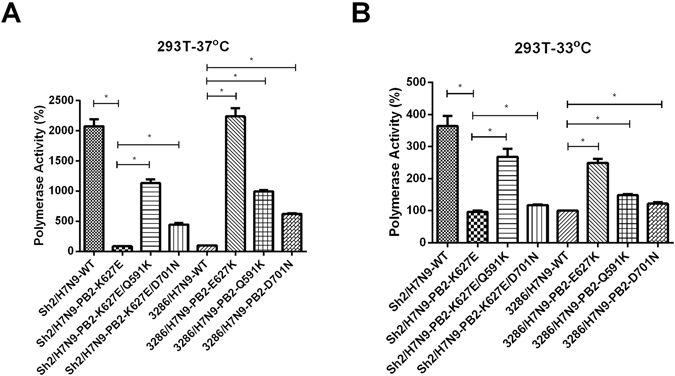
Figure 1
Figure 1
Polymerase activity of the H7N9 and the PB2 mutants. 293 T cells were transfected with plasmids containing PB2, PB1, PA, NP genes of either duck 3286/H7N9 or zoonotic Sh2/H7N9 plus a control luciferase reporter plasmid and a viral UTR-driven luciferase reporter plasmid. After transfection, the 293 T cells were cultured at (A) 37 °C and (B) 33 °C for 24 hour. Luciferase activity was then assayed from the cell extracts. Results are the average of three independent experiments. The values were statistical analyzed by two tailed, non-paired t-test. *p < 0.05.
Figure 2
Figure 2
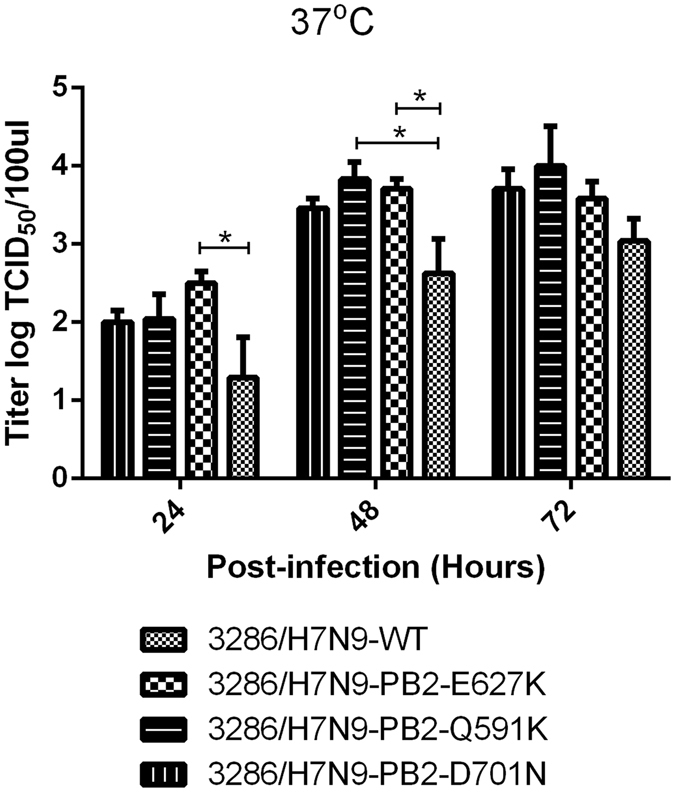
Replication kinetics of the duck 3286/H7N9 variants on A549 cells. A549 cells were infected with the indicated viruses at an MOI of 0.01 and cultured at 37 °C in the presence of TPCK-trypsin at 0.2 ug/ml respectively. Culture supernatants were harvested at the indicated times and virus titers were determined by TCID50 assay. Results are the average of three independent experiments. The viral titers in PB2 mutants were compared to the recombinant wild type virus using the two tailed, non-paired t-test. *p < 0.05.
Figure 3
Figure 3
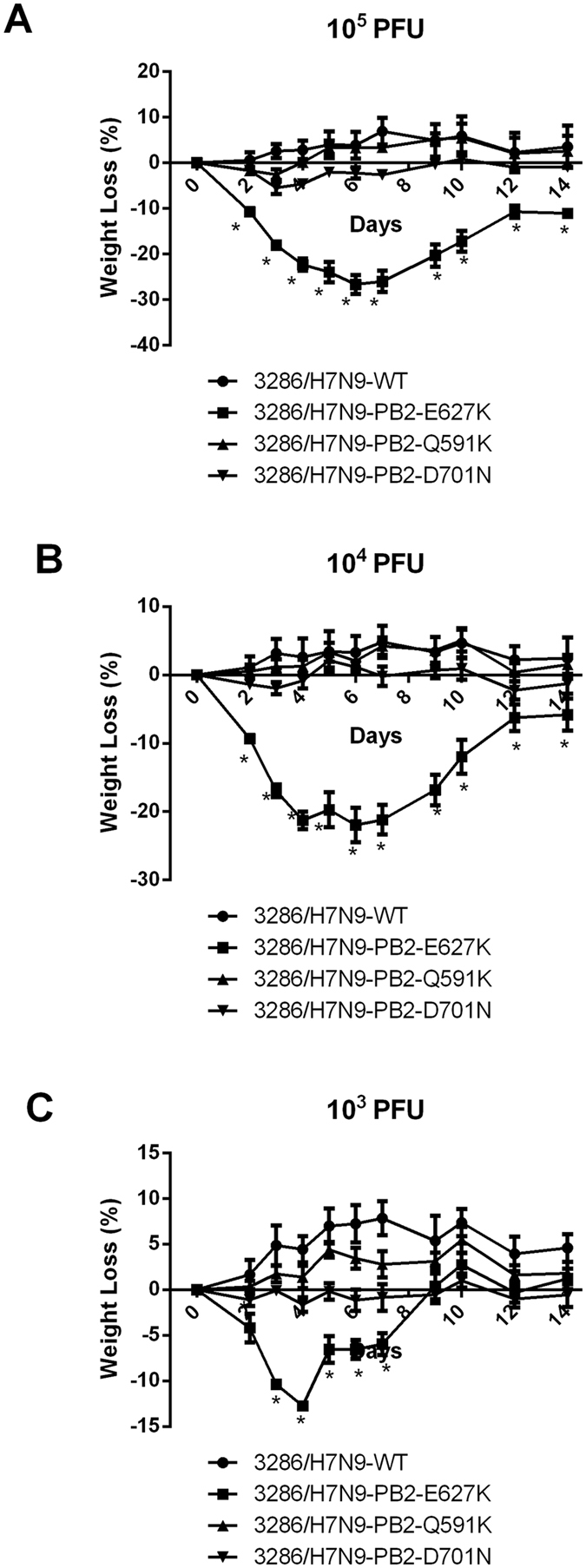
The weight change of the mice infected with the duck 3286/H7N9 and its PB2 mutants. Female BALB/c mice were infected intranasally with (A) 105 PFU (B) 104 PFU (C) 103 PFU of the indicated viruses. The virus infected mice were monitored for 14 days and their weight were determined. Results from each group and each time point are expressed as mean ± SD of six infected mice from two independent experiments. The values were statistically analyzed by two tailed, non-paired t-test. *p < 0.05.
Figure 4
Figure 4
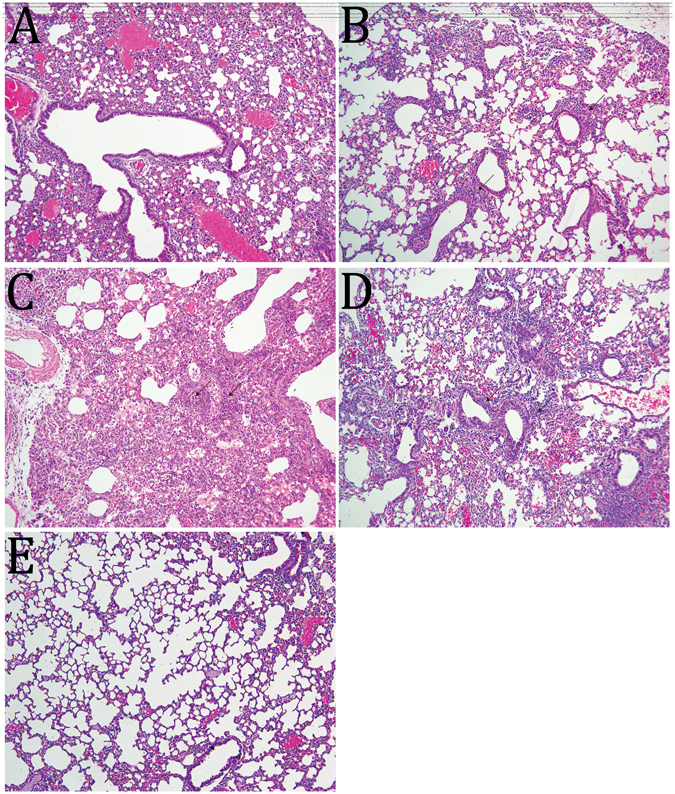
Histopathology of the mice infected with the duck 3286/H7N9 and its PB2 mutants. Histopathology of lung sections were determined from the samples stained by haematoxylin-eosin from mice infected with (A) duck 3286/H7N9, (B) 3286/H7N9-PB2- Q591K (C) 3286/H7N9-PB2-E627K (D) 3286/H7N9-PB2- D701N (E) Mock at 6 days post-infection. Magnification 100X. Arrow: Neutrophils infiltration.
Figure 5
Figure 5
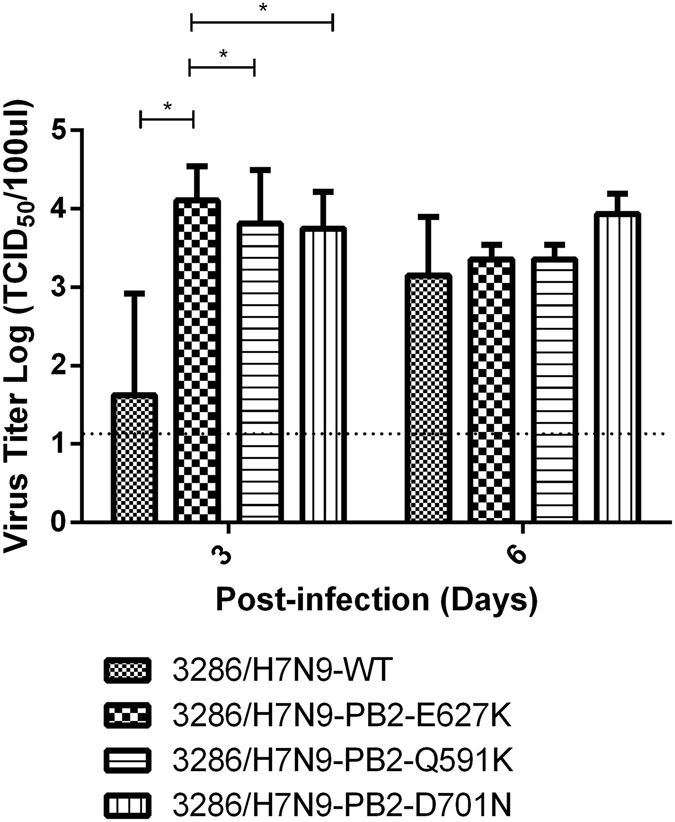
Lung virus titers of mice infected with duck 3286/H7N9 and its PB2 mutants. BALB/c mice were infected with the indicated viruses at 1 × 105 PFU. Infected mice were sacrificed on 3 and 6 days post-infection, and virus titers in lung homogenates were measured in MDCK cells. Results from each group and each time point are expressed as mean ± SD of six infected mice from two independent experiments. The values were statistically compared with the wild type 3286/H7N9 using the two tailed, non-paired t-test. *p < 0.05.
Figure 6
Figure 6
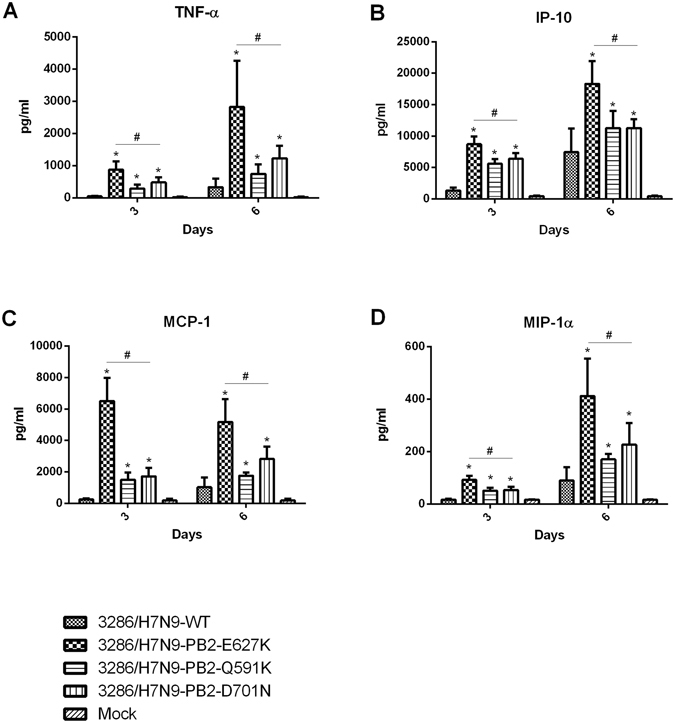
Cytokine responses in the lungs of mice infected with duck 3286/H7N9 and its PB2 mutants. Cytokine levels (A) TNF-α (B) IP-10 (C) MCP-1 (D) MIP-1α from virus infected lungs (n = 6 mice per virus group, days 3, 6 post-inoculation) were measured individually by the FlowCytomix system. Results from each time point are expressed as mean ± SD of six infected mice from two independent experiments. *The values were statistically compared with the wild type 3286/H7N9 using the two tailed, non-paired t-test. p < 0.05. #The values were statistically compared between the 3286/H7N9-PB2-E627K and other PB2 mutants using the two tailed, non-paired t-test. p < 0.05.
Figure 7
Figure 7
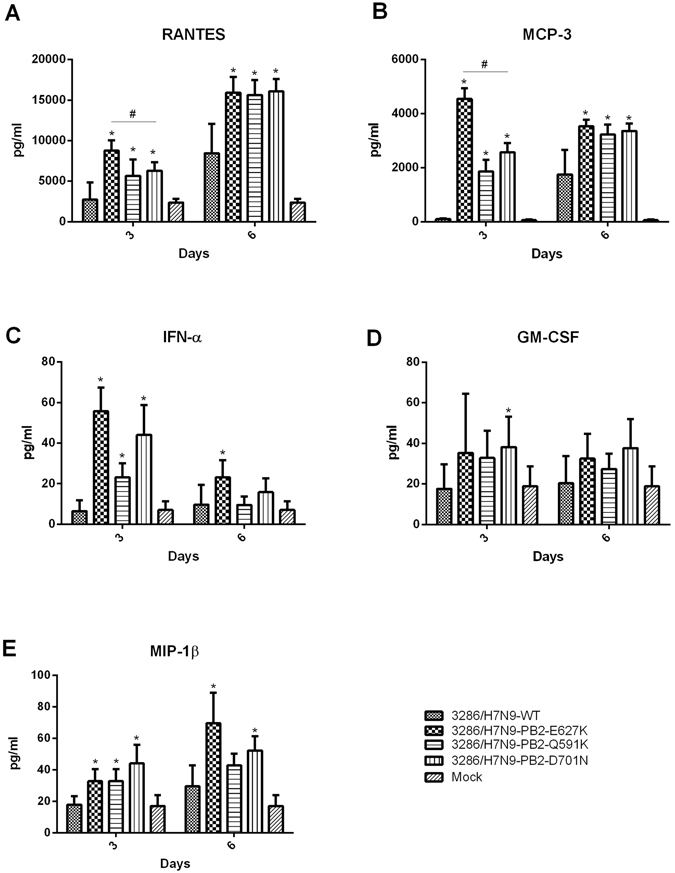
(cont) Cytokine responses in the lungs of mice infected with duck 3286/H7N9 and its PB2 mutants. Cytokine levels (A) RANTES (B) MCP-3 (C) IFN-α (D) GM-CSF E) MIP-1β from virus infected lungs (n = 6 mice per virus group, days 3, 6 post-inoculation) were measured individually by the FlowCytomix system. Results from each time point are expressed as mean ± SD of six infected mice from two independent experiments. *The values were statistically compared with the wild type 3286/H7N9 using the two tailed, non-paired t-test. p < 0.05.

References

    1. World Heath Organization. http://www.who.int/influenza/human_animal_interface /HAI_Risk_Assessment/en/ (2017).
    1. Gao R, et al. Human Infection with a Novel Avian-Origin Influenza A (H7N9) Virus. N Engl J Med. 2013;368:1888–97. doi: 10.1056/NEJMoa1304459. - DOI - PubMed
    1. Yu L, et al. Clinical, virological and histopathological manifestations of fatal human infections by avian influenza A(H7N9) virus. Clin Infect Dis. 2013;57(10):1449–57. doi: 10.1093/cid/cit541. - DOI - PubMed
    1. Gao HN, et al. Clinical findings in 111 cases of influenza A (H7N9) virus infection. N Engl J Med. 2013;368:2277–85. doi: 10.1056/NEJMoa1305584. - DOI - PubMed
    1. Wu P, et al. Human Infection with Influenza A(H7N9) Virus during 3 Major Epidemic Waves, China, 2013–2015. Emerg Infect Dis. 2016;22:964–72. doi: 10.3201/eid2206.151752. - DOI - PMC - PubMed

Publication types

MeSH terms