Review
. 2016 May 11:8:15-25.
doi: 10.2147/EB.S70822. eCollection 2016.

Progress in the clinical development and utilization of vision prostheses: an update

Affiliations
Review

Progress in the clinical development and utilization of vision prostheses: an update

Alice Brandli et al. Eye Brain. .

Abstract

Vision prostheses, or "bionic eyes", are implantable medical bionic devices with the potential to restore rudimentary sight to people with profound vision loss or blindness. In the past two decades, this field has rapidly progressed, and there are now two commercially available retinal prostheses in the US and Europe, and a number of next-generation devices in development. This review provides an update on the development of these devices and a discussion on the future directions for the field.

Keywords: bionic eye; blindness; medical bionics; retinitis pigmentosa; vision prostheses; vision restoration.


Conflict of interest statement

Disclosure The authors report no conflicts of interest in this work.

Figures
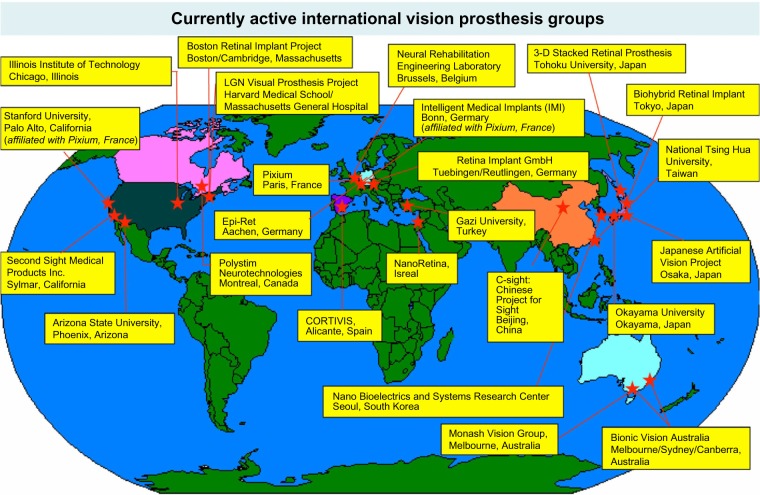
Figure 1
Figure 1
Currently active vision prosthesis research groups, as of January 2016. Notes: Courtesy of Professor Joe Rizzo, Dr Lauren Ayton, and the Detroit Institute of Ophthalmology.
Figure 2
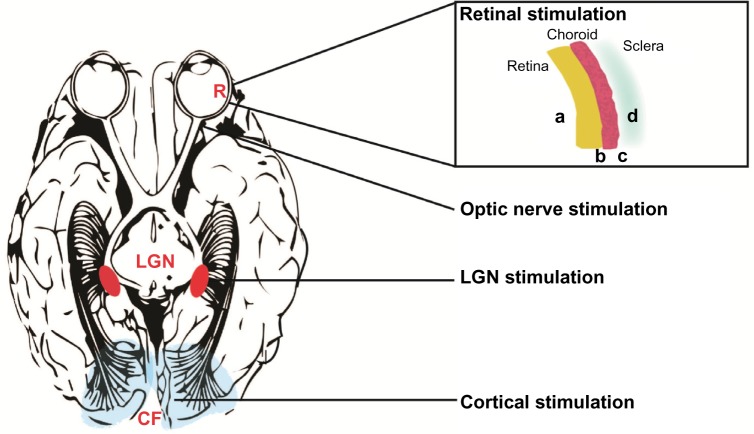
Figure 2
Locations of vision prostheses. Notes: A schematic of the visual pathway as drawn from the ventral side of the brain with the inset box depicting the retinal sites of visual prosthesis implants. Visual prosthesis devices have been implanted at the following locations: within the eye and retina (R) at a, epiretinal; b, subretinal; c, suprachoroidal; and d, intrascleral sites, the optic nerve, the LGN and within the visual cortex, adjacent to the CF. Electrical stimulation at these sites elicits phosphenes that can be used to create low-resolution vision. Abbreviations: CF, calcarine fissure; LGN, lateral geniculate nucleus; R, retina.
Figure 3
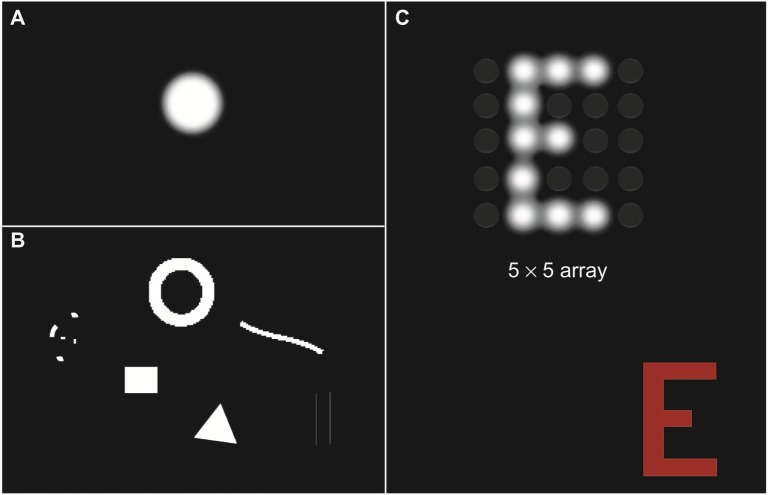
Figure 3
Examples of the simulated phosphenes (single and patterned) and their characteristics as reported by patients. Notes: The theoretically expected phosphene from electrical stimulation of the visual pathway is a white (colorless) circle (A). Other shapes have been reported, such as dots, donut-shaped circles, lines, squares, triangles, and matchsticks (B). Patterns of phosphenes elicited can form an image (the letter E), as depicted on a 5×5 electrode array (C). The stimulus, a red E, is shown in the lower corner.
Figure 4
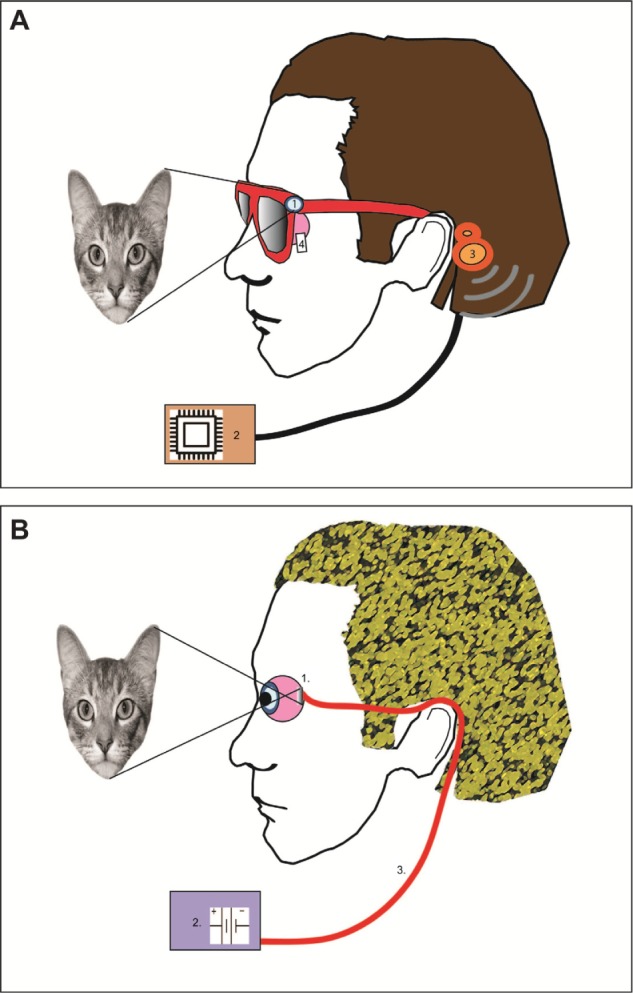
Figure 4
Schematic of a classical prosthesis with a retinal implant (A) and optical sensor prosthesis (B). Notes: Classical prosthesis requires a camera (1) to capture images. The image (a cat) is then processed externally (2) and converted to an electrical stimulation pattern that is transmitted by a wireless receiver (3) to the retinal implant (4) to elicit phosphenes. Optical sensor prosthesis relies on image capture by a subretinally implanted array (1). The light signal is amplified by power derived from an external battery source (2) that is connected using a cable (3). The multiphotodiode array is able to elicit phosphenes within the retina without the use of a camera and visual processing package.

References

    1. World Health Organization . Fact Sheet: Visual Impairment and Blindness. Geneva: World Health Organization; 2014.
    1. Foerster O. Beitraege zur Pathophysiologie der Sehbahn und der Sehsphaere [Contributions to the pathophysiology of the visual pathway and the visual sphere] J Psychol Neurol. 1929;39:435–463. German.
    1. Ho AC, Humayun MS, Dorn JD, et al. Long-term results from an epiretinal prosthesis to restore sight to the blind. Ophthalmology. 2015;122(8):1547–1554. - PMC - PubMed
    1. Kitiratschky VB, Stingl K, Wilhelm B, et al. Safety evaluation of “retina implant alpha IMS” – a prospective clinical trial. Graefes Arch Clin Exp Ophthalmol. 2015;253(3):381–387. - PubMed
    1. Ayton LN, Blamey PJ, Guymer RH, et al. First-in-human trial of a novel suprachoroidal retinal prosthesis. PLoS One. 2014;9(12):e115239. - PMC - PubMed

LinkOut - more resources