


Function and Dysfunction of Microglia during Brain Development: Consequences for Synapses and Neural Circuits
- PMID: 28539882
- PMCID: PMC5423952
- DOI: 10.3389/fnsyn.2017.00009
Function and Dysfunction of Microglia during Brain Development: Consequences for Synapses and Neural Circuits
Abstract
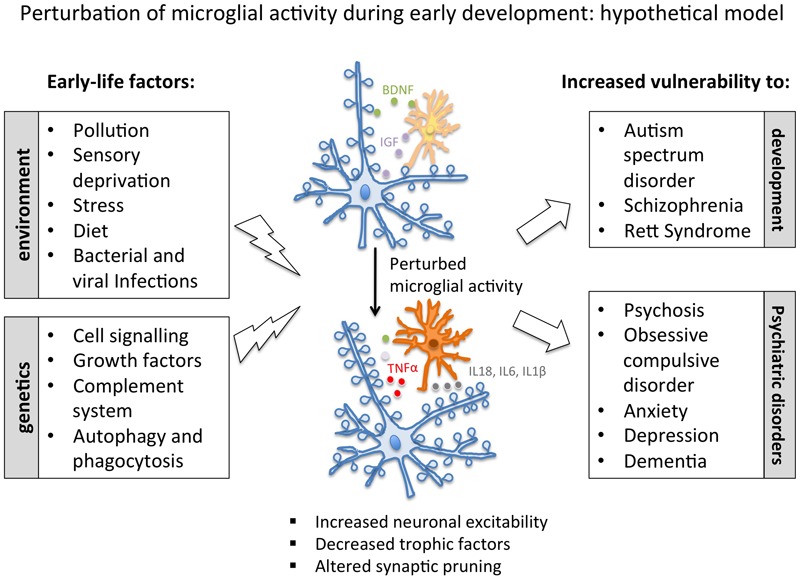
Many diverse factors, ranging from stress to infections, can perturb brain homeostasis and alter the physiological activity of microglia, the immune cells of the central nervous system. Microglia play critical roles in the process of synaptic maturation and brain wiring during development. Any perturbation affecting microglial physiological function during critical developmental periods could result in defective maturation of synaptic circuits. In this review, we critically appraise the recent literature on the alterations of microglial activity induced by environmental and genetic factors occurring at pre- and early post-natal stages. Furthermore, we discuss the long-lasting consequences of early-life microglial perturbation on synaptic function and on vulnerability to neurodevelopmental and psychiatric disorders.
Keywords: brain development; infections; microglia; neurodevelopmental disorders; stress; synapses; synaptic function; synaptic pruning.
Figures
References
-
- Agid O., Shapira B., Zislin J., Ritsner M., Hanin B., Murad H., et al. (1999). Environment and vulnerability to major psychiatric illness: a case control study of early parental loss in major depression, bipolar disorder and schizophrenia. Mol. Psychiatry 4 163–172. - PubMed
-
- Ajdacic-Gross V., Aleksandrowicz A., Rodgers S., Mutsch M., Tesic A., Muller M., et al. (2016). Infectious, atopic and inflammatory diseases, childhood adversities and familial aggregation are independently associated with the risk for mental disorders: results from a large Swiss epidemiological study. World J. Psychiatry 6 419–430. 10.5498/wjp.v6.i4.419 - DOI - PMC - PubMed
-
- Aoki N., Kimura S., Takiyama Y., Atsuta Y., Abe A., Sato K., et al. (2000). The role of the DAP12 signal in mouse myeloid differentiation. J. Immunol. 165 3790–3796. - PubMed
Publication types
LinkOut - more resources
Full Text Sources
Other Literature Sources
