


Lower cranial nerve palsy after the infrafloccular approach in microvascular decompression for hemifacial spasm
- PMID: 28540133
- PMCID: PMC5421220
- DOI: 10.4103/sni.sni_8_17
Lower cranial nerve palsy after the infrafloccular approach in microvascular decompression for hemifacial spasm
Abstract
Background: The infrafloccular approach was introduced as a variation in microvascular decompression (MVD) for hemifacial spasm. However, the rate of postoperative lower cranial nerve (CN) palsy can be high. This study investigated the surgical factors in relation to the occurrence of postoperative lower CN palsy.
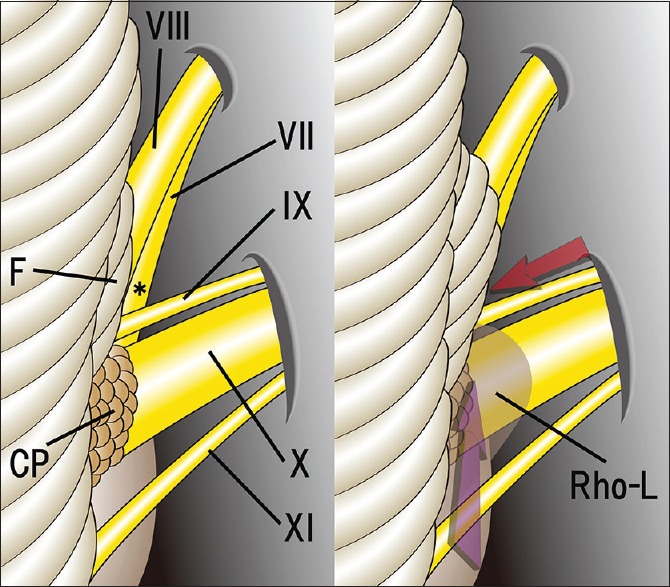
Methods: The case records of 103 patients who underwent MVD were reviewed. Dissection around the lower CNs to approach the root exit zone of CN VII was divided into two steps - incision of the rhomboid lip at the root of the lower CNs and separation of CN IX and flocculus/choroid plexus. The correlations of these steps and other characteristics to the occurrence of lower CN palsy were analyzed.
Results: Ten of the 103 patients suffered from postoperative transient lower CN palsy. The rhomboid lip was incised in 30 cases (29.1%), separation of CN IX and flocculus or choroid plexus was necessary in 24 cases (23.3%), and both steps were required in 7 cases (6.8%). The steps showed no correlation with postoperative lower CN palsy. Posterior inferior cerebellar artery (PICA) as the offending vessel was significantly correlated with postoperative lower CN palsy (P < 0.05).
Conclusions: Our study showed that the offending PICA was the only significant factor for postoperative lower CN palsy. Therefore, correct dissection around the lower CNs, particularly for complicated PICA, is necessary to reduce the risk of postoperative lower CN palsy.
Keywords: Infrafloccular approach; PICA; lower cranial nerve palsy; microvascular decompression.
Conflict of interest statement
There are no conflicts of interest.
Figures
References
-
- Amagasaki K, Watanabe S, Naemura K, Nakaguchi H. Microvascular decompression for hemifacial spasm: How can we protect auditory function? Br J Neurosurg. 2015;29:347–52. - PubMed
-
- Bigder MG, Kaufmann AM. Failed microvascular decompression surgery for hemifacial spasm due to persistent neurovascular compression: An analysis of reoperations. J Neurosurg. 2016;124:90–5. - PubMed
-
- Hitotsumatsu T, Matsushima T, Inoue T. Microvascular decompression for treatment of trigeminal neuralgia, hemifacial spasm, and glossopharyngeal neuralgia: Three surgical approach variations: Technical note. Neurosurgery. 2003;53:1436–41. - PubMed
-
- Lister JR, Rhoton AL, Jr, Matsushima T, Peace DA. Microsurgical anatomy of the posterior inferior cerebellar artery. Neurosurgery. 1982;10:170–99. - PubMed
LinkOut - more resources
Full Text Sources
Other Literature Sources