


Lipid levels and risk of venous thrombosis: results from the MEGA-study
- PMID: 28540474
- PMCID: PMC5591362
- DOI: 10.1007/s10654-017-0251-1
Lipid levels and risk of venous thrombosis: results from the MEGA-study
Abstract
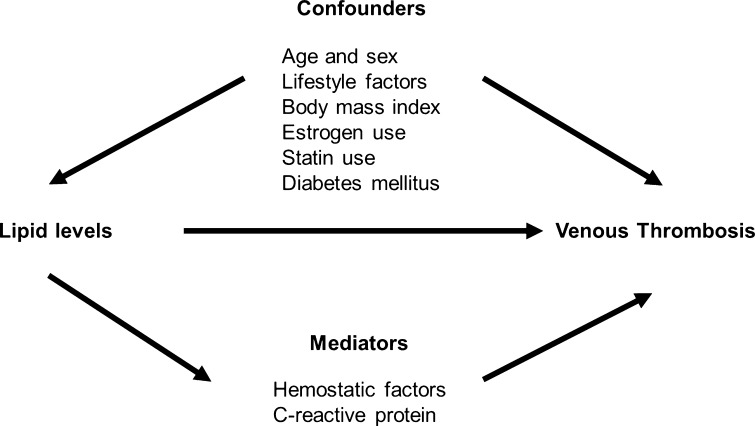
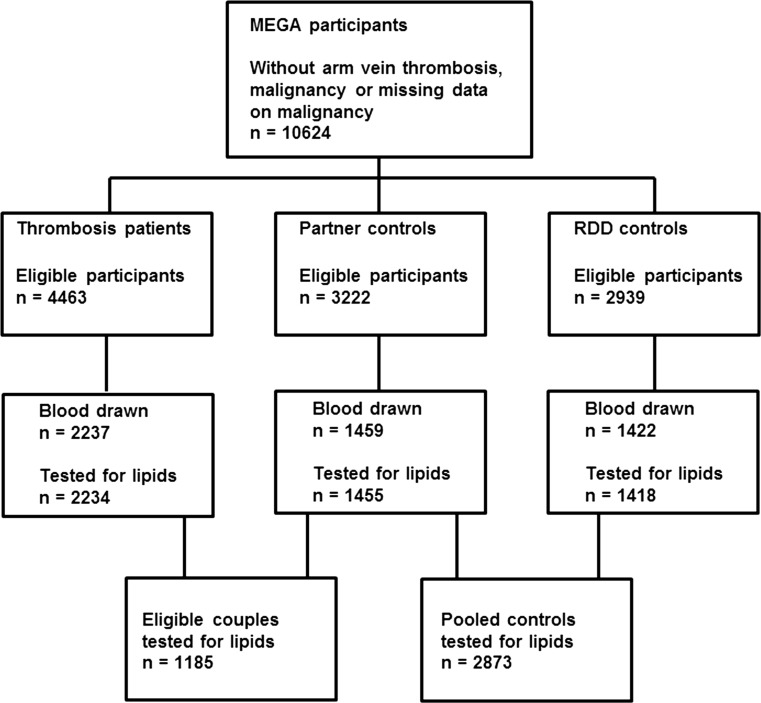
The relationship between lipid levels and risk of venous thrombosis is not well established. We aimed to assess the association between several lipids and risk of venous thrombosis using data from a population-based case-control study, and to evaluate the underlying mechanism, considering confounding by common risk factors and mediation via hemostatic factors and C-reactive protein. From the Multiple Environmental and Genetic Assessment of risk factors for venous thrombosis (MEGA) study, 2234 patients with a first venous thrombosis and 2873 controls were included. Percentile categories of total/low-density lipoprotein/high-density lipoprotein cholesterol, triglycerides, and apolipoproteins B and A1 were established in controls (<10th, 10th-25th, 25th-75th [reference], 75th-90th, >90th percentile). In age- and sex-adjusted models, decreasing levels of apolipoproteins B and A1 were dose-dependently associated with increased thrombosis risk, with odds ratios of 1.35 (95% confidence interval 1.12-1.62) and 1.50 (95% confidence interval 1.25-1.79) for the lowest category versus the reference category, respectively. The dose-response relation remained with further adjustment for body mass index, estrogen use, statin use, and diabetes. Although apolipoproteins B and A1 were associated with several hemostatic factors and C-reactive protein, none explained the increased risk in mediation analyses. The other lipids were not associated with venous thrombosis risk. In conclusion, decreasing levels of apolipoproteins B and A1 were associated with increased risk of venous thrombosis. Our findings are consistent with experimental data on the anticoagulant properties of apolipoproteins B and A1. These findings need to be confirmed and the underlying mechanism further investigated.
Keywords: Apolipoproteins; Epidemiology; Lipids; Lipoproteins; Risk factors; Venous thrombosis.
Conflict of interest statement
Conflict of interest
The authors declare that they have no conflict of interest.
Ethical approval
All procedures performed in studies involving human participants were in accordance with the ethical standards of the institutional and/or national research committee and with the 1964 Helsinki declaration and its later amendments or comparable ethical standards.
Figures
References
-
- National Cholesterol Education Program (NCEP) Expert Panel on Detection, Evaluation, and Treatment of High Blood Cholesterol in Adults (Adult Treatment Panel III) Third Report of the National Cholesterol Education Program (NCEP) Expert panel on detection, evaluation, and treatment of high blood cholesterol in adults (adult treatment panel III) final report. Circulation. 2002;106(25):3143–3421. - PubMed
Publication types
MeSH terms
Substances
Grants and funding
LinkOut - more resources
Full Text Sources
Other Literature Sources
Medical
Research Materials
