Routine Angiographic Follow-Up versus Clinical Follow-Up after Percutaneous Coronary Intervention in Acute Myocardial Infarction
- PMID: 28540983
- PMCID: PMC5447101
- DOI: 10.3349/ymj.2017.58.4.720
Routine Angiographic Follow-Up versus Clinical Follow-Up after Percutaneous Coronary Intervention in Acute Myocardial Infarction
Abstract
Purpose: Differences in the utility of routine angiographic follow-up (RAF) and clinical follow-up (CF) after percutaneous coronary intervention (PCI) in acute myocardial infarction (AMI) are not well understood. The present study aimed to compare the 3-year clinical outcomes of RAF and CF in AMI patients who underwent PCI with drug-eluting stents (DES).
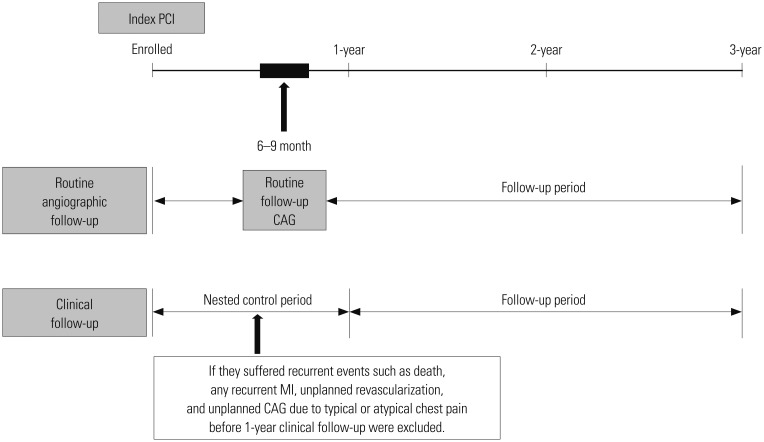
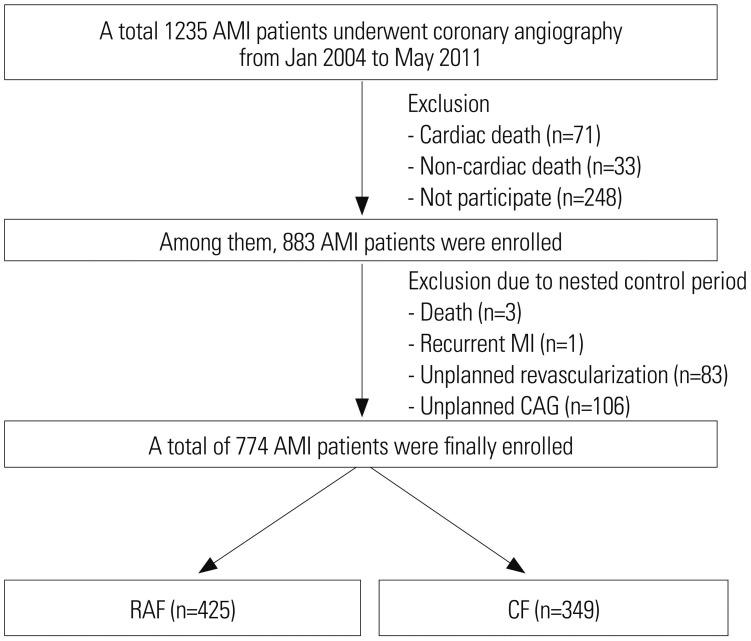
Materials and methods: A total of 774 consecutive AMI patients who underwent PCI with DES were enrolled. RAF was performed at 6 to 9 months after index PCI (n=425). The remaining patients were medically managed and clinically followed (n=349); symptom-driven events were captured. To adjust for any potential confounders, a propensity score matched analysis was performed using a logistic regression model, and two propensity-matched groups (248 pairs, n=496, C-statistic=0.739) were generated. Cumulative clinical outcomes up to 3 years were compared between RAF and CF groups.
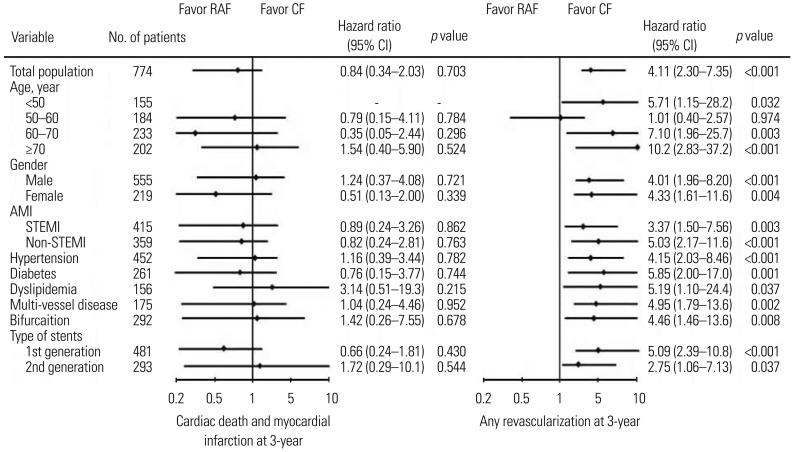
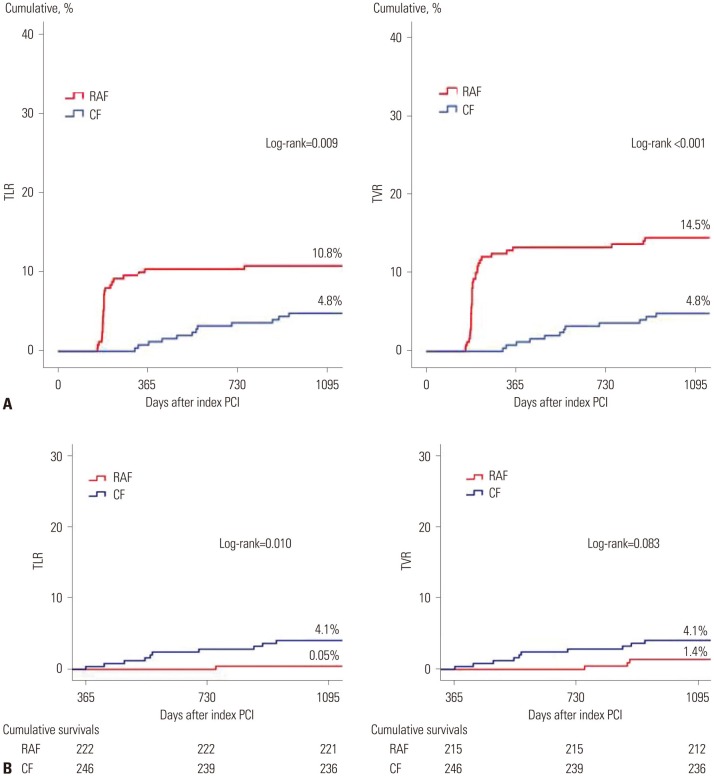
Results: During the 3-year follow-up period, the cumulative incidences of revascularization [target lesion revascularization: hazard ratio (HR), 2.40; 95% confidence interval (CI), 1.18-4.85; p=0.015, target vessel revascularization (TVR): HR, 3.33; 95% CI, 1.69-6.58; p=0.001, non-TVR: HR, 5.64; 95% CI, 1.90-16.6; p=0.002] and major adverse cardiac events (MACE; HR, 3.32; 95% CI, 1.92-5.73; p<0.001) were significantly higher in the RAF group than the CF group. However, the 3-year incidences of death and myocardial infarction were not different between the two groups.
Conclusion: RAF following index PCI with DES in AMI patients was associated with increased incidences of revascularization and MACE. Therefore, CF seems warranted for asymptomatic patients after PCI for AMI.
Keywords: Acute myocardial infarction; coronary angiography; outcomes.
© Copyright: Yonsei University College of Medicine 2017
Conflict of interest statement
The authors have no financial conflicts of interest.
Figures
References
-
- Garg S, Serruys PW. Coronary stents: current status. J Am Coll Cardiol. 2010;56(10 Suppl):S1–S42. - PubMed
-
- Kirtane AJ, Gupta A, Iyengar S, Moses JW, Leon MB, Applegate R, et al. Safety and efficacy of drug-eluting and bare metal stents: comprehensive meta-analysis of randomized trials and observational studies. Circulation. 2009;119:3198–3206. - PubMed
-
- Cutlip DE, Chauhan MS, Baim DS, Ho KK, Popma JJ, Carrozza JP, et al. Clinical restenosis after coronary stenting: perspectives from multicenter clinical trials. J Am Coll Cardiol. 2002;40:2082–2089. - PubMed
Publication types
MeSH terms
LinkOut - more resources
Full Text Sources
Other Literature Sources
Medical
Research Materials
Miscellaneous