


Long-Term PM2.5 Exposure and Respiratory, Cancer, and Cardiovascular Mortality in Older US Adults
- PMID: 28541385
- PMCID: PMC6915823
- DOI: 10.1093/aje/kwx166
Long-Term PM2.5 Exposure and Respiratory, Cancer, and Cardiovascular Mortality in Older US Adults
Abstract
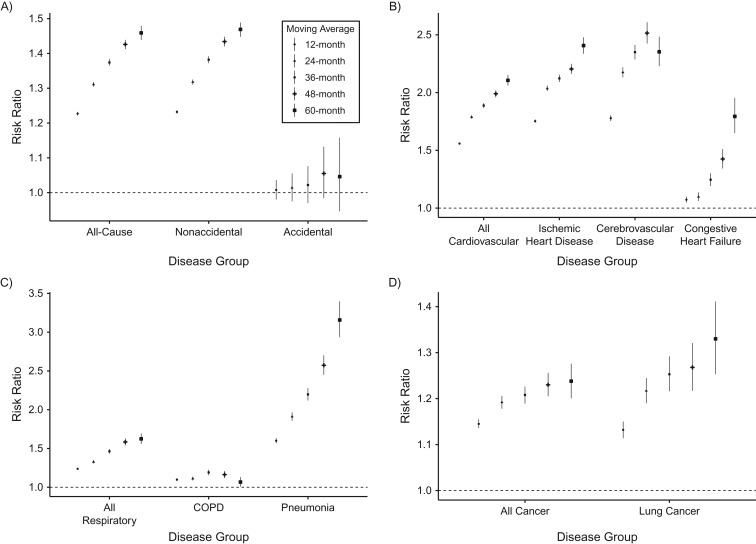
The impact of chronic exposure to fine particulate matter (particulate matter with an aerodynamic diameter less than or equal to 2.5 μm (PM2.5)) on respiratory disease and lung cancer mortality is poorly understood. In a cohort of 18.9 million Medicare beneficiaries (4.2 million deaths) living across the conterminous United States between 2000 and 2008, we examined the association between chronic PM2.5 exposure and cause-specific mortality. We evaluated confounding through adjustment for neighborhood behavioral covariates and decomposition of PM2.5 into 2 spatiotemporal scales. We found significantly positive associations of 12-month moving average PM2.5 exposures (per 10-μg/m3 increase) with respiratory, chronic obstructive pulmonary disease, and pneumonia mortality, with risk ratios ranging from 1.10 to 1.24. We also found significant PM2.5-associated elevated risks for cardiovascular and lung cancer mortality. Risk ratios generally increased with longer moving averages; for example, an elevation in 60-month moving average PM2.5 exposures was linked to 1.33 times the lung cancer mortality risk (95% confidence interval: 1.24, 1.40), as compared with 1.13 (95% confidence interval: 1.11, 1.15) for 12-month moving average exposures. Observed associations were robust in multivariable models, although evidence of unmeasured confounding remained. In this large cohort of US elderly, we provide important new evidence that long-term PM2.5 exposure is significantly related to increased mortality from respiratory disease, lung cancer, and cardiovascular disease.
Keywords: PM2.5; air pollution; cardiovascular disease mortality; chronic exposure; fine particles; lung cancer mortality; particulate matter; respiratory disease mortality.
© The Author(s) 2017. Published by Oxford University Press on behalf of the Johns Hopkins Bloomberg School of Public Health. All rights reserved. For permissions, please e-mail: journals.permissions@oup.com.
Figures
References
-
- Miller KA, Siscovick DS. Long-term exposure to air pollution and incidence of cardiovascular events in women. N Engl J Med. 2007;356(5):447–458. - PubMed
-
- Chen H, Goldberg MS, Villeneuve PJ. A systematic review of the relation between long-term exposure to ambient air pollution and chronic diseases. Rev Environ Health. 2008;23(4):243–297. - PubMed
MeSH terms
Substances
Grants and funding
LinkOut - more resources
Full Text Sources
Other Literature Sources
Medical
