


Consistent multi-level trophic effects of marine reserve protection across northern New Zealand
- PMID: 28542268
- PMCID: PMC5443496
- DOI: 10.1371/journal.pone.0177216
Consistent multi-level trophic effects of marine reserve protection across northern New Zealand
Abstract
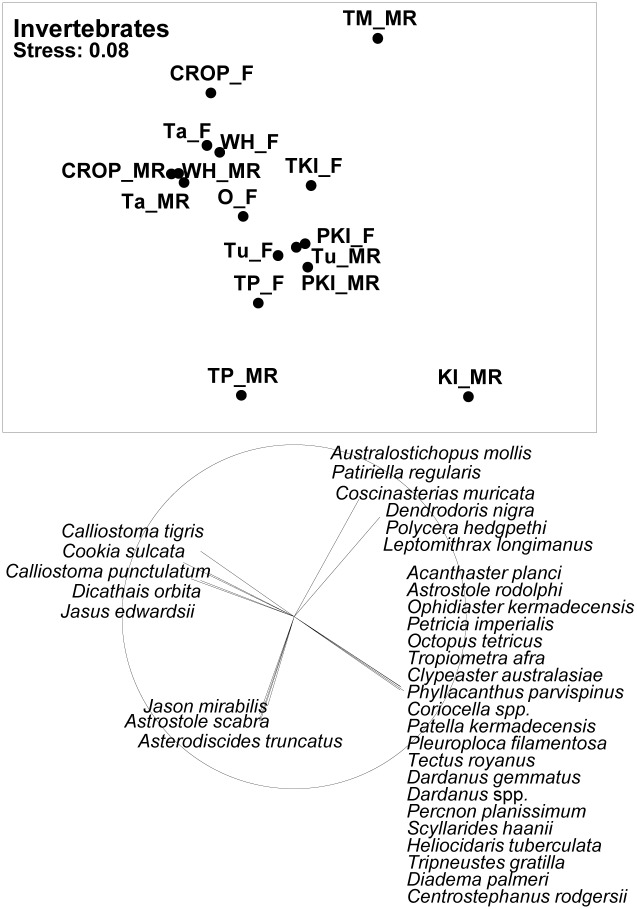
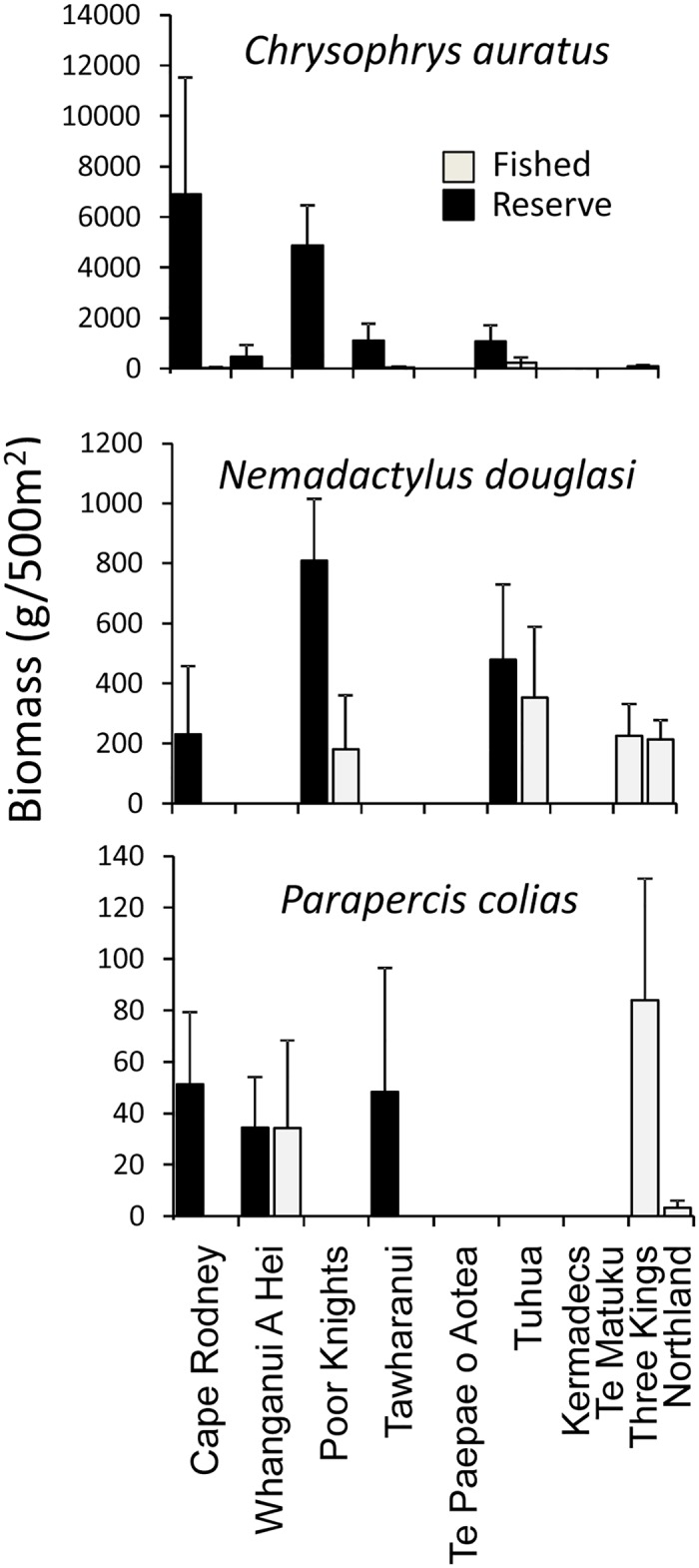
Through systematic Reef Life Survey censuses of rocky reef fishes, invertebrates and macroalgae at eight marine reserves across northern New Zealand and the Kermadec Islands, we investigated whether a system of no-take marine reserves generates consistent biodiversity outcomes. Ecological responses of reef assemblages to protection from fishing, including potential trophic cascades, were assessed using a control-impact design for the six marine reserves studied with associated reference sites, and also by comparing observations at reserve sites with predictions from random forest models that assume reserve locations are fished. Reserve sites were characterised by higher abundance and biomass of large fishes than fished sites, most notably for snapper Chrysophrys auratus, with forty-fold higher observed biomass inside relative to out. In agreement with conceptual models, significant reserve effects not only reflected direct interactions between fishing and targeted species (higher large fish biomass; higher snapper and lobster abundance), but also second order interactions (lower urchin abundance), third order interactions (higher kelp cover), and fourth order interactions (lower understory algal cover). Unexpectedly, we also found: (i) a consistent trend for higher (~20%) Ecklonia cover across reserves relative to nearby fished sites regardless of lobster and urchin density, (ii) an inconsistent response of crustose coralline algae to urchin density, (iii) low cover of other understory algae in marine reserves with few urchins, and (iv) more variable fish and benthic invertebrate communities at reserve relative to fished locations. Overall, reef food webs showed complex but consistent responses to protection from fishing in well-enforced temperate New Zealand marine reserves. The small proportion of the northeastern New Zealand coastal zone located within marine reserves (~0.2%) encompassed a disproportionately large representation of the full range of fish and benthic invertebrate biodiversity within this region.
Conflict of interest statement
Figures






References
-
- Ballantine W. Fifty years on: lessons from marine reserves in New Zealand and principles for a worldwide network. Biological Conservation. 2014;176 297–307.
-
- Ballantine B. Marine Reserves for New Zealand. University of Auckland, Leigh Laboratory Bulletin. 1991;25:1–196.
-
- Babcock RC. Leigh Marine Laboratory contributions to marine conservation. New Zealand Journal of Marine and Freshwater Research. 2013;47:360–73.
-
- Department of Conservation and Ministry of Fisheries. Marine protected areas policy and implementation plan. Wellington, New Zealand: Department of Conservation and Ministry of Fisheries; 2005.
-
- Department of Conservation and Ministry of Environment. The New Zealand biodiversity strategy. Wellington, New Zealand: Department of Conservation and Ministry of Environment; 2000.
MeSH terms
LinkOut - more resources
Full Text Sources
Other Literature Sources
Miscellaneous
