


Regional brain amyloid-β accumulation associates with domain-specific cognitive performance in Parkinson disease without dementia
- PMID: 28542444
- PMCID: PMC5444629
- DOI: 10.1371/journal.pone.0177924
Regional brain amyloid-β accumulation associates with domain-specific cognitive performance in Parkinson disease without dementia
Abstract
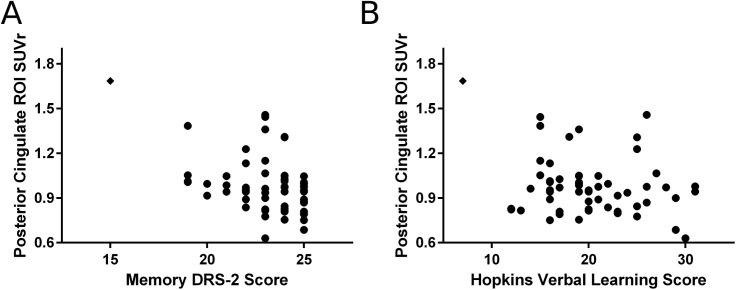
Parkinson disease patients develop clinically significant cognitive impairment at variable times over their disease course, which is often preceded by milder deficits in memory, visuo-spatial, and executive domains. The significance of amyloid-β accumulation to these problems is unclear. We hypothesized that amyloid-β PET imaging by 18F-florbetapir, a radiotracer that detects fibrillar amyloid-β plaque deposits, would identify subjects with global cognitive impairment or poor performance in individual cognitive domains in non-demented Parkinson disease patients. We assessed 61 non-demented Parkinson disease patients with detailed cognitive assessments and 18F-florbetapir PET brain imaging. Scans were interpreted qualitatively (positive or negative) by two independent nuclear medicine physicians blinded to clinical data, and quantitatively by a novel volume-weighted method. The presence of mild cognitive impairment was determined through an expert consensus process using Level 1 criteria from the Movement Disorder Society. Nineteen participants (31.2%) were diagnosed with mild cognitive impairment and the remainder had normal cognition. Qualitative 18F-florbetapir PET imaging was positive in 15 participants (24.6%). Increasing age and presence of an APOE ε4 allele were associated with higher composite 18F-florbetapir binding. In multivariable models, an abnormal 18F-florbetapir scan by expert rating was not associated with a diagnosis of mild cognitive impairment. However, 18F-florbetapir retention values in the posterior cingulate gyrus inversely correlated with verbal memory performance. Retention values in the frontal cortex, precuneus, and anterior cingulate gyrus retention values inversely correlated with naming performance. Regional cortical amyloid-β amyloid, as measured by 18F-florbetapir PET, may be a biomarker of specific cognitive deficits in non-demented Parkinson disease patients.
Conflict of interest statement
Figures
References
-
- Postuma RB, Berg D, Stern M, Poewe W, Olanow CW, Oertel W, et al. MDS clinical diagnostic criteria for Parkinson's disease. Movement disorders: official journal of the Movement Disorder Society. 2015;30(12):1591–601. Epub 2015/10/17. - PubMed
-
- Hely MA, Reid WG, Adena MA, Halliday GM, Morris JG. The Sydney multicenter study of Parkinson's disease: the inevitability of dementia at 20 years. Movement disorders: official journal of the Movement Disorder Society. 2008;23(6):837–44. Epub 2008/03/01. - PubMed
-
- Aarsland D, Andersen K, Larsen JP, Lolk A, Kragh-Sorensen P. Prevalence and characteristics of dementia in Parkinson disease: an 8-year prospective study. Archives of neurology. 2003;60(3):387–92. Epub 2003/03/14. - PubMed
-
- Lee VM, Trojanowski JQ. Mechanisms of Parkinson's disease linked to pathological alpha-synuclein: new targets for drug discovery. Neuron. 2006;52(1):33–8. Epub 2006/10/04. doi: 10.1016/j.neuron.2006.09.026 - DOI - PubMed
-
- Irwin DJ, White MT, Toledo JB, Xie SX, Robinson JL, Van Deerlin V, et al. Neuropathologic substrates of Parkinson disease dementia. Annals of neurology. 2012;72(4):587–98. Epub 2012/10/06. PubMed Central PMCID: PMC3484250. doi: 10.1002/ana.23659 - DOI - PMC - PubMed
MeSH terms
Substances
Grants and funding
LinkOut - more resources
Full Text Sources
Other Literature Sources
Medical
Miscellaneous
