. 2017 May 22;12(5):e0178145.
doi: 10.1371/journal.pone.0178145. eCollection 2017.

Genet-specific DNA methylation probabilities detected in a spatial epigenetic analysis of a clonal plant population

Affiliations

Genet-specific DNA methylation probabilities detected in a spatial epigenetic analysis of a clonal plant population

Kiwako S Araki et al. PLoS One. .

Abstract

In sessile organisms such as plants, spatial genetic structures of populations show long-lasting patterns. These structures have been analyzed across diverse taxa to understand the processes that determine the genetic makeup of organismal populations. For many sessile organisms that mainly propagate via clonal spread, epigenetic status can vary between clonal individuals in the absence of genetic changes. However, fewer previous studies have explored the epigenetic properties in comparison to the genetic properties of natural plant populations. Here, we report the simultaneous evaluation of the spatial structure of genetic and epigenetic variation in a natural population of the clonal plant Cardamine leucantha. We applied a hierarchical Bayesian model to evaluate the effects of membership of a genet (a group of individuals clonally derived from a single seed) and vegetation cover on the epigenetic variation between ramets (clonal plants that are physiologically independent individuals). We sampled 332 ramets in a 20 m × 20 m study plot that contained 137 genets (identified using eight SSR markers). We detected epigenetic variation in DNA methylation at 24 methylation-sensitive amplified fragment length polymorphism (MS-AFLP) loci. There were significant genet effects at all 24 MS-AFLP loci in the distribution of subepiloci. Vegetation cover had no statistically significant effect on variation in the majority of MS-AFLP loci. The spatial aggregation of epigenetic variation is therefore largely explained by the aggregation of ramets that belong to the same genets. By applying hierarchical Bayesian analyses, we successfully identified a number of genet-specific changes in epigenetic status within a natural plant population in a complex context, where genotypes and environmental factors are unevenly distributed. This finding suggests that it requires further studies on the spatial epigenetic structure of natural populations of diverse organisms, particularly for sessile clonal species.


Conflict of interest statement

Competing Interests: The authors have declared that no competing interests exist.

Figures

Fig 1
Fig 1. Conceptual framework for analyses of spatial epigenetic structure in a clonal plant population.
The analyses consisted of three conceptual parts (a, b, and c). (a) From the natural population, we obtained three types of spatial information: environmental heterogeneity (vegetation cover), genet distribution (SSR), and epigenetic variation (MS-AFLP). In the top layer, spatial environmental heterogeneity is represented by color gradients. In the second layer, different genets are indicated by different colors. In the bottom layer, the epigenetic status of a particular epigenetic site in each sampled ramet is indicated by either closed (positive subepiloci) or open (zero subepiloci) circles. (b) GLMM (generalized linear mixed model), the epigenetic status yijk ∈{0, 1} was assumed to follow the Bernoulli distribution of probability, qijk. This is defined using a combination of a logit link function and a linear predictor, logit(qijk) = g0 + gi + gik + (e0 + ei) xj + sj (see text for details). (c) To represent the probabilistic nature of epigenetics, we estimated model parameters as probability distributions using hierarchical Bayesian modeling and MCMC (Markov chain Monte Carlo) computation. We defined and compared two kinds of probabilities: the global probability of the ith MS-AFLP loci, and the genet-specific probability of kth genet for the ith MS-AFLP loci. The results are visualized using figures for each MS-AFLP locus as shown in the bottom diagrams. In the bottom left graph, methylation probability (q) is converted from logit (q) [logit (q) = log (q /(1 –q)), q = 0.0067, 0.27, 0.5, 0.73, and 0.99 corresponds to logit (q) = –5, –1, 0, 1, and 5, respectively]. In the bottom left graph, medians of the global probability (%) are shown by a horizontal dotted line. Medians and 95% BCI of genet-specific probabilities are shown by horizontal and vertical lines, respectively. Genets are arranged from left to right in decreasing order of number of ramets. The spatial locations of the genets are shown in the bottom right panel. For both of the lower panels, red and blue coloring represents genets that deviate positively and negatively from the global probability, respectively.
Fig 2
Fig 2. A flowering ramet of Cardamine leucantha (a), the study population at Rikubetsu, Hokkaido, Japan (b), and typical clonal growth of the study species (c–e).
Multiple underground stolons (stoloniferous rhizomes) begin to elongate in spring (c). Daughter ramets (tagged with orange tape) are formed at the tip of stolons in late autumn (d). Multiple daughter ramets produced from a single mother ramet extend shoots in the next growth season (e).
Fig 3
Fig 3. Sampling design.
The study plot measured 20 m × 20 m. Vegetation cover data was used as a measure of environmental heterogeneity (a), and the spatial distribution of genets (groups of clonal ramets with shared genotypes) was determined through simple sequence repeat (SSR) analyses (b). In (a), the focal study plot is indicated by red lines. It consisted of four hundred 1-m2 quadrats. The vegetation cover of the forest floor (the fraction of the area covered by forest floor herbs and ferns large enough to shade C. leucantha ramets) was classified according to five categories of shading (no shade, ≤ 30%, ≤ 60%, ≤ 90%, or ≤ 100% vegetation cover) for each of the 484 quadrats (the focal 400 plus the surrounding 84). Black dots represent the sampling points. In (b), numbers represent genets, which are numbered in decreasing order of the number of ramets they contained. Patchy and disjunct genet members that belonged to genets with multiple ramets are grouped by shading and circles, respectively. Numbers without shading or circling represent unique genets found in only one sample.
Fig 4
Fig 4. Correlograms (solid lines) calculated for genetic SSR (blue) and epigenetic MS-AFLP (green) markers.
In the spatial autocorrelation analyses, the correlation coefficient (r) was calculated using ramet combinations for each distance class set at 1-m intervals. All eight SSR loci and the 24 MS-AFLP loci were used and all ramets were included in the analysis. 95% confidence intervals are denoted for genetic markers (dotted line) and epigenetic markers (dashed line) in corresponding colors.
Fig 5
Fig 5. Spatial distributions of epigenetic status for the n-subepiloci (non-methylated site) [both cut (condition I); (a, d)], m-subepiloci (CG-methylated site) ([EcoRI-HpaII digestion; (b, e)], and h-subepiloci (CHG-hemimethylated site) [EcoRI-MspI digestion; (c, f)] of an MS-AFLP locus, Lo3-343, plotted on a map of genets (a, b, c) and vegetation cover (d, e, f).
Open and closed circles represent 0 and 1 scores, respectively. Genet distribution and vegetation cover as for Fig 3.
Fig 6
Fig 6. Genet-specific probability (a–c) and spatial distribution of genet-specific methylation status (d–f) for the n-subepiloci (a, d), m-subepiloci (b, e) and h-subepiloci (f, g) of the MS-AFLP locus, Lo3-343.
In a–c, medians and 95% BCI of genet specific probabilities are indicated by horizontal lines and vertical lines, respectively. Genets are arranged from left to right in descending order of genet size, i.e. number of ramets, in each diagram. Horizontal dotted lines indicate the median of global probabilities. In the maps (d–f), open and closed circles represent 0 and 1 scores, respectively. Patchy genet members that belong to genets with multiple ramets are grouped by shading. Genets with significantly higher and lower genet-specific probabilities than the global probability (no overlap between 95% BCI of genet-specific probability and median of global probability) are shown in red and blue, respectively, in all panels.
Fig 7
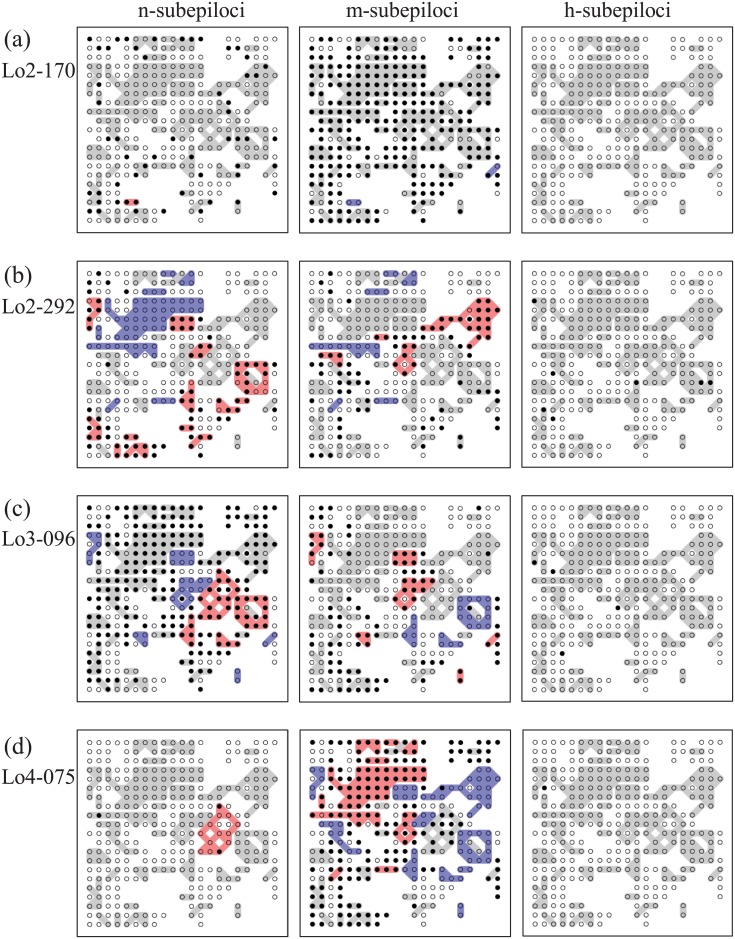
Fig 7. Spatial distributions of genet-specific methylation status of four selected loci: Lo2-170 (a), Lo2-292 (b), Lo3-096 (c), and Lo4-075 (d).
Three diagrams for each locus represent n-subepiloci (left), m-subepiloci (middle) and h-subepiloci (right). Symbols as for Figs 1 and 6. For statistical details, see the corresponding probability deviance diagrams in S3 Fig.

References

    1. Jackson JBC, Buss LW, Cook RE. Population biology and evolution of clonal organisms. New Haven: Yale University; 1985.
    1. Arnaud-Haond S, Duarte CM, Alberto F, Serrão EA. Standardizing methods to address clonality in population studies. Mol Ecol. 2007; 16: 5115–5139. 10.1111/j.1365-294X.2007.03535.x - DOI - PubMed
    1. Tuomi J, Vuorisalo T. Hierarchical selection in modular organisms. Trends Ecol Evol. 1989; 4: 209–213. 10.1016/0169-5347(89)90075-X - DOI - PubMed
    1. van Groenendael JM, de Kroon H. Clonal growth in plants: regulation and function. The Hague: SPB Academic Publishing; 1990.
    1. de Kroon H, Hutchings MJ. Morphological plasticity in clonal plants: the foraging concept reconsidered. J Ecol. 1995; 83: 143–152.

LinkOut - more resources