


Genetic variations in sterol regulatory element binding protein cleavage-activating protein (SCAP) are associated with blood pressure in overweight/obese Chinese children
- PMID: 28542467
- PMCID: PMC5438183
- DOI: 10.1371/journal.pone.0177973
Genetic variations in sterol regulatory element binding protein cleavage-activating protein (SCAP) are associated with blood pressure in overweight/obese Chinese children
Erratum in
-
Correction: Genetic variations in sterol regulatory element binding protein cleavage-activating protein (SCAP) are associated with blood pressure in overweight/obese Chinese children.PLoS One. 2019 Aug 20;14(8):e0221612. doi: 10.1371/journal.pone.0221612. eCollection 2019. PLoS One. 2019. PMID: 31430348 Free PMC article.
Abstract
Objective: Previous studies demonstrated a role of variations in sterol regulatory element binding protein (SREBP) cleavage-activating protein (SCAP) in obesity and blood lipids. But the associations between SCAP polymorphisms and blood pressure (BP) are not clear. This study aimed to investigate the relationship between genetic variations in SCAP and BP phenotypes in a Chinese pediatric population.
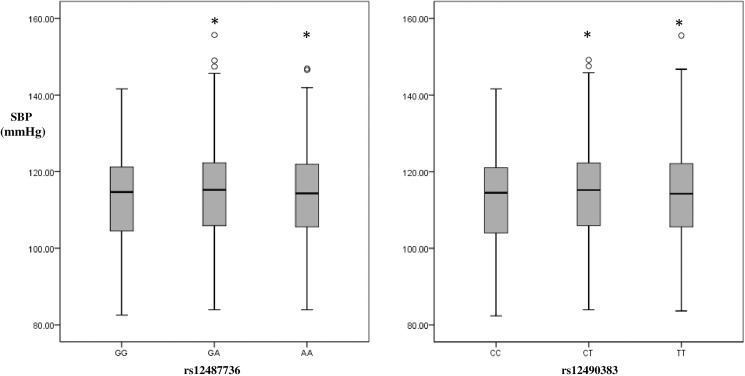
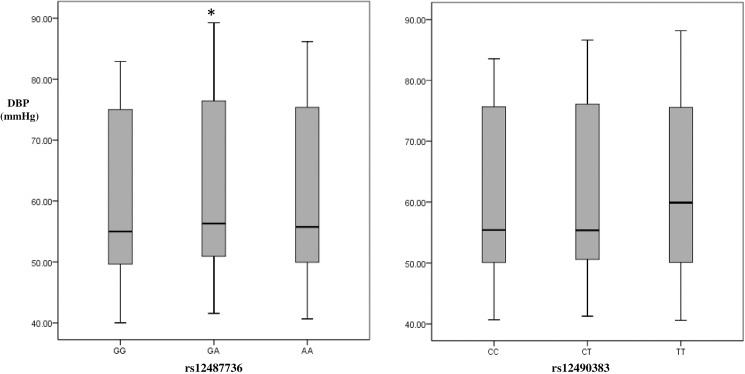
Methods: A case-control study on 702 high blood pressure (HBP) children and 1319 controls was conducted to explore the correlation between single nucleotide polymorphism markers (rs12487736 and rs12490383) of SCAP and BP phenotypes. The associations with continuous and categorical variables were examined by linear regression and logistic regression models under a dominant genetic model for the minor rs12487736 A allele and rs12490383 T allele.
Results: The rs12487736 polymorphism was significantly associated with systolic BP (SBP) (β = 1.66, P = 0.003) and diastolic BP (DBP) (β = 1.35, P = 0.024) with age, age-squared, sex, study population and body mass index (BMI) adjusted under the dominant genetic model. The rs12490383 polymorphism was significantly associated with SBP (β = 1.71, P = 0.004) and SHBP (OR = 1.39, 95%CI: 1.04-1.86, P = 0.027). When analyzed by BMI categories, in the normal-weight children, no significant association between the SCAP polymorphisms and BP phenotypes was observed (all P > 0.05). However, in the overweight/obese children, rs12487736 was significantly associated with SBP (β = 1.6, P = 0.019) and SHBP (OR = 1.36, 95%CI: 1.02-1.82; P = 0.037), rs12490383 was associated with SBP (β = 2.04, P = 0.004) and SHBP (OR = 1.50, 95%CI: 1.10-2.05; P = 0.01).
Conclusions: This study demonstrated that SCAP rs12487736 and rs12490383 were significantly associated with SBP and SHBP in overweight/obese Chinese children. It provided the evidence for association of SCAP with SBP.
Conflict of interest statement
Figures
References
-
- Forouzanfar MH, Alexander L, Anderson HR, Bachman VF, Biryukov S, Brauer M, et al. Global, regional, and national comparative risk assessment of 79 behavioural, environmental and occupational, and metabolic risks or clusters of risks in 188 countries, 1990–2013: a systematic analysis for the Global Burden of Disease Study 2013. Lancet 2015. - PMC - PubMed
-
- Chen X, Wang Y. Tracking of blood pressure from childhood to adulthood: a systematic review and meta-regression analysis. Circulation 2008; 117(25): 3171–3180. doi: 10.1161/CIRCULATIONAHA.107.730366 - DOI - PMC - PubMed
-
- Daniels SR, Pratt CA, Hayman LL. Reduction of risk for cardiovascular disease in children and adolescents. Circulation 2011; 124(15): 1673–1686. doi: 10.1161/CIRCULATIONAHA.110.016170 - DOI - PMC - PubMed
-
- Snieder H, Harshfield GA, Treiber FA. Heritability of blood pressure and hemodynamics in African- and European-American youth. Hypertension 2003; 41(6): 1196–1201. doi: 10.1161/01.HYP.0000072269.19820.0D - DOI - PubMed
MeSH terms
Substances
LinkOut - more resources
Full Text Sources
Other Literature Sources
Medical
Miscellaneous
