


Review
doi: 10.1002/jso.24653.
Epub 2017 May 22.
"Heat shock protein 70 in pancreatic diseases: Friend or foe"
Affiliations
- PMID: 28543919
- PMCID: PMC5714583
- DOI: 10.1002/jso.24653
Item in Clipboard
Review
"Heat shock protein 70 in pancreatic diseases: Friend or foe"
J Surg Oncol.
2017 Jul.
Abstract
The heat shock response in pancreatitis that is activated via HSP70 protects acinar cells through multiple simultaneous mechanisms. It inhibits trypsinogen activation and modulates NF-κB signaling to limit acinar cell injury. On the other hand, HSP70 is overexpressed in pancreatic cancer and is hijacked by the cellular machinery to inhibit apoptosis. Inhibition of HSP70 in pancreatic cancer by a novel compound, Minnelide, has shown considerable clinical promise.
Keywords: HSP70; calcium; lysosomes; minnelide; pancreatic cancer; pancreatitis; triptolide.
© 2017 Wiley Periodicals, Inc.
Figures
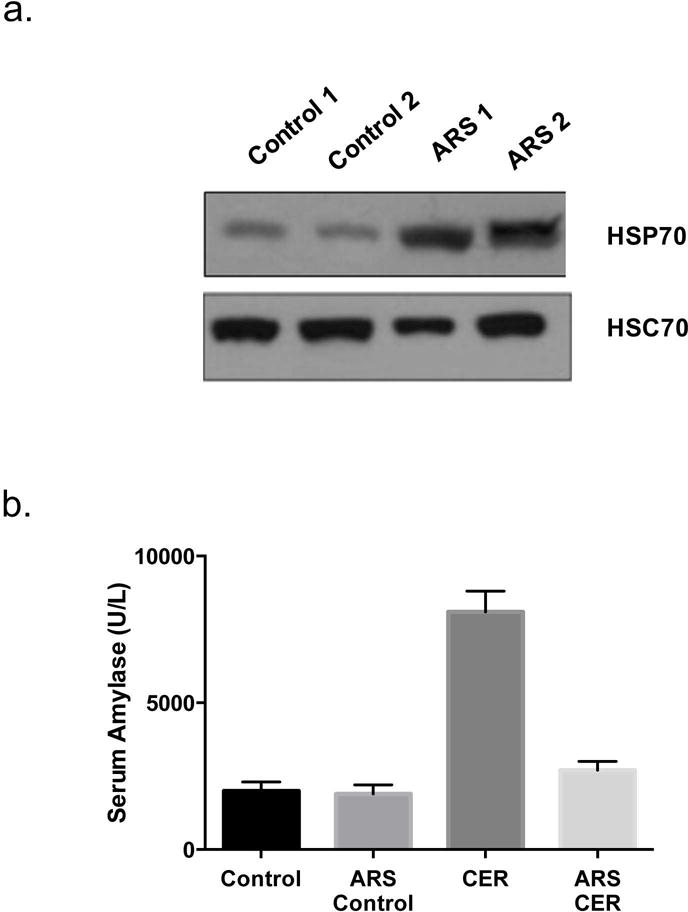
(a) HSP70 Levels are induced by sodium arsenite in rat acini following a single intraperitoneal injection of sodium arsenite (10 mg/kg) and sacrifice at different times after the injection. Pancreas samples from control (CON1 and CON2) and treated rats (ARS) were processed for quantitation of HSP expression by Western blotting. (b) Pre-administration of Sodium Arsenite fourteen hours before induction of acute pancreatitis with Cerulein (ARS + CER, 20 micrograms/kg) reduced serum amylase levels in rats compared to Cerulein treated mice (CER). Adapted from Bhagat et. al [29]
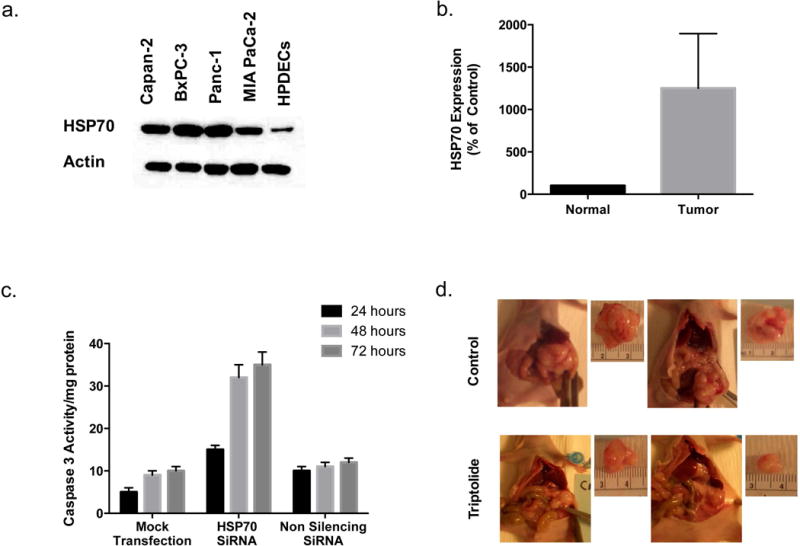
(a) Protein levels of HSP70 were overexpressed in established pancreatic cancer cell lines (Capan-2, BxPC-3, Panc-1, MIA PaCa-2) compared to normal human pancreatic ductal cells (HPDECS). (b) HSP70 Expression was significantly increased in tumors compared to the surrounding normal pancreas. (c) Silencing HSP70 in MIA PaCa-2 cells led to a time dependent apoptosis as seen by an increase in in caspase-3 activity. Adapted from Aghdassi et al.[40] (d) Representative pictures of triptolide treated tumors and controls in nude mice with orthotopic MIA PaCa-2 cancer cells. Mice with orthotopic MiaPaCa-2 tumors who Triptolide were given daily i.p injections (0.2 mg/kg/d) for 60 consecutive days. Adapted from Phillips et al. [54])
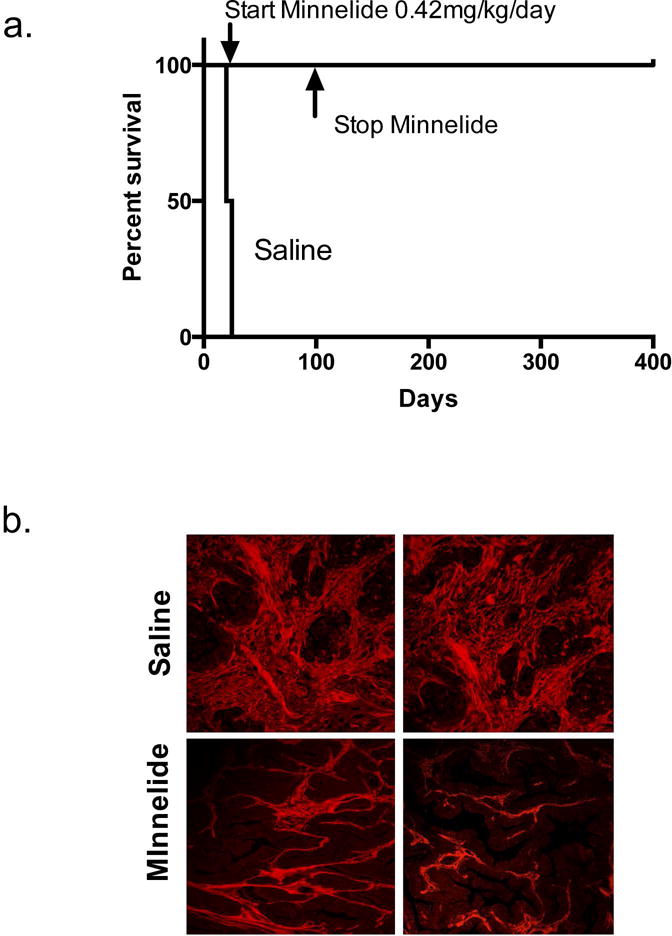
(a) Overall survival in athymic nude mice in an aggressive orthotopic model of AsPC-1 shows increased survival with Minnelide treated mice even after stopping therapy at 100 days and follow up till 100 days whereas the median survival in saline treated mice was only 36 days. Adapted from Chugh et al. [55] (b) Tumors from Minnelide treated mice (0.4mg/kg/day) had considerably less collagen content in an aggressive syngeneic mouse model of pancreatic cancer (KPC). Adapted from Banerjee et. al ([57]
References
-
- Kregel KC. Invited Review: Heat shock proteins: modifying factors in physiological stress responses and acquired thermotolerance. Journal of Applied Physiology. 2002;92:2177–2186. - PubMed
-
- Li GC, Meyer JL, Mak JY, Hahn GM. Heat-induced protection of mice against thermal death. Cancer Res. 1983;43:5758–5760. - PubMed
-
- Landry J, Bernier D, Chretien P, et al. Synthesis and degradation of heat shock proteins during development and decay of thermotolerance. Cancer Res. 1982;42:2457–2461. - PubMed
-
- Landry J, Chretien P. Relationship between hyperthermia-induced heat-shock proteins and thermotolerance in Morris hepatoma cells. Can J Biochem Cell Biol. 1983;61:428–437. - PubMed
-
- Guttman SD, Glover CV, Allis CD, Gorovsky MA. Heat shock, deciliation and release from anoxia induce the synthesis of the same set of polypeptides in starved T. pyriformis. Cell. 1980;22:299–307. - PubMed
Publication types
MeSH terms
Substances
Grants and funding
LinkOut - more resources
Full Text Sources
Other Literature Sources
Medical
