Review
. 2017 May 23;8(6):148.
doi: 10.3390/genes8060148.

CpG and Non-CpG Methylation in Epigenetic Gene Regulation and Brain Function

Affiliations
Review

CpG and Non-CpG Methylation in Epigenetic Gene Regulation and Brain Function

Hyun Sik Jang et al. Genes (Basel). .

Abstract

DNA methylation is a major epigenetic mark with important roles in genetic regulation. Methylated cytosines are found primarily at CpG dinucleotides, but are also found at non-CpG sites (CpA, CpT, and CpC). The general functions of CpG and non-CpG methylation include gene silencing or activation depending on the methylated regions. CpG and non-CpG methylation are found throughout the whole genome, including repetitive sequences, enhancers, promoters, and gene bodies. Interestingly, however, non-CpG methylation is restricted to specific cell types, such as pluripotent stem cells, oocytes, neurons, and glial cells. Thus, accumulation of methylation at non-CpG sites and CpG sites in neurons seems to be involved in development and disease etiology. Here, we provide an overview of CpG and non-CpG methylation and their roles in neurological diseases.

Keywords: CpG methylation; epigenetics; non-CpG methylation.


Conflict of interest statement

The authors declare no conflict of interest.

Figures
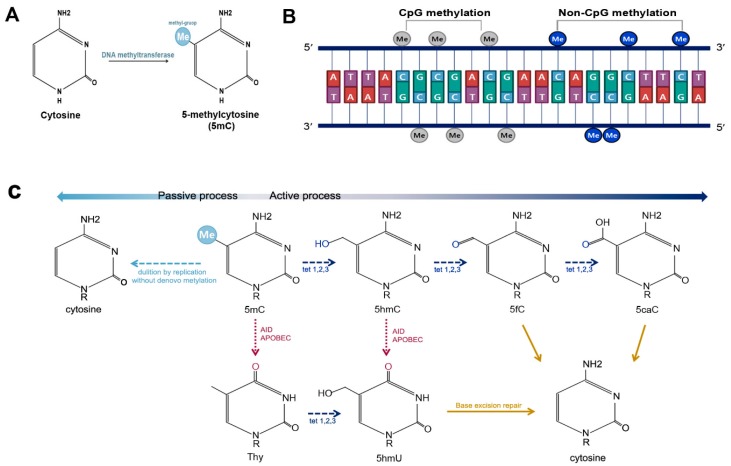
Figure 1
Figure 1
DNA methylation and demethylation. (A) DNA methylation occurs at the fifth carbon of cytosine and leads to the formation of 5-methylcytosine (5mC); (B) DNA methylation is predominantly found at CpG sites, and is much less commonly observed at non-CpG sites, such as CpA, CpT, and CpC; and (C) 5mC can be demethylated by passive or active processes. Active DNA demethylation can occur either via oxidation or deamination. The oxidation process is carried out by Ten-Eleven-Translocation (TET) proteins, including TET1, TET2, and TET3. TETs convert 5mC into 5-hydroxymethylcytosine (5hmC), which is further changed into 5-formylcytosine (5fC) and 5-carboxylcytosine (5caC). 5caC is excised and replaced via base excision repair. 5mC and 5hmC can also be demethylated via deamination by activation induced cytidine deaminase (AID)/apolipoprotein B mRNA editing enzyme, catalytic polypeptide (APOBEC).
Figure 2
Figure 2
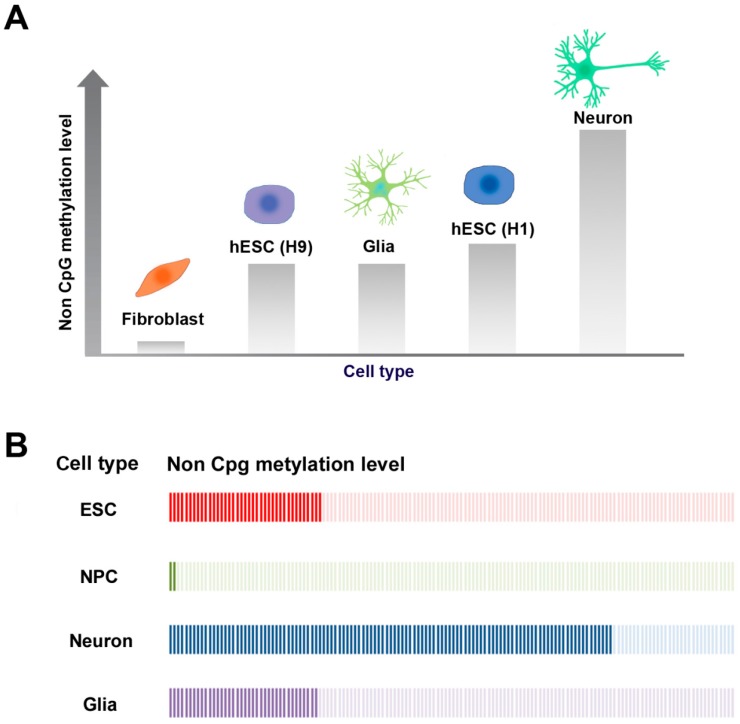
Non-CpG methylation levels in different cell types during differentiation of human ES cells. (A) Tissue-specific non-CpG methylation levels. In mammalian somatic cells, neurons have the highest non-CpG methylation levels, although non-CpG methylation is rare in most other differentiated cell types, such as fibroblasts. Non-CpG methylation is also enriched in ES cells. The human male ES cell line (H1) is more highly methylated than the female ES cell line (H9); (B) Dynamics of non-CpG methylation levels during the differentiation of ES cells. Non-CpG methylation levels decrease when ES cells differentiate into neural progenitor cells (NPCs). When NPCs are further differentiated into neurons and glial cells, non-CpG methylation is increased again. Interestingly, non-CpG methylation levels are higher in neurons than in glial cells.

References

    1. Russo V.E., Martienssen R.A., Riggs A.D. Epigenetic Mechanisms of Gene Regulation. Cold Spring Harbor Laboratory Press; Cold Spring Harbor, NY, USA: 1996.
    1. Portela A., Esteller M. Epigenetic modifications and human disease. Nat. Biotechnol. 2010;28:1057–1068. doi: 10.1038/nbt.1685. - DOI - PubMed
    1. Riggs A.D. X inactivation, differentiation, and DNA methylation. Cytogenet. Genome Res. 1975;14:9–25. doi: 10.1159/000130315. - DOI - PubMed
    1. Holliday R., Pugh J.E. DNA modification mechanisms and gene activity during development. Science. 1975;187:226–232. doi: 10.1126/science.1111098. - DOI - PubMed
    1. Christman J.K. 5-azacytidine and 5-aza-2′-deoxycytidine as inhibitors of DNA methylation: Mechanistic studies and their implications for cancer therapy. Oncogene. 2002;21:5483–5495. doi: 10.1038/sj.onc.1205699. - DOI - PubMed