


Suicide attempts in U.S. Army combat arms, special forces and combat medics
- PMID: 28545424
- PMCID: PMC5445296
- DOI: 10.1186/s12888-017-1350-y
Suicide attempts in U.S. Army combat arms, special forces and combat medics
Abstract
Background: The U.S. Army suicide attempt rate increased sharply during the wars in Iraq and Afghanistan. Risk may vary according to occupation, which significantly influences the stressors that soldiers experience.
Methods: Using administrative data from the Army Study to Assess Risk and Resilience in Servicemembers (Army STARRS), we identified person-month records for all active duty Regular Army enlisted soldiers who had a medically documented suicide attempt from 2004 through 2009 (n = 9650) and an equal-probability sample of control person-months (n = 153,528). Logistic regression analyses examined the association of combat occupation (combat arms [CA], special forces [SF], combat medic [CM]) with suicide attempt, adjusting for socio-demographics, service-related characteristics, and prior mental health diagnosis.
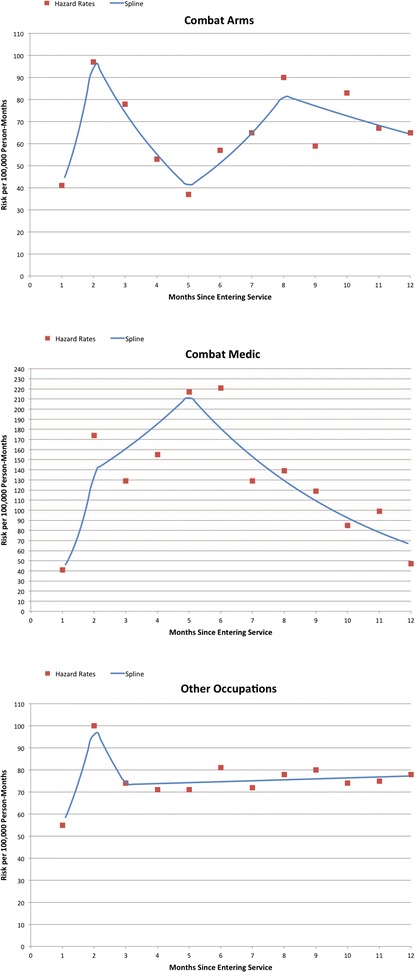
Results: In adjusted models, the odds of attempting suicide were higher in CA (OR = 1.2 [95% CI: 1.1-1.2]) and CM (OR = 1.4 [95% CI: 1.3-1.5]), but lower in SF (OR = 0.3 [95% CI: 0.2-0.5]) compared to all other occupations. CA and CM had higher odds of suicide attempt than other occupations if never deployed (ORs = 1.1-1.5) or previously deployed (ORs = 1.2-1.3), but not when currently deployed. Occupation was associated with suicide attempt in the first ten years of service, but not beyond. In the first year of service, primarily a time of training, CM had higher odds of suicide attempt than both CA (OR = 1.4 [95% CI: 1.2-1.6]) and other occupations (OR = 1.5 [95% CI: 1.3-1.7]). Discrete-time hazard functions revealed that these occupations had distinct patterns of monthly risk during the first year of service.
Conclusions: Military occupation can inform the understanding suicide attempt risk among soldiers.
Keywords: Military; Occupation; Suicide attempt.
Figures
References
-
- Schoenbaum M, Kessler RC, Gilman SE, Colpe LJ, Heeringa SG, Stein MB, Ursano RJ, Cox KL. Predictors of suicide and accident death in the Army study to assess risk and resilience in Servicemembers (Army STARRS) JAMA Psychiatry. 2014;71(5):493–503. doi: 10.1001/jamapsychiatry.2013.4417. - DOI - PMC - PubMed
-
- Ursano RJ, Kessler RC, Heeringa SG, Cox KL, Naifeh JA, Fullerton CS, Sampson NA, Kao T-C, Aliaga PA, Vegella P et al: Nonfatal suicidal behaviors in U.S. Army administrative records, 2004–2009: Results from the Army study to assess risk and resilience in Servicemembers (Army STARRS). Psychiatry 2015, 78:1–21. - PMC - PubMed
-
- Black SA, Gallaway MS, Bell MR, Ritchie EC. Prevalence and risk factors associated with suicides of army soldiers 2001–2009. Mil Psychol. 2011;23:433–451. doi: 10.1037/h0094766. - DOI
MeSH terms
Grants and funding
LinkOut - more resources
Full Text Sources
Other Literature Sources
Medical
