. 2017 May 25;19(1):109.
doi: 10.1186/s13075-017-1319-8.

Pre-silencing of genes involved in the electron transport chain (ETC) pathway is associated with responsiveness to abatacept in rheumatoid arthritis

Affiliations

Pre-silencing of genes involved in the electron transport chain (ETC) pathway is associated with responsiveness to abatacept in rheumatoid arthritis

C Derambure et al. Arthritis Res Ther. .

Abstract

Background: In the current context of personalized medicine, one of the major challenges in the management of rheumatoid arthritis (RA) is to identify biomarkers that predict drug responsiveness. From the European APPRAISE trial, our main objective was to identify a gene expression profile associated with responsiveness to abatacept (ABA) + methotrexate (MTX) and to understand the involvement of this signature in the pathophysiology of RA.

Methods: Whole human genome microarrays (4 × 44 K) were performed from a first subset of 36 patients with RA. Data validation by quantitative reverse-transcription (qRT)-PCR was performed from a second independent subset of 32 patients with RA. Gene Ontology and WikiPathways database allowed us to highlight the specific biological mechanisms involved in predicting response to ABA/MTX.

Results: From the first subset of 36 patients with RA, a combination including 87 transcripts allowed almost perfect separation between responders and non-responders to ABA/MTX. Next, the second subset of patients 32 with RA allowed validation by qRT-PCR of a minimal signature with only four genes. This latter signature categorized 81% of patients with RA with 75% sensitivity, 85% specificity and 85% negative predictive value. This combination showed a significant enrichment of genes involved in electron transport chain (ETC) pathways. Seven transcripts from ETC pathways (NDUFA6, NDUFA4, UQCRQ, ATP5J, COX7A2, COX7B, COX6A1) were significantly downregulated in responders versus non-responders to ABA/MTX. Moreover, dysregulation of these genes was independent of inflammation and was specific to ABA response.

Conclusion: Pre-silencing of ETC genes is associated with future response to ABA/MTX and might be a crucial key to susceptibility to ABA response.

Keywords: Abatacept; Abatacept response; Biomarkers; Microarray; Mitochondria; Oxydative stress; Rheumatoid arthritis.


Figures
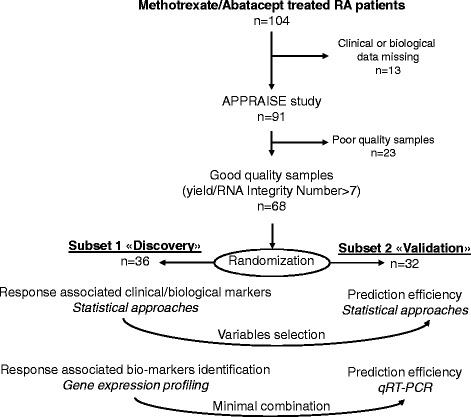
Fig. 1
Fig. 1
Ancillary study design from the APPRAISE trial. Of the 104 patients with rheumatoid arthritis (RA) enrolled in the APPRAISE trial, 68 were included in our ancillary study after discarding patients with missing data or poor-quality RNA samples. Among these 68 patients with RA, two subsets were designated, one for identification and one for validation. The first step of this ancillary study was to identify clinical parameters to predict abatacept (ABA)/methotrexate (MTX) response. The second step was to identify a gene combination able to predict ABA/MTX response. Subset 1, comprising 36 patients with RA, was used to identify clinical parameters or gene combinations to predict drug response. Subset 2, comprising 32 patients with RA, was used to validate these clinical parameters or gene combinations. qRT-PCR quantitative reverse-transcription PCR
Fig. 2
Fig. 2
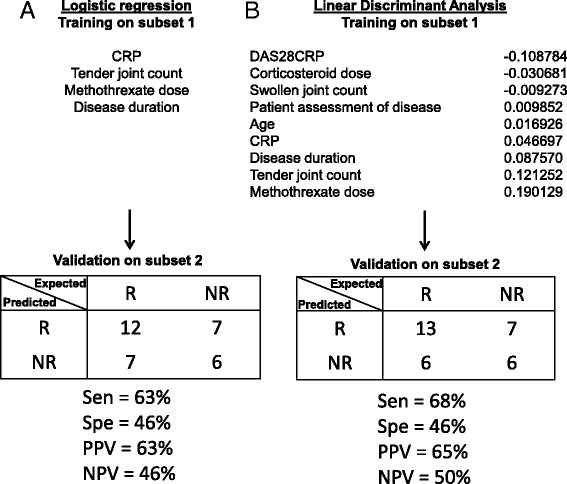
Inability of clinical and biological parameters to predict response to abatacept/methotrexate (ABA/MTX). Two independent statistical methods were performed to identify variables to predict drug response in subset 1. Next, the prediction accuracy of these variables was evaluated in subset 2. a In subset 1, four variables were selected by logistic regression: C-reactive protein (CRP), tender joint count, MTX dose and disease duration. In subset 2, these four variables allowed good categorization of 12 out of 19 responders (R) and 6 out of 13 non-responders (NR). The remaining 14 patients were misclassified. b In subset 1, linear discriminant analysis was performed to balance each parameter by calculation of the coefficient of linear discriminant analysis. In subset 2, these data allowed good categorization of 13 out of 19 R and 6 out of 13 NR. The remaining 13 patients were misclassified. DAS28 disease activity score in 28 joints, Sen sensitivity, Spe specificity, PPV positive predictive value, NPV negative predictive value
Fig. 3
Fig. 3
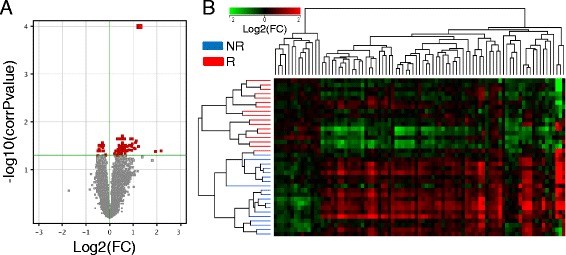
Gene expression profiling associated with response to abatacept/methotrexate in subset 1. Baseline samples from subset 1 (n = 36 (17 responders (R) and 19 non-responders (NR)) were hybridized on 4 × 44 K whole human genome microarrays. a The t test with the Benjamini–Hochberg correction for estimation of the false discovery rate (p < 0.05) was used to identify 87 transcripts (red dots) with dysregulation that was associated with response (R vs NR). b Hierarchical clustering: Pearson coefficient and complete linkage metrics were used to obtain the transcripts and sample dendrograms. Fold change (FC) is the ratio of relative abundance of transcripts in patients with rheumatoid arthritis vs control pool
Fig. 4
Fig. 4
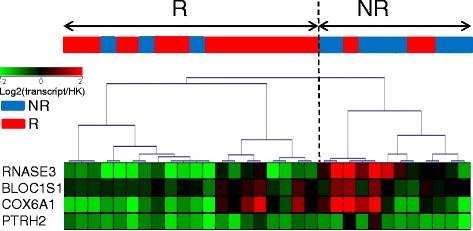
Validation of a small transcript combination associated with response to abatacept/methotrexate (ABA/MTX) in subset 2. A minimal combination of four transcripts (RNASE3, BLOC1S1, COX6A1, PTRH2) was identified by logistic regression from the 87 transcripts previously identified with subset 1. Next, the ability of these four transcripts to predict ABA/MTX response was evaluated by quantitative reverse-transcription (qRT)-PCR with subset-2 samples. Hierarchical clustering based on normalized qRT-PCR values was built with the Pearson coefficient metric and complete linkage. These data allowed good categorization of 16 out of 19 responders (R) and 10 out of 13 non-responders (NR), for a total of 26 among the 32 patients with RA overall in subset 2. Intensity values were expressed as an expression ratio (transcript/housekeeping (HK) gene)
Fig. 5
Fig. 5
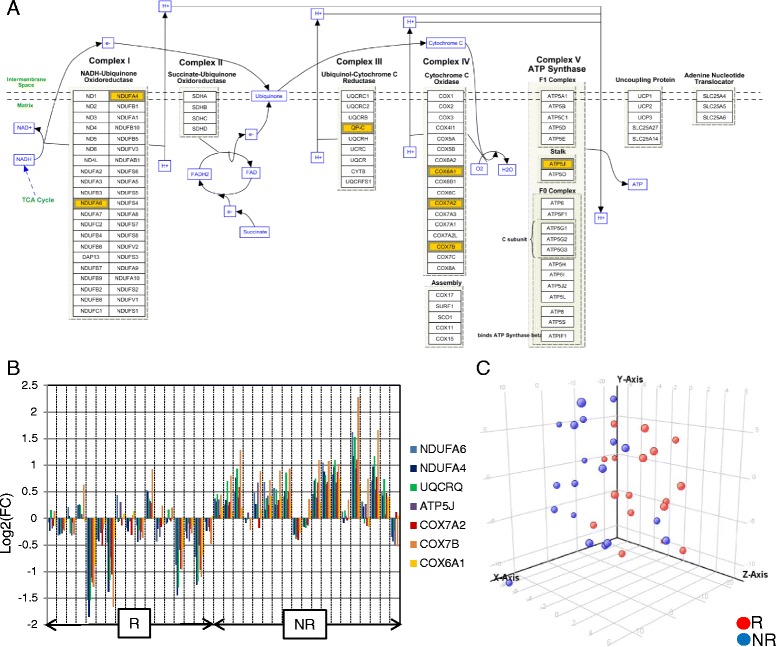
Pre-silencing of mitochondrial respiratory chain associated with abatacept/methotrexate (ABA/MTX) response. a Electron transport chain (ETC) WP111-41171 WikiPathway (http://www.wikipathways.org/index.php/Pathway:WP111). In the 87 mRNA dysregulated between responders (R) and non-responders (NR) to ABA/MTX, there was highly significant enrichment of mRNA involved in ETC (p value = 1.6.10-9). The p value was determined by standard hypergeometric distribution. This enrichment involved 7 mRNA from the 87 transcripts, which are highlighted in yellow among the 104 proteins from the whole ETC pathway. b Gene expression level expressed as fold change (FC) (patients with RA/control pool) for these 7 mRNA in 17 R and 19 NR. c Principal component analysis of 17 R and 19 NR performed with gene expression level (fold change) of the 104 mRNA from the whole ETC pathway. Component 1: 40.3%; component 2: 16.7%

References

    1. Smolen JS, Aletaha D. Rheumatoid arthritis therapy reappraisal: strategies, opportunities and challenges. Nat Rev Rheumatol. 2015;11(5):276–89. doi: 10.1038/nrrheum.2015.8. - DOI - PubMed
    1. Nam JL, Ramiro S, Gaujoux-Viala C, Takase K, Leon-Garcia M, Emery P, et al. Efficacy of biological disease-modifying antirheumatic drugs: a systematic literature review informing the 2013 update of the EULAR recommendations for the management of rheumatoid arthritis. Ann Rheum Dis. 2014;73(3):516–28. doi: 10.1136/annrheumdis-2013-204577. - DOI - PubMed
    1. Orme ME, Macgilchrist KS, Mitchell S, Spurden D, Bird A. Systematic review and network meta-analysis of combination and monotherapy treatments in disease-modifying antirheumatic drug-experienced patients with rheumatoid arthritis: analysis of American College of Rheumatology criteria scores 20, 50, and 70. Biologics. 2012;6:429–64. - PMC - PubMed
    1. Ramiro S, Gaujoux-Viala C, Nam JL, Smolen JS, Buch M, Gossec L, et al. Safety of synthetic and biological DMARDs: a systematic literature review informing the 2013 update of the EULAR recommendations for management of rheumatoid arthritis. Ann Rheum Dis. 2014;73(3):529–35. doi: 10.1136/annrheumdis-2013-204575. - DOI - PubMed
    1. Singh JA, Christensen R, Wells GA, Suarez-Almazor ME, Buchbinder R, Lopez-Olivo MA, et al. A network meta-analysis of randomized controlled trials of biologics for rheumatoid arthritis: a Cochrane overview. CMAJ. 2009;181(11):787–96. doi: 10.1503/cmaj.091391. - DOI - PMC - PubMed

Publication types