


Objectively Measured Sedentary Time and Cardiovascular Risk Factor Control in US Hispanics/Latinos With Diabetes Mellitus: Results From the Hispanic Community Health Study/Study of Latinos (HCHS/SOL)
- PMID: 28546455
- PMCID: PMC5669141
- DOI: 10.1161/JAHA.116.004324
Objectively Measured Sedentary Time and Cardiovascular Risk Factor Control in US Hispanics/Latinos With Diabetes Mellitus: Results From the Hispanic Community Health Study/Study of Latinos (HCHS/SOL)
Abstract
Background: Cardiovascular disease (CVD) risk factor control is a cornerstone of diabetes mellitus management. Little is known about relationships of objectively measured sedentary time and physical activity with major CVD risk factor control in individuals with diabetes mellitus. We examined associations of objectively measured sedentary time and moderate-to-vigorous physical activity with reaching major CVD risk factor control goals among US Hispanic/Latino adults with diabetes mellitus.
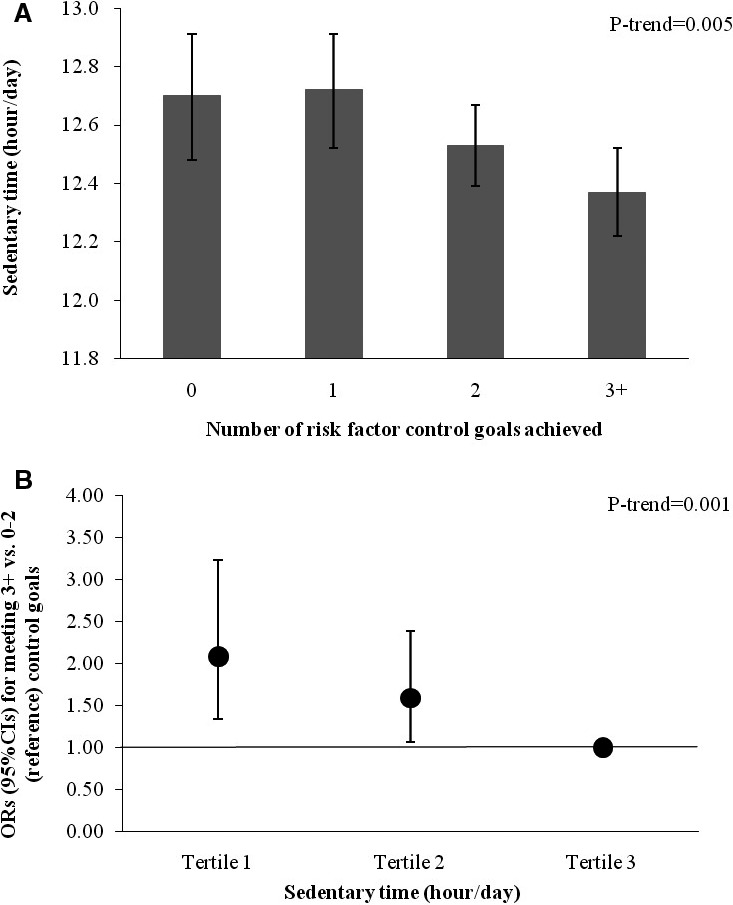
Methods and results: This cross-sectional analysis included 1699 participants with diabetes mellitus from the Hispanic Community Health Study/Study of Latinos (2008-2011). Logistic regression models were used to estimate the odds ratios (ORs) of meeting the following 5 major CVD risk factor control goals: hemoglobin A1c <7.0%; systolic/diastolic blood pressure <140/80 mm Hg; triglycerides <150 mg/dL; low-density lipoprotein cholesterol <100 mg/dL; and high-density lipoprotein cholesterol >40/50 mg/dL for men/women. After adjustment for covariates including moderate-to-vigorous physical activity, less sedentary time was associated with increased odds of reaching hemoglobin A1c (OR=1.76 [95% CI: 1.10, 2.82]) and triglyceride control goals (OR=2.16 [1.36, 3.46]), and reaching ≥3 CVD risk factor control goals (OR=2.08 [1.34, 3.23]) (all ORs for comparisons of extreme tertiles of sedentary time). Moderate-to-vigorous physical activity was not associated with reaching any CVD risk factor control goals. Substituting 60-min/day of sedentary time with light-intensity physical activity was associated with increased odds of reaching hemoglobin A1c (OR=1.18 [1.04, 1.35]), high-density lipoprotein cholesterol (OR=1.17 [1.04, 1.32]), and triglyceride (OR=1.20 [1.05, 1.36]) control goals.
Conclusions: Among US Hispanic/Latino adults with diabetes mellitus, less sedentary time, but not moderate-to-vigorous physical activity, was associated with improved CVD risk factor control, specifically in reaching hemoglobin A1c and triglyceride control goals.
Keywords: Hispanic/Latino; cardiovascular disease risk factors; diabetes mellitus; moderate‐to‐vigorous physical activity; sedentary behaviors.
© 2017 The Authors. Published on behalf of the American Heart Association, Inc., by Wiley.
Figures
References
-
- Centers for Disease Control and Prevention . National Diabetes Fact Sheet: National Estimates and General Information on Diabetes and Prediabetes in the United States. Atlanta: U.S. Department of Health and Human Services, Centers for Disease Control and Prevention; 2011.
-
- Rodriguez CJ, Allison M, Daviglus ML, Isasi CR, Keller C, Leira EC, Palaniappan L, Pina IL, Ramirez SM, Rodriguez B, Sims M. Status of cardiovascular disease and stroke in Hispanics/Latinos in the United States: a science advisory from the American Heart Association. Circulation. 2014;130:593–625. - PMC - PubMed
Publication types
MeSH terms
Substances
Grants and funding
LinkOut - more resources
Full Text Sources
Other Literature Sources
Medical
