. 2017 Aug;174(15):2563-2575.
doi: 10.1111/bph.13868. Epub 2017 Jul 5.

Novel selective PDE type 1 inhibitors cause vasodilatation and lower blood pressure in rats

Affiliations

Novel selective PDE type 1 inhibitors cause vasodilatation and lower blood pressure in rats

Morten Laursen et al. Br J Pharmacol. 2017 Aug.

Abstract

Background and purpose: The PDE enzymes (PDE1-11) hydrolyse and thus inactivate cyclic nucleotides and are important in the regulation of the cardiovascular system. Here,we have investigated the effects on the cardiovascular system, of two novel selective PDE1 inhibitors, Lu AF41228 and Lu AF58027.

Experimental approach: We used rat mesenteric small arteries (internal diameters of 200-300 μm), RT-PCR and measured isometric wall tension. Effects of Lu AF41228 and Lu AF58027 on heart rate and BP were assessed in both anaesthetized and conscious male rats.

Key results: Nanomolar concentrations of Lu AF41228 and Lu AF58027 inhibited PDE1A, PDE1B and PDE1C enzyme activity, while micromolar concentrations were required to observe inhibitory effects at other PDEs. RT-PCR revealed expression of PDE1A, PDE1B and PDE1C in rat brain, heart and aorta, but only PDE1A and PDE1B in mesenteric arteries. In rat isolated mesenteric arteries contracted with phenylephrine or U46619, Lu AF41228 and Lu AF58027 induced concentration-dependent relaxations which were markedly reduced by inhibitors of guanylate cyclase, ODQ, and adenylate cyclase, SQ22536, and in preparations without endothelium. In anaesthetized rats, Lu AF41228 and Lu AF58027 dose-dependently lowered mean BP and increased heart rate. In conscious rats with telemetric pressure transducers, repeated dosing with Lu AF41228 lowered mean arterial BP 10-15 mmHg and increased heart rate.

Conclusions and implications: These novel PDE1 inhibitors induce vasodilation and lower BP, suggesting a potential use of these vasodilators in the treatment of hypertension and vasospasm.


Figures

Figure 1
Figure 1
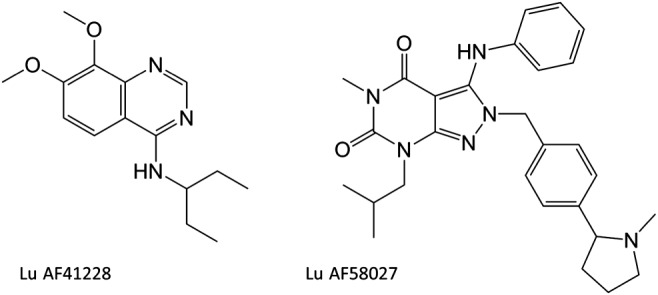
Structure of Lu AF41228 and Lu AF58027.
Figure 2
Figure 2
RT‐PCR of PDE1A–C expression. Expression in rat (1) mesenteric arteries, (2) aorta, (3) lung, (4) heart and (5) brain. PDE1A–C were expressed in all investigated tissues with the exception of PDE1C, which was not expressed in mesenteric arteries. The bands were sequenced and confirmed as the correct product. The gels are representative of tissue from three animals, run in three different experiments. Primers can be seen in Supporting Information Table S1.
Figure 3
Figure 3
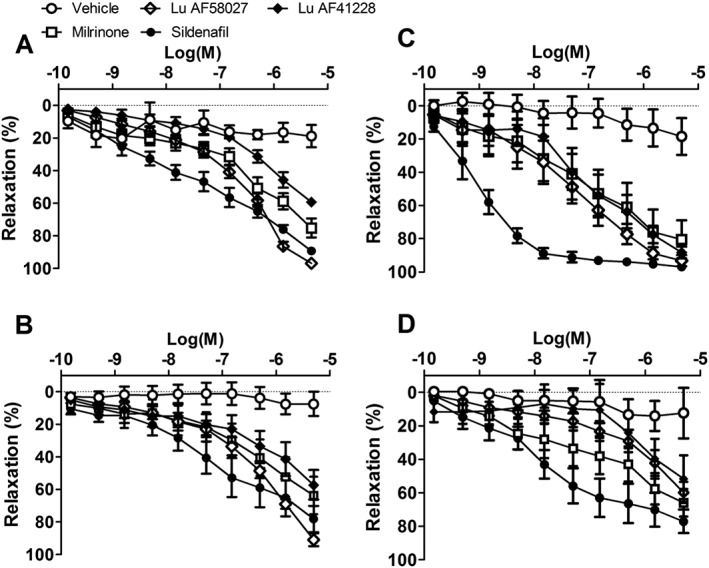
Vasodilatation induced by PDE1 inhibition in rat small arteries. Concentration–response curves for sildenafil (n = 6), a PDE5 inhibitor; milrinone (n = 5), a PDE3 inhibitor; and two PDE1 inhibitors, Lu AF41228 (n = 5) and Lu AF58027 (n = 5), and vehicle (n = 7) in (A, B) noradrenaline‐ and (C, D) U46619‐contracted, (A, C) mesenteric and (B, D) femoral arteries. Data are means ± SEM, where n indicates the number of animals.
Figure 4
Figure 4
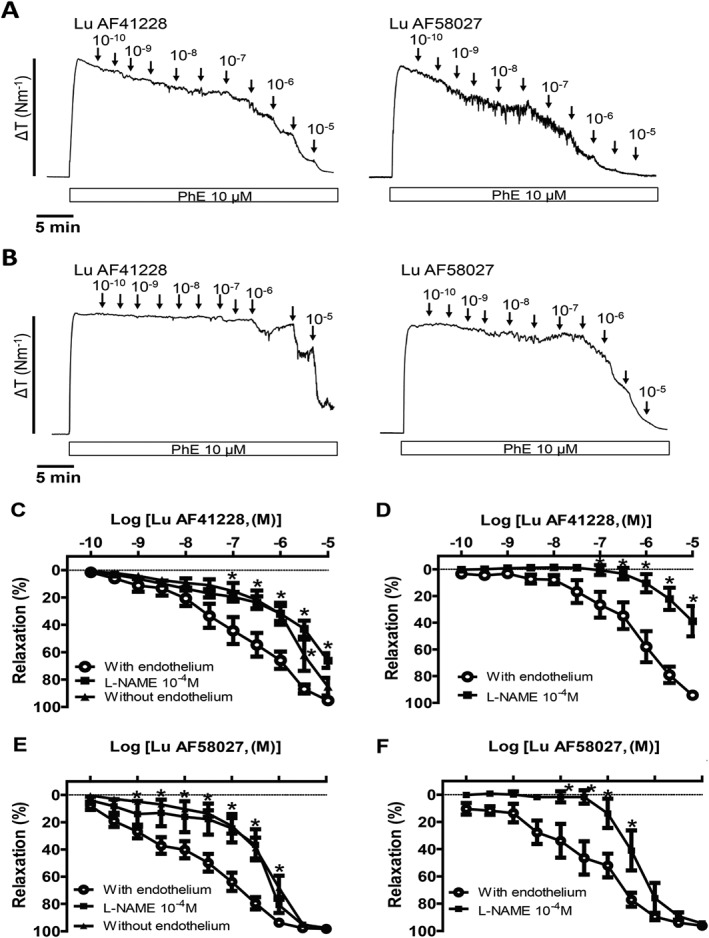
Effect of endothelial cell removal and NOS inhibition on vasodilatation induced by PDE1 inhibition in rat mesenteric arteries. Original recordings showing concentration–response curves for Lu AF41228 and Lu AF58027 in phenylephrine (PhE)‐contracted mesenteric arteries with endothelium (A) and without endothelium (B). Average concentration–response curves for Lu AF41228 in (C) PhE‐contracted arteries with endothelium (n = 12), in the presence of the NOS inhibitor, L‐NAME (n = 6), and in arteries without endothelium (n = 6), (D) U46619‐contracted arteries with endothelium (n = 6) and in the presence of L‐NAME (n = 6). Concentration–response curves for Lu AF58027 in (E) PhE‐contracted arteries with endothelium (n = 10), in the presence of L‐NAME (n = 6) and in arteries without endothelium (n = 7), (F) U46619‐contracted arteries with endothelium (n = 6) and in the presence of L‐NAME (n = 6). Data are means ± SEM, where n indicates the number of animals. *P < 0.05, significantly different from arteries with endothelium.
Figure 5
Figure 5
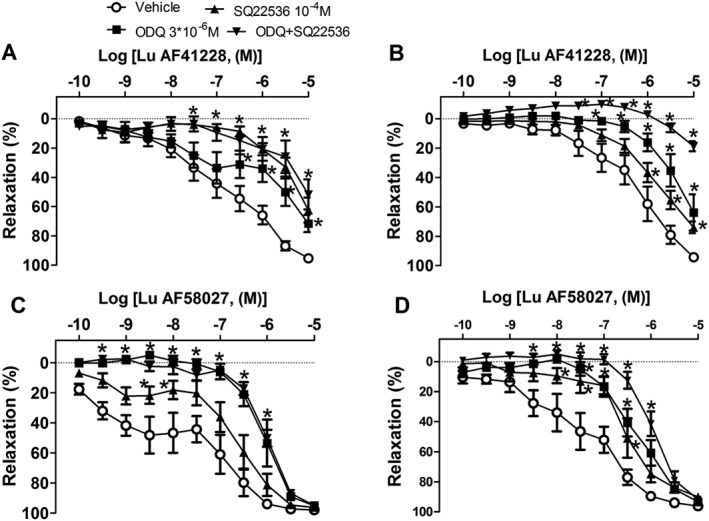
Effect of guanylate cyclase and adenylate cyclase inhibition on vasodilatation induced by PDE1 inhibition in rat mesenteric arteries. Concentration–response curves for Lu AF41228 in (A) phenylephrine‐contracted arteries incubated with vehicle (n = 6); an inhibitor of guanylate cyclase, ODQ (n = 6); an inhibitor of adenylate cyclase, SQ22536 (n = 6); or the combination of ODQ and SQ22536 (n = 5), and (B) U46619‐contracted arteries incubated with vehicle (n = 6), ODQ (n = 6), SQ22536 (n = 6) or the combination of ODQ and SQ22536 (n = 5). Concentration–response curves for Lu 58027 in (C) phenylephrine‐contracted arteries incubated with vehicle (n = 6); an inhibitor of guanylate cyclase, ODQ (n = 7); an inhibitor of adenylate cyclase, SQ22536 (n = 5); or the combination of ODQ and SQ22536 (n = 6), and (D) U46619‐contracted arteries incubated with vehicle (n = 6), ODQ (n = 7), SQ22536 (n = 5) or the combination of ODQ and SQ22536 (n = 6). Data are means ± SEM. *P < 0.05, significantly different from vehicle control.
Figure 6
Figure 6
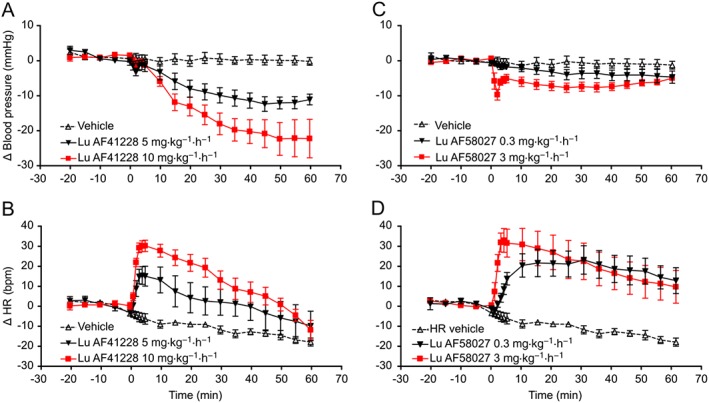
BP decrease and HR increase in response to PDE1 inhibition in anaesthetized rats. After equilibrium was reached, baseline was recorded for 20 min and animals were then given i.v. infusions of either compound or vehicle (continuous infusion over 60 min). Plasma exposure was measured in separate time‐matched animals. (A) Decrease in BP in response to Lu AF41228 (5 and 10 mg·kg−1·h−1). A minor response occurred immediately after start of the drug infusion at both doses followed by a return towards baseline after 5 min. BP then dose‐dependently decreased compared with vehicle throughout the experiment (5 mg·kg−1·h−1: P < 0.05, n = 4, 10 mg·kg−1·h−1: P < 0.05, n = 6, vehicle: n = 4). (B) Dose‐dependent increase in HR in response to Lu AF41228 (5 and 10 mg·kg−1·h−1). Response occurred immediately after start of the drug infusion (5 mg·kg−1·h−1: P < 0.05, n = 4, 10 mg·kg−1·h−1: P < 0.05, n = 6, vehicle: n = 4). (C) Decrease in BP in response to Lu AF58027 (0.3 and 3 mg·kg−1·h−1). Only a small but significant decrease was observed at 0.3 mg·kg−1·h−1. At 3 mg·kg−1·h−1, a minor response occurred immediately after start of the drug infusion followed by a return towards baseline after 5 min. BP then remained stably decreased compared with vehicle throughout the experiment (0.3 mg·kg−1·h−1: P < 0.05, n = 4, 3 mg·kg−1·h−1: P < 0.05, n = 6, vehicle: n = 4). (D) Dose‐dependent increase in HR in response to Lu AF58027 (0.3 and 3 mg·kg−1·h−1). Response occurred immediately after start of the drug infusion (0.3 mg·kg−1·h−1: P < 0.05, n = 4, 3 mg·kg−1·h−1: P < 0.05, n = 6, vehicle: n = 4).
Figure 7
Figure 7
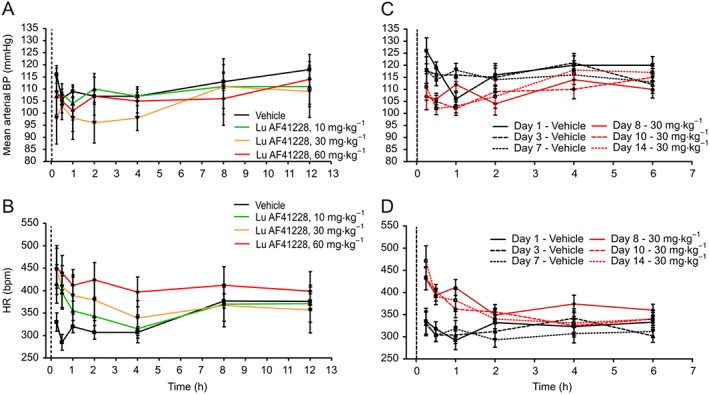
BP and HR changes in response to PDE1 inhibition in telemetered rats. Rats were dosed once with three different doses of Lu AF41228 (A, B, C) or twice daily with a single dose of Lu AF41228 for 7 days (D, E, F). Dotted vertical line represents time of dosing. All experiments are n = 6 except for exposure evaluations. (A) Lu AF41228 did not lead to statistically significant changes in mean arterial BP at any dose tested (maximum 60 mg·kg−1). (B) Lu AF41228 resulted in dose‐dependent increases in HR immediately after dosing. (C) After repeated dosing, Lu AF41228 resulted in a minor decrease in mean arterial BP (P < 0.05 after 0.25 and 0.5 h at day 8 and after 0.5 and 1 h at days 10 and 14). (D) After repeated dosing, Lu AF41228 resulted in an increase in HR immediately after dosing. The effect was similar at days 8, 10 and 14 (P < 0.05 after 0.25 and 0.5 and 1 h at day 8 and after 0.25 and 0.5 h at days 10 and 14).

References

    1. Alexander SPH, Fabbro D, Kelly E, Marrion N, Peters JA, Benson HE et al. (2015a). The Concise Guide to PHARMACOLOGY 2015/16: Enzymes. Br J Pharmacol 172: 6024–6109. - PMC - PubMed
    1. Alexander SPH, Davenport AP, Kelly E, Marrion N, Peters JA, Benson HE et al. (2015b). The Concise Guide to PHARMACOLOGY 2015/16: G protein‐coupled receptors. Br J Pharmacol 172: 5744–5869. - PMC - PubMed
    1. Andersen CU, Mulvany MJ, Simonsen U (2005). Lack of synergistic effect of molsidomine and sildenafil on development of pulmonary hypertension in chronic hypoxic rats. Eur J Pharmacol 510: 87–96. - PubMed
    1. Bautista Nino PK, Durik M, Danser AH, de Vries R, Musterd‐Bhaggoe UM, Meima ME et al. (2015). Phosphodiesterase 1 regulation is a key mechanism in vascular aging. Clin Sci (Lond) 129: 1061–1075. - PubMed
    1. Bender AT, Beavo JA (2006). Cyclic nucleotide phosphodiesterases: molecular regulation to clinical use. Pharmacol Rev 58: 488–520. - PubMed

Publication types

MeSH terms

Substances