. 2017 Sep 15;6(9):1710-1721.
doi: 10.1021/acssynbio.7b00059. Epub 2017 May 26.

A Fluorescent Split Aptamer for Visualizing RNA-RNA Assembly In Vivo

Affiliations

A Fluorescent Split Aptamer for Visualizing RNA-RNA Assembly In Vivo

Khalid K Alam et al. ACS Synth Biol. .

Abstract

RNA-RNA assembly governs key biological processes and is a powerful tool for engineering synthetic genetic circuits. Characterizing RNA assembly in living cells often involves monitoring fluorescent reporter proteins, which are at best indirect measures of underlying RNA-RNA hybridization events and are subject to additional temporal and load constraints associated with translation and activation of reporter proteins. In contrast, RNA aptamers that sequester small molecule dyes and activate their fluorescence are increasingly utilized in genetically encoded strategies to report on RNA-level events. Split-aptamer systems have been rationally designed to generate signal upon hybridization of two or more discrete RNA transcripts, but none directly function when expressed in vivo. We reasoned that the improved physiological properties of the Broccoli aptamer enable construction of a split-aptamer system that could function in living cells. Here we present the Split-Broccoli system, in which self-assembly is nucleated by a thermostable, three-way junction RNA architecture and fluorescence activation requires both strands. Functional assembly of the system approximately follows second-order kinetics in vitro and improves when cotranscribed, rather than when assembled from purified components. Split-Broccoli fluorescence is digital in vivo and retains functional modularity when fused to RNAs that regulate circuit function through RNA-RNA hybridization, as demonstrated with an RNA Toehold switch. Split-Broccoli represents the first functional split-aptamer system to operate in vivo. It offers a genetically encoded and nondestructive platform to monitor and exploit RNA-RNA hybridization, whether as an all-RNA, stand-alone AND gate or as a tool for monitoring assembly of RNA-RNA hybrids.

Keywords: RNA AND gate; RNA interaction; RNA synthetic biology; binary aptamer; cotranscriptional RNA assembly; fluorescence complementation.


Conflict of interest statement

The authors declare no competing financial interest.

Figures
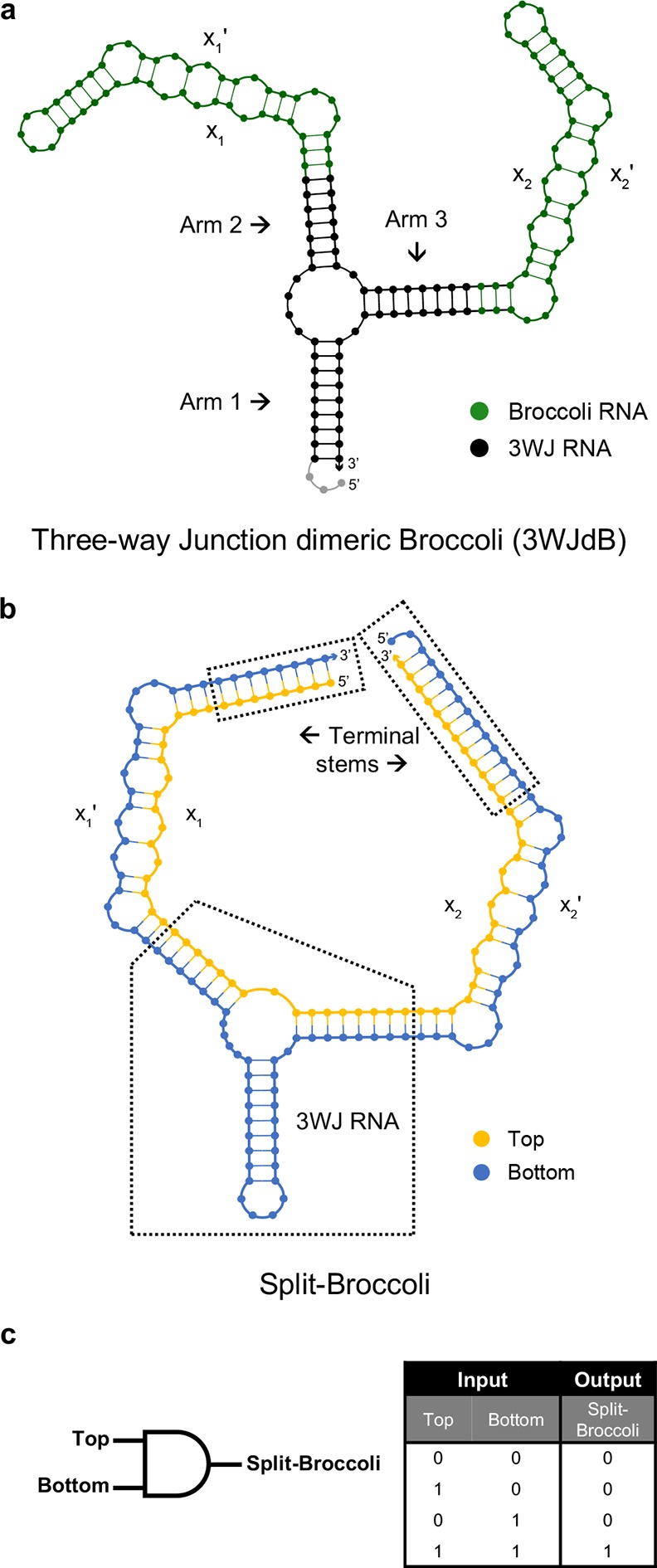
Figure 1
Figure 1
Design and NUPACK predicted secondary structures of 3WJdB and Split-Broccoli. (a) Monomers of Broccoli aptamer (green) were inserted into Arms 2 and 3 of the three-way junction (3WJ) RNA motif (black) to create the unimolecular, unsplit three-way junction dimeric Broccoli (3WJdB). (b) Design of the Split-Broccoli system required inversion of the Broccoli monomer present in Arm 2 to ensure that neither Top (yellow) nor Bottom (blue) strand alone contained the full sequence required to independently form a fully functional monomer of Broccoli (i.e., xn:xn′). Predicted hybridization of the two strands was strengthened with the addition of terminal stems. (c) The Split-Broccoli system illustrated as an RNA AND gate (left) and its corresponding truth table (right). Output from the system should be true (1) only when both inputs are also true.
Figure 2
Figure 2
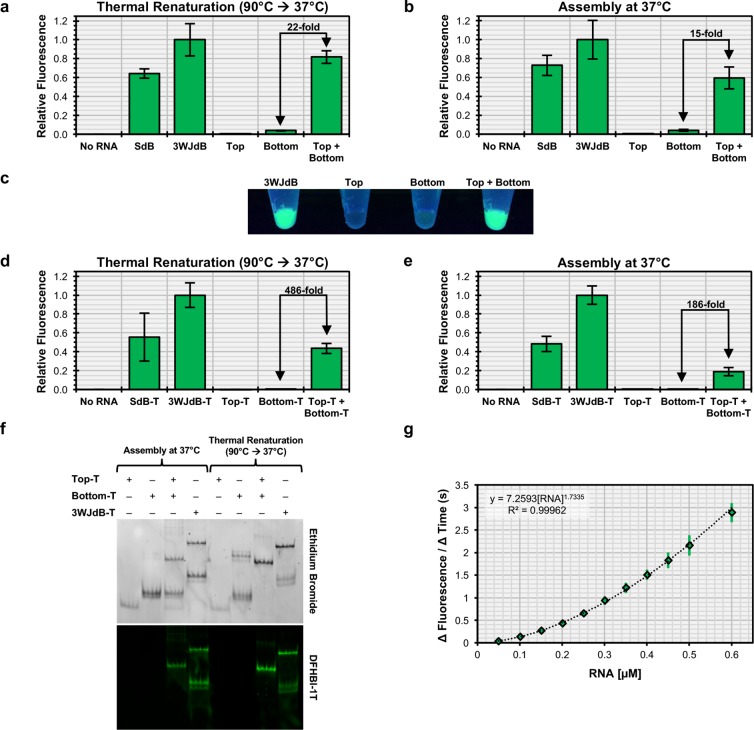
In vitro assembly of the Split-Broccoli system in the absence and presence of transcription terminator structures. Assembly of equimolar amounts of purified Split-Broccoli RNA components (Top + Bottom) demonstrate robust function comparable to fluorescence of the stabilized dimeric Broccoli (SdB) and 3WJdB, (a) when thermally renatured or (b) when simply incubated together at physiological temperature. Background signal from either Top or Bottom alone remains minimal for both assembly methods. (c) Fluorescence of 3WJdB and the Split-System (Top + Bottom, thermally renatured) is easily observed when excited with longwave ultraviolet light, whereas signal from Bottom alone is only slightly discernible. When transcribed with transcription terminator structures (denoted by appending “-T” to the names of the individual RNAs) and assembled in vitro (d, e), the Split-Broccoli system exhibits a decrease in relative fluorescence, but demonstrates a larger fold-change in fluorescence activation over either Top-T or Bottom-T alone. (f) Nondenaturing gel electrophoresis and dual staining with ethidium bromide and DFHBI-1T of the Split-Broccoli system with transcription terminator structures suggests that decreased fluorescence of the system is a result of incomplete hybridization between Top-T and Bottom-T, rather than nonfunctional assembly. (g) Functional assembly of Top-T and Bottom-T approximately follows second-order kinetics (y = A[Top][Bottom] = A[Top]2, for equimolar mixture). Mean values are shown with error bars to indicate standard deviations (n = 5 for panels a, b, d, e; n = 4 for panel g).
Figure 3
Figure 3
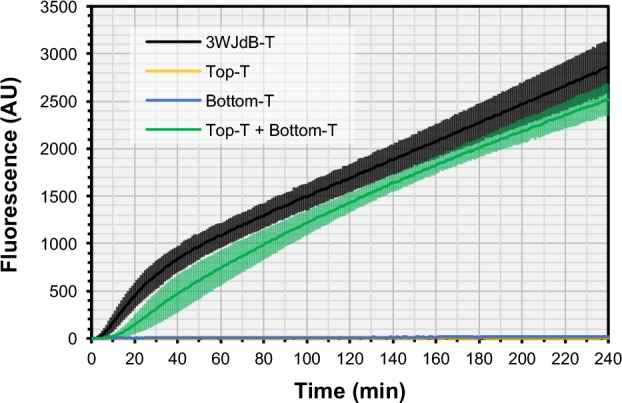
Cotranscriptional assembly of Split-Broccoli with transcription terminator structures improves signal relative to independently transcribed and assembled RNA. When cotranscribed with equimolar amounts of template DNA in a one-pot in vitro transcription reaction designed to maximize time resolution, Split-Broccoli (Top-T + Bottom-T, green) exhibits approximately 88% of the signal generated by the unimolecular, unsplit variant (3WJdB-T, black) after a 4-h reaction. By the final time point at 240 min, Split-Broccoli demonstrates a 124-fold increase over either Top-T (yellow) or Bottom-T (blue) alone. Mean values are shown (n = 4) with error bars to indicate standard deviations.
Figure 4
Figure 4
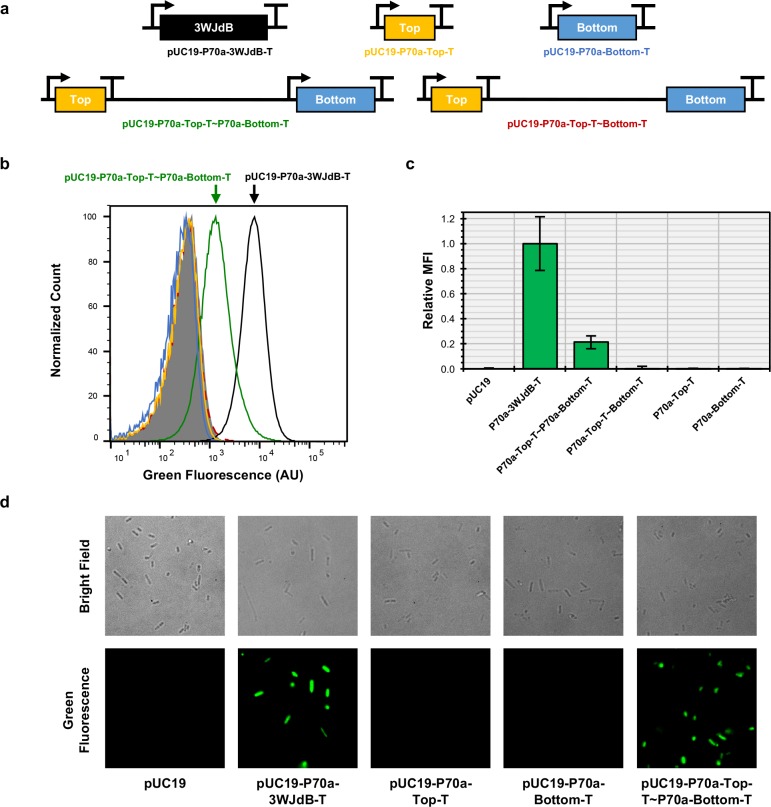
The Split-Broccoli system functions when expressed in vivo. (a) DNA templates corresponding to 3WJdB-T (black), Top-T (yellow), Bottom-T (blue) were individually cloned into the pUC19 plasmid. A single plasmid expressing both Top-T and Bottom-T was created (pUC19-P70a-Top-T∼P70a-Bottom-T), as was a control plasmid for runon transcription which lacked a promoter immediately upstream of Bottom-T (pUC19-P70a-Top-T∼Bottom-T). (b) A representative flow cytometry histogram of 5 × 10⁴ events per population illustrates a shift in fluorescence for the plasmid containing the Split-Broccoli expression plasmid (green). Bacterial populations transformed with plasmids containing either Top-T or Bottom-T alone, or lacking a promoter upstream of Bottom-T, demonstrate background levels of fluorescence equivalent to the unmodified pUC19 plasmid control. (c) Relative mean fluorescence intensities for flow cytometric analyses of transformed populations, normalized to the pUC19 plasmid (set to 0) and 3WJdB-T (set to 1), are shown with error bars to indicate standard deviations (n ≥ 4). (d) Fluorescence microscopy imaging further validates the in vivo functionality of the Split-Broccoli system, as green fluorescence is only observed for E. coli transformed with either the unimolecular 3WJdB-T encoding plasmid or bimolecular Split-Broccoli encoding plasmid.
Figure 5
Figure 5
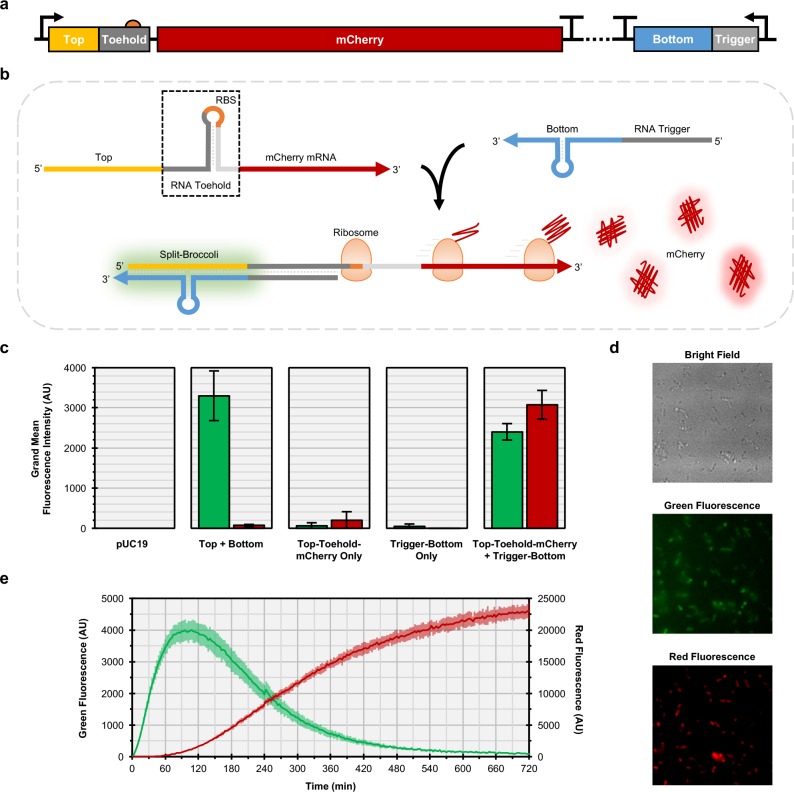
Split-Broccoli is modular and can be used to monitor RNA–RNA hybridization events in vivo. (a) A Split-Broccoli Toehold Switch plasmid was constructed to include two constitutively expressed transcription units. The first transcription unit encodes Top (yellow) and Toehold (gray) sequences within the 5′ UTR of the mCherry mRNA (red). Translation of the Top-Toehold-mCherry mRNA is suppressed due to sequestration of the ribosome binding site (orange) and start codon within the toehold structure (boxed). The second transcription unit encodes Trigger (gray) and Bottom (blue) sequences, which can base pair with Top-Toehold-mCherry. (b) Hybridization of Top-Toehold-mCherry with Trigger-Bottom allows fluorescence activation of the Split-Broccoli system and translation of mCherry. (c) Green fluorescence (left columns) and red fluorescence (right columns) from flow cytometric analysis of populations show background levels of fluorescence for plasmids encoding a single transcription unit only (Top-Toehold-mCherry or Trigger-Bottom). Top + Bottom, which transcribes the Split-Broccoli system, exhibits only green fluorescence, while the Split-Broccoli Toehold Switch plasmid (Top-Toehold-mCherry + Trigger-Bottom) exhibits both red and green fluorescence, indicating both hybridization of Split-Broccoli and translation of mCherry. Grand mean fluorescence intensity (n = 4) is shown with error bars to indicate standard deviations. (d) Fluorescence microscopy imaging of E. coli harboring the Split-Broccoli Toehold Switch plasmid confirms hybridization of the Top and Bottom components of Split-Broccoli (green fluorescence) and activation of mCherry translation (red fluorescence). (e) An E. coli cell-free system (TX-TL) was used to monitor transcription and translation of the Split-Broccoli Toehold Switch plasmid and demonstrates the increased temporal sensitivity of Split-Broccoli (green fluorescence, left axis) over mCherry (red fluorescence, right axis). Mean values (n = 3) are shown with error bars to indicate standard deviations.

References

    1. Cech T. R.; Steitz J. A. (2014) The noncoding RNA revolution-trashing old rules to forge new ones. Cell 157, 77–94. 10.1016/j.cell.2014.03.008. - DOI - PubMed
    1. Johnson S. F.; Telesnitsky A. (2010) Retroviral RNA dimerization and packaging: the what, how, when, where, and why. PLoS Pathog. 6, e1001007. 10.1371/journal.ppat.1001007. - DOI - PMC - PubMed
    1. Jinek M.; Chylinski K.; Fonfara I.; Hauer M.; Doudna J. A.; Charpentier E. (2012) A programmable dual-RNA-guided DNA endonuclease in adaptive bacterial immunity. Science 337, 816–821. 10.1126/science.1225829. - DOI - PMC - PubMed
    1. Abudayyeh O. O.; Gootenberg J. S.; Konermann S.; Joung J.; Slaymaker I. M.; Cox D. B. T.; Shmakov S.; Makarova K. S.; Semenova E.; Minakhin L.; Severinov K.; Regev A.; Lander E. S.; Koonin E. V.; Zhang F. (2016) C2c2 is a single-component programmable RNA-guided RNA-targeting CRISPR effector. Science 353, aaf5573–aaf5573. 10.1126/science.aaf5573. - DOI - PMC - PubMed
    1. Geisler S.; Coller J. (2013) RNA in unexpected places: long non-coding RNA functions in diverse cellular contexts. Nat. Rev. Mol. Cell Biol. 14, 699–712. 10.1038/nrm3679. - DOI - PMC - PubMed

Publication types

MeSH terms