


Microenvironment of a tumor-organoid system enhances hepatocellular carcinoma malignancy-related hallmarks
- PMID: 28548903
- PMCID: PMC5654820
- DOI: 10.1080/15476278.2017.1322243
Microenvironment of a tumor-organoid system enhances hepatocellular carcinoma malignancy-related hallmarks
Abstract
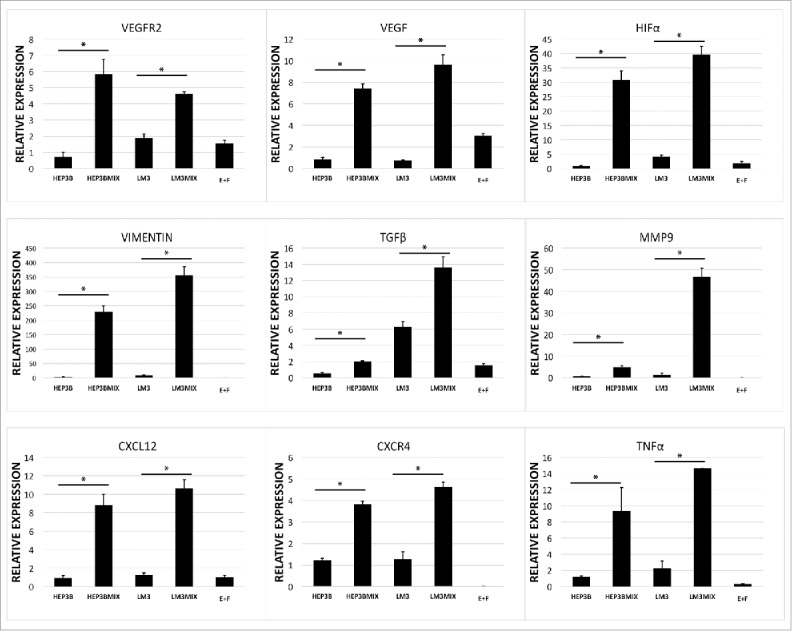
Organ-like microenviroment and 3-dimensional (3D) cell culture conformations have been suggested as promising approaches to mimic in a micro-scale a whole organ cellular functions and interactions present in vivo. We have used this approach to examine biologic features of hepatocellular carcinoma (HCC) cells. In this study, we demonstrate that hepatocellular carcinoma (HCC) cells, fibroblasts, endothelial cells and extracellular matrix can generate organoid-like spheroids that enhanced numerous features of human HCC observed in vivo. We show that the addition of non-parenchymal cells such as fibroblast and endothelial cells is required for spheroid formation as well as the maintenance of the tissue-like structure. Furthermore, HCC cells cultured as spheroids with non-parenchymal cells express more neo-angiogenesis-related markers (VEGFR2, VEGF, HIF-α), tumor-related inflammatory factors (CXCR4, CXCL12, TNF-α) and molecules-related to induced epithelial-mesenchymal transition (TGFβ, Vimentin, MMP9) compared with organoids containing only HCC cells. These results demonstrate the importance of non-parenchymal cells in the cellular composition of HCC organoids. The novelty of the multicellular-based organotypic culture system strongly supports the integration of this approach in a high throughput approach to identified patient-specific HCC malignancy and accurate anti-tumor therapy screening after surgery.
Keywords: endothelial cell; fibroblast; hepatocellular carcinoma; organoid; tumor microenvironment.
Figures
References
-
- Organization WH. World Cancer Report 2014. World Health Organization: International Agency for Research on Cancer; 2014.
-
- Wang FS, Fan JG, Zhang Z, Gao B, Wang HY. The global burden of liver disease: the major impact of China. Hepatology 2014; 60(6):2099-108; PMID:25164003; https://doi.org/10.1002/hep.27406 - DOI - PMC - PubMed
-
- Forner A, Llovet JM, Bruix J. Hepatocellular carcinoma. Lancet 2012; 379(9822):1245-55; PMID:22353262; https://doi.org/10.1016/S0140-6736(11)61347-0 - DOI - PubMed
-
- Shibata T, Aburatani H. Exploration of liver cancer genomes. Nat Rev Gastroenterol Hepatol 2014; 11(6):340-9; PMID:24473361; https://doi.org/10.1038/nrgastro.2014.6 - DOI - PubMed
-
- Tao J, Xu E, Zhao Y, Singh S, Li X, Couchy G, Chen X, Zucman-Rossi J, Chikina M, Monga SP. Modeling a human hepatocellular carcinoma subset in mice through coexpression of met and point-mutant beta-catenin. Hepatology 2016; 64(5):1587-605; PMID:27097116; https://doi.org/10.1002/hep.28601 - DOI - PMC - PubMed
Publication types
MeSH terms
Substances
LinkOut - more resources
Full Text Sources
Other Literature Sources
Medical
Miscellaneous
