


Survival and axillary recurrence following sentinel node-positive breast cancer without completion axillary lymph node dissection: the randomized controlled SENOMAC trial
- PMID: 28549453
- PMCID: PMC5446737
- DOI: 10.1186/s12885-017-3361-y
Survival and axillary recurrence following sentinel node-positive breast cancer without completion axillary lymph node dissection: the randomized controlled SENOMAC trial
Abstract
Background: The role of axillary lymph node dissection (ALND) has increasingly been called into question among patients with positive sentinel lymph nodes. Two recent trials have failed to show a survival difference in sentinel node-positive breast cancer patients who were randomized either to undergo completion ALND or not. Neither of the trials, however, included breast cancer patients undergoing mastectomy or those with tumors larger than 5 cm, and power was debatable to show a small survival difference.
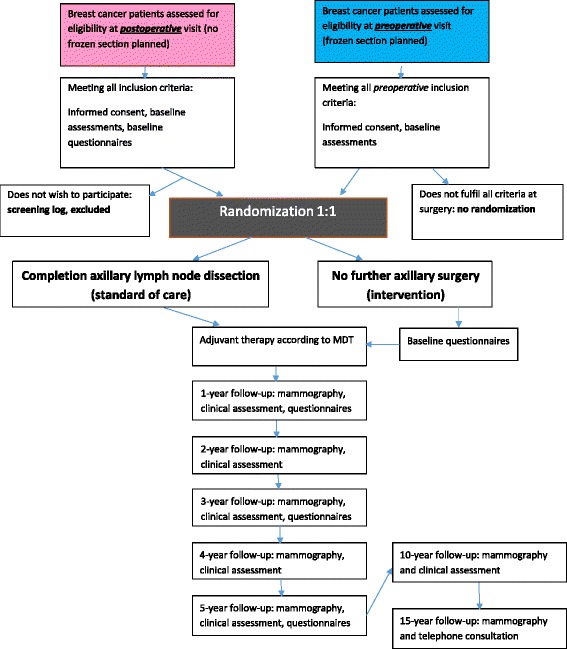
Methods: The prospective randomized SENOMAC trial includes clinically node-negative breast cancer patients with up to two macrometastases in their sentinel lymph node biopsy. Patients with T1-T3 tumors are eligible as well as patients prior to systemic neoadjuvant therapy. Both breast-conserving surgery and mastectomy, with or without breast reconstruction, are eligible interventions. Patients are randomized 1:1 to either undergo completion ALND or not by a web-based randomization tool. This trial is designed as a non-inferiority study with breast cancer-specific survival at 5 years as the primary endpoint. Target accrual is 3500 patients to achieve 80% power in being able to detect a potential 2.5% deterioration of the breast cancer-specific 5-year survival rate. Follow-up is by annual clinical examination and mammography during 5 years, and additional controls after 10 and 15 years. Secondary endpoints such as arm morbidity and health-related quality of life are measured by questionnaires at 1, 3 and 5 years.
Discussion: Several large subgroups of breast cancer patients, such as patients undergoing mastectomy or those with larger tumors, have not been included in key trials; however, the use of ALND is being questioned even in these groups without the support of high-quality evidence. Therefore, the SENOMAC Trial will investigate the need of completion ALND in case of limited spread to the sentinel lymph nodes not only in patients undergoing any breast surgery, but also in neoadjuvantly treated patients and patients with larger tumors.
Trial registration: NCT 02240472 , retrospective registration date September 14, 2015 after trial initiation on January 31, 2015.
Trial registration: ClinicalTrials.gov NCT02240472 NCT02240472.
Keywords: Axillary lymph node dissection; Breast cancer; Macrometastasis; Sentinel lymph node biopsy; Survival.
Figures
References
-
- Fisher B, Bauer M, Wickerham DL, Redmond CK, Fisher ER, Cruz AB, et al. Relation of number of positive axillary nodes to the prognosis of patients with primary breast cancer. An NSABP update. Cancer. 1983;52(9):1551–1557. doi: 10.1002/1097-0142(19831101)52:9<1551::AID-CNCR2820520902>3.0.CO;2-3. - DOI - PubMed
-
- Sobin LH, Gospodarowicz MK, Wittekind C. TNM classification of malignant tumours. 7th Edition. ISBN: 978-1-4443-3241-4 ed. Oxford: Wiley-Blackwell; 2009.
Publication types
MeSH terms
Associated data
LinkOut - more resources
Full Text Sources
Other Literature Sources
Medical
