


Amlexanox Enhances Premature Termination Codon Read-Through in COL7A1 and Expression of Full Length Type VII Collagen: Potential Therapy for Recessive Dystrophic Epidermolysis Bullosa
- PMID: 28549954
- PMCID: PMC5573171
- DOI: 10.1016/j.jid.2017.05.011
Amlexanox Enhances Premature Termination Codon Read-Through in COL7A1 and Expression of Full Length Type VII Collagen: Potential Therapy for Recessive Dystrophic Epidermolysis Bullosa
Abstract
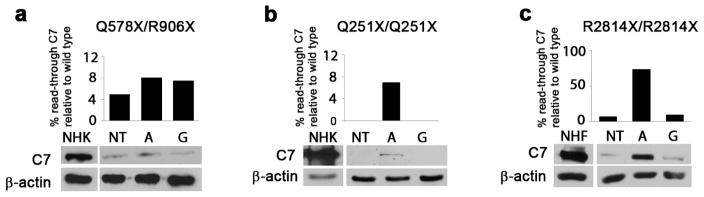
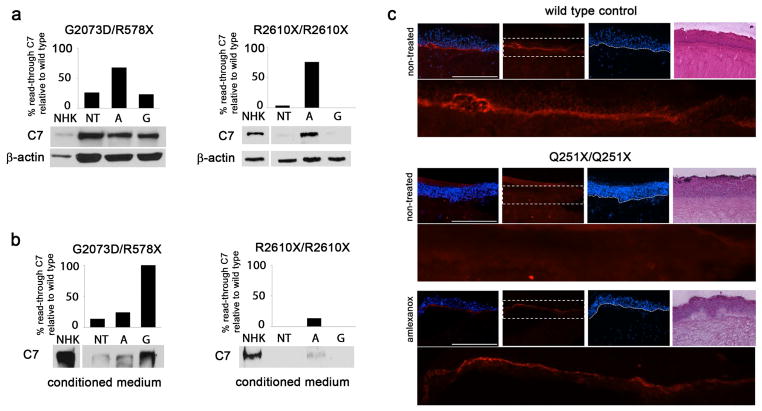
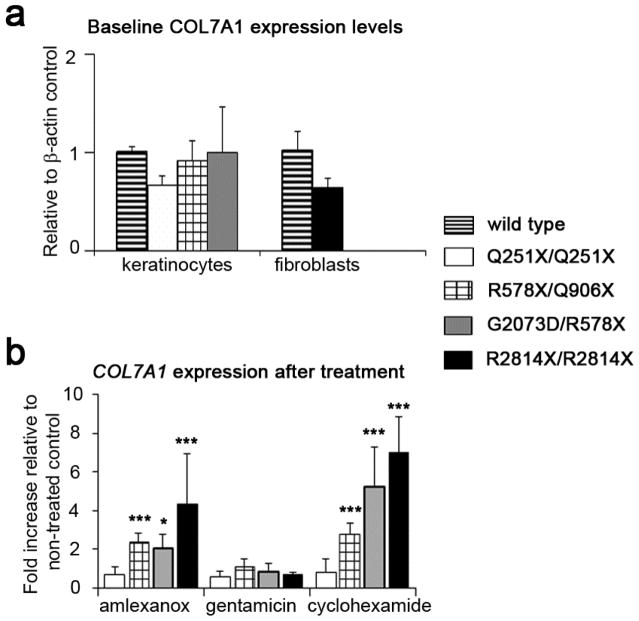
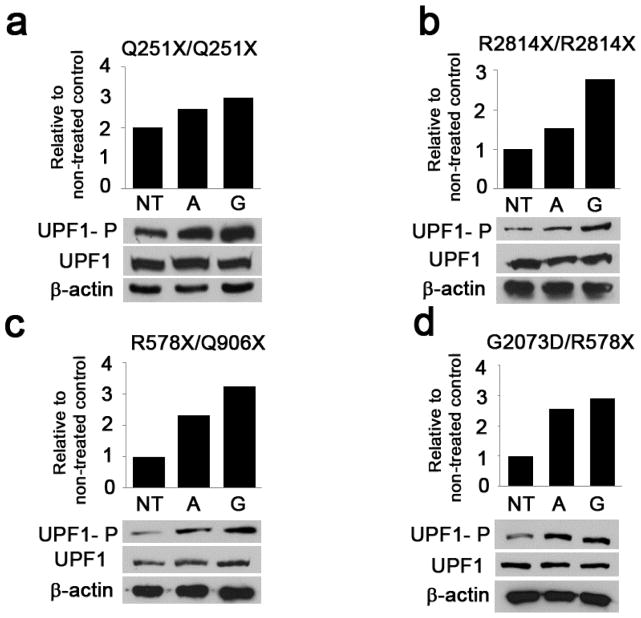
Recessive dystrophic epidermolysis bullosa (RDEB) is a rare monogenic blistering disorder caused by the lack of functional type VII collagen, leading to skin fragility and subsequent trauma-induced separation of the epidermis from the underlying dermis. A total of 46% of patients with RDEB harbor at least one premature termination codon (PTC) mutation in COL7A1, and previous studies have shown that aminoglycosides are able to overcome RDEB PTC mutations by inducing "read-through" and incorporation of an amino acid at the PTC site. However, aminoglycoside toxicity will likely prevent widespread clinical application. Here the FDA-approved drug amlexanox was tested for its ability to read-through PTC mutations in cells derived from patients with RDEB. Eight of 12 different PTC alleles responded to treatment and produced full length protein, in some cases more than 50% relative to normal controls. Read-through type VII collagen was readily detectable in cell culture media and also localized to the dermal-epidermal junction in organotypic skin culture. Amlexanox increased COL7A1 transcript and the phosphorylation of UPF-1, an RNA helicase associated with nonsense-mediated mRNA decay, suggesting that amlexanox inhibits nonsense-mediated mRNA decay in cells from patients with RDEB that respond to read-through treatment. This preclinical study demonstrates the potential of repurposing amlexanox for the treatment of patients with RDEB harboring PTC mutation in COL7A1.
Copyright © 2017 The Authors. Published by Elsevier Inc. All rights reserved.
Conflict of interest statement
The authors state no conflict of interest.
Figures
References
-
- Bremer J, Bornert O, Nystrom A, Gostynski A, Jonkman MF, Aartsma-Rus A, et al. Antisense Oligonucleotide-mediated Exon Skipping as a Systemic Therapeutic Approach for Recessive Dystrophic Epidermolysis Bullosa. Mol Ther Nucleic Acids. 2016;5:e379. - PubMed
-
- Brittingham R, Uitto J, Fertala A. High-affinity binding of the NC1 domain of collagen VII to laminin 5 and collagen IV. Biochem Biophys Res Commun. 2006;343:692–9. - PubMed
-
- Chen M, Kasahara N, Keene DR, Chan L, Hoeffler WK, Finlay D, et al. Restoration of type VII collagen expression and function in dystrophic epidermolysis bullosa. Nat Genet. 2002;32:670–5. - PubMed
Publication types
MeSH terms
Substances
Grants and funding
LinkOut - more resources
Full Text Sources
Other Literature Sources
