Meta-Analysis
. 2017 Jul 17;83(15):e00609-17.
doi: 10.1128/AEM.00609-17. Print 2017 Aug 1.

Europe-Wide Meta-Analysis of Borrelia burgdorferi Sensu Lato Prevalence in Questing Ixodes ricinus Ticks

Affiliations
Meta-Analysis

Europe-Wide Meta-Analysis of Borrelia burgdorferi Sensu Lato Prevalence in Questing Ixodes ricinus Ticks

Martin Strnad et al. Appl Environ Microbiol. .

Abstract

Lyme borreliosis is the most common zoonotic disease transmitted by ticks in Europe and North America. Despite having multiple tick vectors, the causative agent, Borrelia burgdorferisensu lato, is vectored mainly by Ixodes ricinus in Europe. In the present study, we aimed to review and summarize the existing data published from 2010 to 2016 concerning the prevalence of B. burgdorferi sensu lato spirochetes in questing I. ricinus ticks. The primary focus was to evaluate the infection rate of these bacteria in ticks, accounting for tick stage, adult tick gender, region, and detection method, as well as to investigate any changes in prevalence over time. The data obtained were compared to the findings of a previous metastudy. The literature search identified data from 23 countries, with 115,028 ticks, in total, inspected for infection with B. burgdorferi sensu lato We showed that the infection rate was significantly higher in adults than in nymphs and in females than in males. We found significant differences between European regions, with the highest infection rates in Central Europe. The most common genospecies were B. afzelii and B. garinii, despite a negative correlation of their prevalence rates. No statistically significant differences were found among the prevalence rates determined by conventional PCR, nested PCR, and real-time PCR.IMPORTANCEBorrelia burgdorferisensu lato is a pathogenic bacterium whose clinical manifestations are associated with Lyme borreliosis. This vector-borne disease is a major public health concern in Europe and North America and may lead to severe arthritic, cardiovascular, and neurological complications if left untreated. Although pathogen prevalence is considered an important predictor of infection risk, solitary isolated data have only limited value. Here we provide summarized information about the prevalence of B. burgdorferi sensu lato spirochetes among host-seeking Ixodes ricinus ticks, the principal tick vector of borreliae in Europe. We compare the new results with previously published data in order to evaluate any changing trends in tick infection.

Keywords: Borrelia burgdorferi sensu lato; Ixodes ricinus; Lyme borreliosis; Lyme disease; genospecies; meta-analysis; tick.


Figures

FIG 1
FIG 1
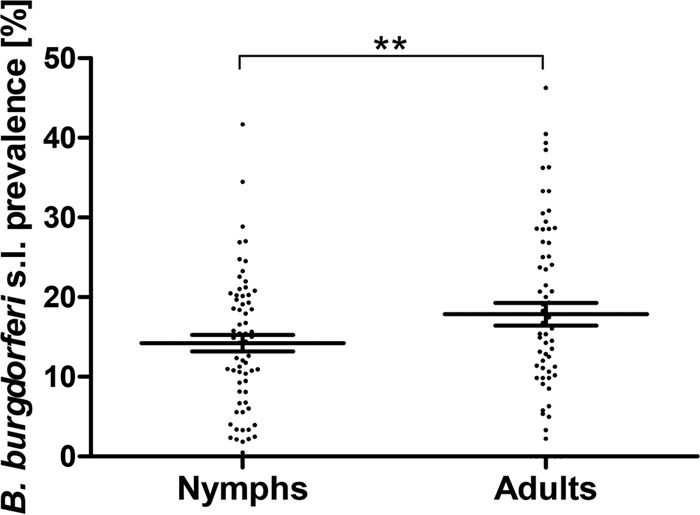
Comparison of B. burgdorferi sensu lato prevalences in nymphal and adult I. ricinus ticks in Europe. Each dot represents a single entry (locality). Data were extracted from 65 entries where the prevalence rates for both developmental stages were reported. The middle lines represent the means; error bars, standard errors of the means. **, P < 0.01.
FIG 2
FIG 2
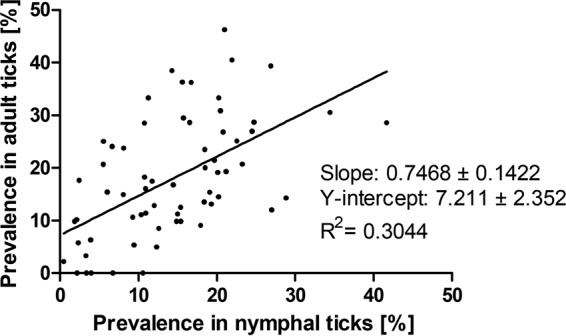
Linear correlation analysis for the prevalence of B. burgdorferi sensu lato in adult and nymphal I. ricinus ticks in Europe. Each dot represents a single entry (locality). Data were extracted from 65 entries where the prevalence rates for both developmental stages were reported.
FIG 3
FIG 3
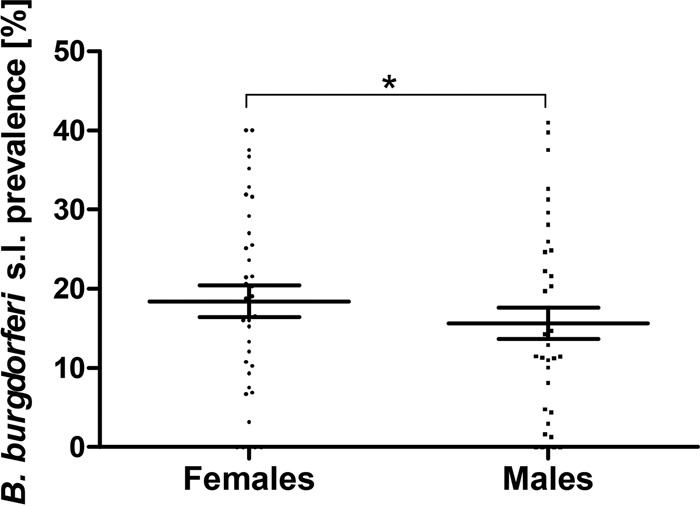
Comparison of B. burgdorferi sensu lato prevalence rates between female and male I. ricinus ticks in Europe. Each dot represents a single entry (locality). Data were extracted from 37 entries where the prevalence rate for each sex was reported. The middle lines represent the means; error bars, standard errors of the means. *, P < 0.05.
FIG 4
FIG 4
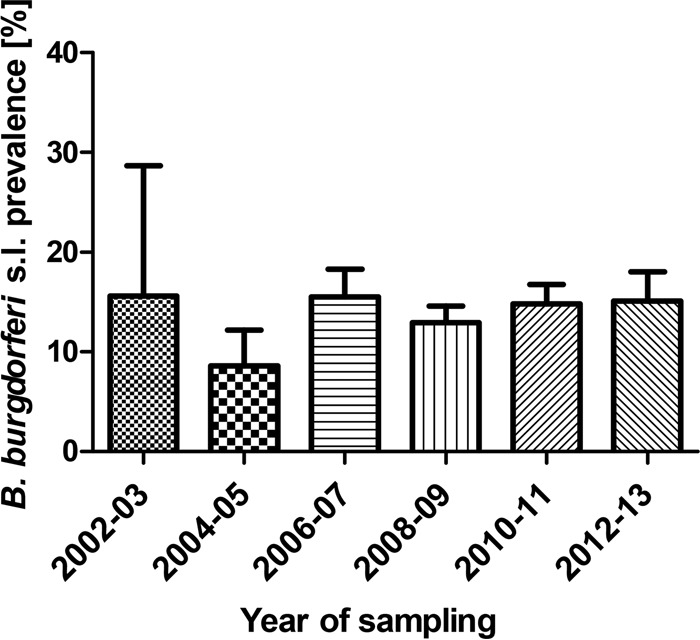
Mean prevalences of B. burgdorferi sensu lato in I. ricinus ticks in Europe in 2-year cycles. Each bar represents the mean prevalence reached in a particular 2-year cycle. Error bars, standard errors of the means.
FIG 5
FIG 5
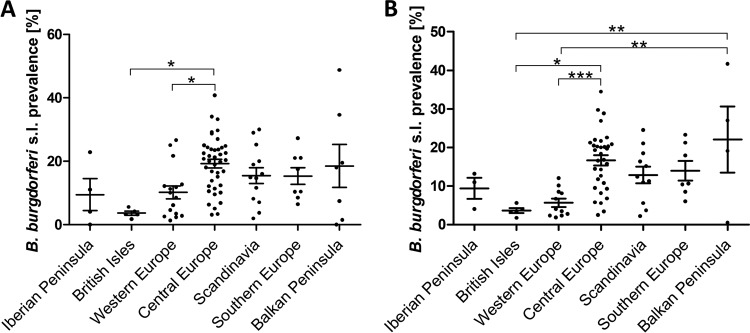
Prevalence of B. burgdorferi sensu lato in I. ricinus ticks in defined regions of Europe. Each dot represents a single entry (locality). The middle lines represent the means; error bars, standard errors of the means. Results were compared by ANOVA, followed by Bonferroni's multiple-comparison test. *, P < 0.05; **, P < 0.01; ***, P < 0.001. (A) Comparison of all ticks; (B) comparison of nymphal I. ricinus ticks.
FIG 6
FIG 6
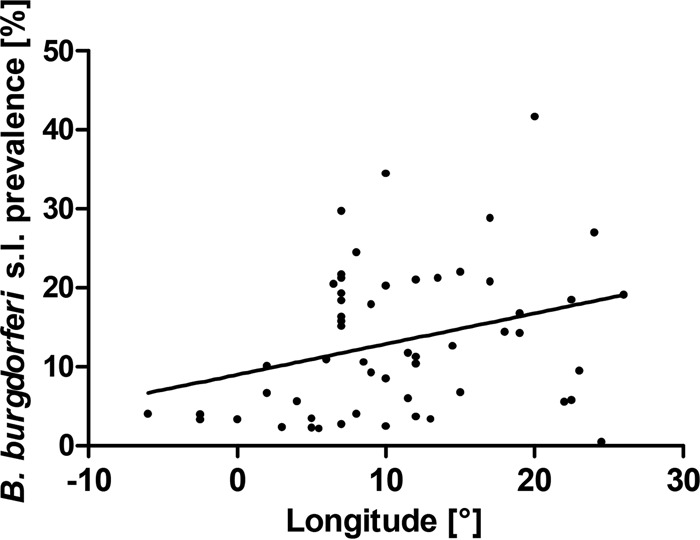
Regression analysis of the prevalence of B. burgdorferi sensu lato in nymphal I. ricinus ticks in Europe with longitude (linear regression; R2 = 0.0927; P < 0.05). Each dot represents a single entry (locality).
FIG 7
FIG 7
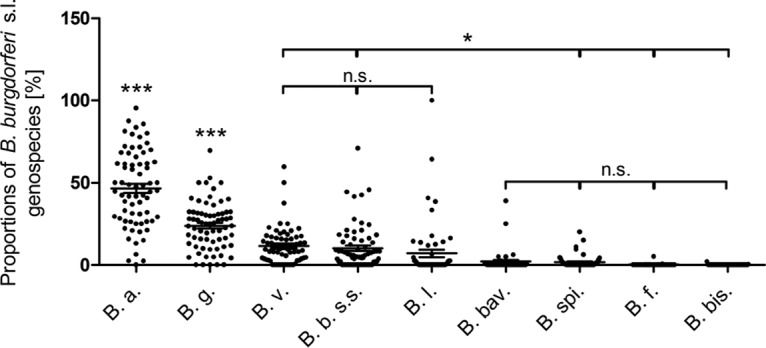
Proportions of B. burgdorferi sensu lato genospecies in I. ricinus ticks in Europe. Each dot represents a single entry (locality). The middle lines represent the means; error bars, standard errors of the means. Results were compared by ANOVA, followed by Bonferroni's multiple-comparison test. B. a., B. afzelii; B. g., B. garinii; B. v., B. valaisiana; B. b. s.s., B. burgdorferi sensu stricto; B. l., B. lusitaniae; B. bav., B. bavariensis; B. spi., B. spielmanii; B. f., B. finlandensis; B. bis., B. bissettiae. *, P < 0.05; ***, P < 0.001; n.s., not statistically significant.
FIG 8
FIG 8
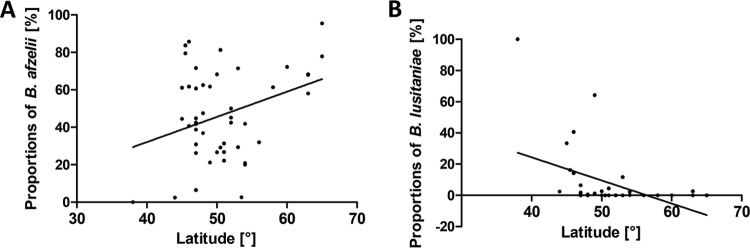
Regression analyses of B. afzelii (A) and B. lusitaniae (B) infection rates in I. ricinus ticks in Europe with latitude.
FIG 9
FIG 9
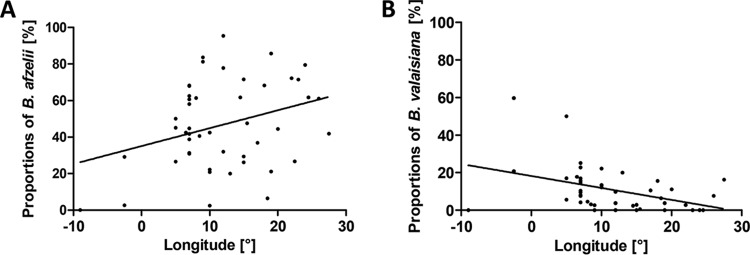
Regression analyses of B. afzelii (A) and B. valaisiana (B) infection rates in I. ricinus ticks in Europe with longitude.
FIG 10
FIG 10
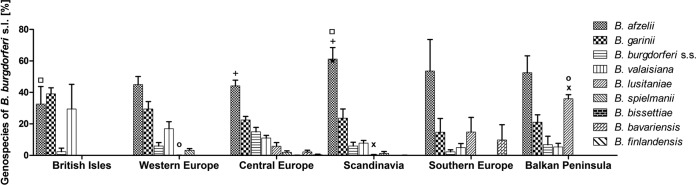
Proportional representation of B. burgdorferi sensu lato genospecies in I. ricinus ticks in Europe in different geographic regions. Each bar represents the mean proportion of a particular genospecies in a region; error bars, standard errors of the means. Each symbol (◽, o, +, x) indicates a statistically significant difference (P < 0.05) in the proportional representation of a particular genospecies between two different regions, as determined by two-way ANOVA followed by Bonferroni's multiple-comparison test. s.s., sensu stricto.

References

    1. Stanek G, Wormser GP, Gray J, Strle F. 2012. Lyme borreliosis. Lancet 379:461–473. doi: 10.1016/S0140-6736(11)60103-7. - DOI - PubMed
    1. Margos G, Vollmer SA, Cornet M, Garnier M, Fingerle V, Wilske B, Bormane A, Vitorino L, Collares-Pereira M, Drancourt M, Kurtenbach K. 2009. A new Borrelia species defined by multilocus sequence analysis of housekeeping genes. Appl Environ Microbiol 75:5410–5416. doi: 10.1128/AEM.00116-09. - DOI - PMC - PubMed
    1. Strle F, Picken RN, Cheng Y, Cimperman J, Maraspin V, Lotric-Furlan S, Ruzic-Sabljic E, Picken MM. 1997. Clinical findings for patients with Lyme borreliosis caused by Borrelia burgdorferi sensu lato with genotypic and phenotypic similarities to strain 25015. Clin Infect Dis 25:273–280. doi: 10.1086/514551. - DOI - PubMed
    1. Rudenko N, Golovchenko M, Růzek D, Piskunova N, Mallátová N, Grubhoffer L. 2009. Molecular detection of Borrelia bissettii DNA in serum samples from patients in the Czech Republic with suspected borreliosis. FEMS Microbiol Lett 292:274–281. doi: 10.1111/j.1574-6968.2009.01498.x. - DOI - PubMed
    1. Collares-Pereira M, Couceiro S, Franca I, Kurtenbach K, Schäfer SM, Vitorino L, Gonçalves L, Baptista S, Vieira ML, Cunha C. 2004. First isolation of Borrelia lusitaniae from a human patient. J Clin Microbiol 42:1316–1318. doi: 10.1128/JCM.42.3.1316-1318.2004. - DOI - PMC - PubMed

Publication types

LinkOut - more resources